Kirjojen hintavertailu. Mukana 12 390 323 kirjaa ja 12 kauppaa.

Kirjailija

Peter John Brownlee

Kirjat ja teokset yhdessä paikassa: 4 kirjaa, julkaisuja vuosilta 2013-2020, suosituimpien joukossa Colonization, Wilderness, and Spaces Between. Vertaile teosten hintoja ja tarkista saatavuus suomalaisista kirjakaupoista.

4 kirjaa

Kirjojen julkaisuhaarukka 2013-2020.

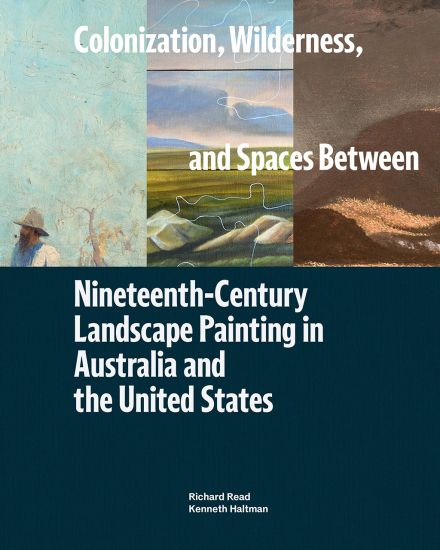
Colonization, Wilderness, and Spaces Between

Colonization, Wilderness, and Spaces Between

Peter John Brownlee; David Peters Corbett; Rachael Z. DeLue; Kenneth Haltman; David Hansen; Elizabeth Hutchinson; Alan Michelson; Christopher Pease; Ruth Pullin; Richard Read; Catherine Speck

Terra Foundation for the Arts,U.S.
2020
nidottu
This volume of essays frames a comparative history of landscape painting in Australia and the United States through recent considerations of the Anthropocene, arguing that careful and deep analysis of specific nineteenth-century artworks reveals issues of environmental concern both past and present. Carefully drawn from two symposia held at the Art Gallery of Western Australia in Perth in 2016 and at the Ian Potter Museum of Art, University of Melbourne the following year, the volume includes eight essays and a conversation between artists. Colonization, Wilderness, and Spaces Between brings together the fresh insights of scholars and artists from Australia, the United Kingdom, and the United States and provides a resource for thinking critically about the historical, imperial, and environmental information that can be gleaned from looking closely at landscape paintings.
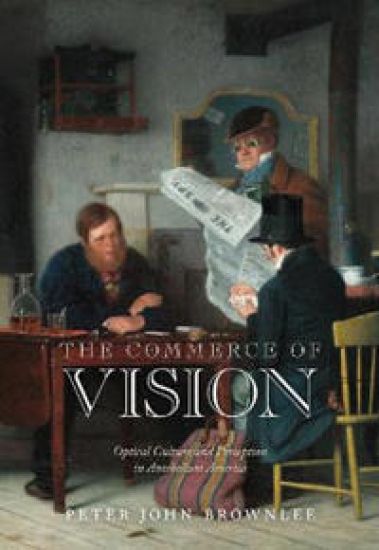
The Commerce of Vision

The Commerce of Vision

Peter John Brownlee

University of Pennsylvania Press
2018
sidottu
When Ralph Waldo Emerson wrote in 1837 that "Our Age is Ocular," he offered a succinct assessment of antebellum America's cultural, commercial, and physiological preoccupation with sight. In the early nineteenth century, the American city's visual culture was manifest in pamphlets, newspapers, painting exhibitions, and spectacular entertainments; businesses promoted their wares to consumers on the move with broadsides, posters, and signboards; and advances in ophthalmological sciences linked the mechanics of vision to the physiological functions of the human body. Within this crowded visual field, sight circulated as a metaphor, as a physiological process, and as a commercial commodity. Out of the intersection of these various discourses and practices emerged an entirely new understanding of vision. The Commerce of Vision integrates cultural history, art history, and material culture studies to explore how vision was understood and experienced in the first half of the nineteenth century. Peter John Brownlee examines a wide selection of objects and practices that demonstrate the contemporary preoccupation with ocular culture and accurate vision: from the birth of ophthalmic surgery to the business of opticians, from the typography used by urban sign painters and job printers to the explosion of daguerreotypes and other visual forms, and from the novels of Edgar Allan Poe and Herman Melville to the genre paintings of Richard Caton Woodville and Francis Edmonds. In response to this expanding visual culture, antebellum Americans cultivated new perceptual practices, habits, and aptitudes. At the same time, however, new visual experiences became quickly integrated with the machinery of commodity production and highlighted the physical shortcomings of sight, as well as nascent ethical shortcomings of a surface-based culture. Through its theoretically acute and extensively researched analysis, The Commerce of Vision synthesizes the broad culturing of vision in antebellum America.
Home Front

Home Front

Peter John Brownlee; Sarah Burns; Diane Dillon; Daniel Greene; Scott Manning Stevens

University of Chicago Press
2013
sidottu
More than one hundred and fifty years after Confederates fired on Fort Sumter, the Civil War still occupies a prominent place in the national collective memory. Paintings and photographs, plays and movies, novels, poetry, and songs portray the war as a battle over the future of slavery, focusing on Lincoln's determination to save the Union, or highlighting the cruelty of brother fighting brother. Battles and battlefields occupy us, too: Bull Run, Antietam, and Gettysburg all conjure up images of desolate landscapes strewn with war dead. Yet battlefields were not the only landscapes altered by the war. Countless individuals saw their daily lives upended while the entire nation suffered. Home Front reveals this side of the war as it happened, comprehensively examining the visual culture of the Northern home front. Through contributions from leading scholars, we discover how the war influenced household economies and the cotton industry; how the absence of young men from the home changed daily life; how war relief work linked home fronts and battlefronts; why Indians on the frontier were pushed out of the riven nation's consciousness during the war years; and how wartime landscape paintings illuminated the nation's past, present, and future. A companion volume to a collaborative exhibition organized by the Newberry Library and the Terra Foundation for American Art, Home Front is the first book to expose the visual culture of a world far removed from the horror of war yet intimately bound to it.
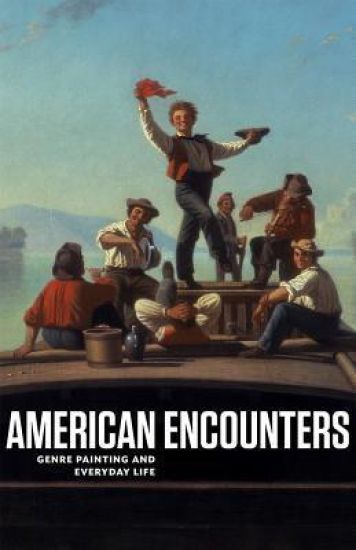
American Encounters

American Encounters

Peter John Brownlee

University of Washington Press
2013
pokkari
Genre painting flourished in the U.S. during the mid-19th century. These narrative scenes depicting the everyday activities of stock or typed characters captivated American audiences. Delineating distinctly American characters, often through the exploration of racial, regional, or class differences, genre painting, like landscape, was often called upon as a vehicle for expression of cultural nationalism.Two paintings from the Louvre represent the Dutch and English schools, key sources on which genre painters in the U.S. drew in developing their own idiom. These rich genre paintings, alongside three outstanding American examples, enable the exploration of a variety of interrelated themes including the development of character types, confrontations between them, the spaces of their confrontations, the role of the senses as well as music and narrative, and the graphic reproduction and dissemination of genre paintings in the form of prints.Genre Painting and Everyday Life accompanies the first of a series of focused exhibitions collaboratively organized by the Musee du Louvre, the Crystal Bridges Museum of American Art, the High Museum of Art, and the Terra Foundation for American Art.