Kirjojen hintavertailu. Mukana 12 390 323 kirjaa ja 12 kauppaa.
Kirjailija
Peter Mair
Kirjat ja teokset yhdessä paikassa: 10 kirjaa, julkaisuja vuosilta 1990-2023, suosituimpien joukossa On Parties, Party Systems and Democracy. Vertaile teosten hintoja ja tarkista saatavuus suomalaisista kirjakaupoista.
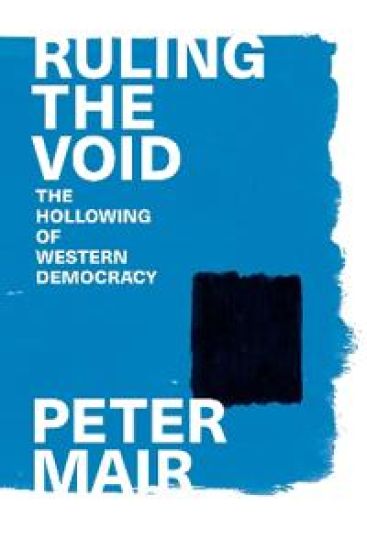
The age of party democracy has passed, argues Peter Mair in Ruling the Void. The major parties have become so disconnected from society that they no longer seem capable of sustaining democracy in its present form.First published in 2013, Ruling the Void presciently observed that the widening gap between citizens and their political leaders posed a crisis of legitimacy for the governing class, and was fuelling populist mobilizations against it. Europe's political elites had remodelled themselves as a homogeneous professional class, withdrawing into state institutions that offer relative stability in a world of fickle voters. Meanwhile, non-democratic agencies and practices proliferated - not least among them the European Union itself. Mair weighs the impact of these changes, and offers an authoritative assessment of the prospects for popular political representation today, not only in the varied democracies of Britain and the EU but throughout the developed world.With a new Introduction by Chris Bickerton, author of The European Union: A Citizen's Guide.
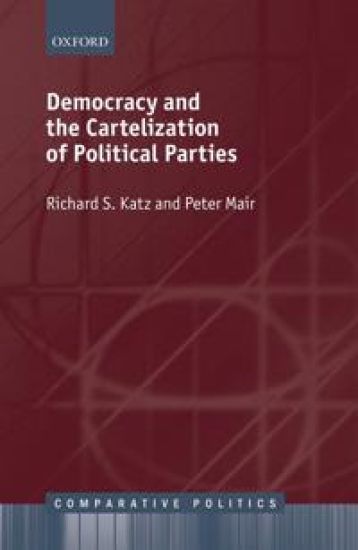
Political parties have long been recognized as essential institutions of democratic governance. Both the organization of parties, and their relationships with citizens, the state, and each other have evolved since the rise of liberal democracy in the 19th and early 20th centuries. Going into the 21st century, it appears that parties losing popular support, putting both parties, and potentially democracy, in peril. This book traces the evolution of parties from the model of the mass party, through the catch-all party model, to argue that by the late 20th century the principal governing parties and (and their allied smaller parties - collectively the political 'mainstream') were effectively forming a cartel, in which the form of competition might remain, and indeed even appear to intensify, while its substance was increasingly hollowed out. The spoils of office were increasingly shared rather than restricted to the temporary winners; contentious policy questions were kept off the political agenda, and competition shifted from large questions of policy to minor questions of managerial competence. To support this cartel, the internal arrangements of parties changed to privilege the party in public office over the party on the ground. The unintended consequence has been to stimulate the rise of extra-cartel challengers to these cozy arrangements in the form of anti-party-system parties and populist oppositions on the left, but especially on the right. Comparative Politics is a series for researchers, teachers, and students of political science that deals with contemporary government and politics. Global in scope, books in the series are characterised by a stress on comparative analysis and strong methodological rigour. The series is published in association with the European Consortium for Political Research. For more information visit: www.ecprnet.eu. The series is edited by Emilie van Haute, Professor of Political Science, Université libre de Bruxelles; Ferdinand Müller-Rommel, Director of the Center for the Study of Democracy, Leuphana University; and Susan Scarrow, John and Rebecca Moores Professor of Political Science, University of Houston.
This collection brings together some of the most significant and influential work by leading comparativist Peter Mair (1951–2011). The selection ranges from considerations on the relevance of concept formation to the study of party systems and party organisations; and from reflections on the democratic legitimacy of the European Union to the future of party democracy. Including frequently cited papers alongside lesser-known work, the writings collected in this volume attest to the broad scope and depth of Mair’s insights into comparative party politics, and the changing realities of party government. As such, they form an important and enduring contribution to the study of politics, and a fitting tribute to an inspirational and much-missed figure in the global political science community. Edited and introduced by Ingrid van Biezen, with an intellectual portrait of Peter Mair by Stefano Bartolini and Hans Daalder.
This collection brings together some of the most significant and influential work by leading comparativist Peter Mair (1951–2011). The selection ranges from considerations on the relevance of concept formation to the study of party systems and party organisations; and from reflections on the democratic legitimacy of the European Union to the future of party democracy. Including frequently cited papers alongside lesser-known work, the writings collected in this volume attest to the broad scope and depth of Mair’s insights into comparative party politics, and the changing realities of party government. As such, they form an important and enduring contribution to the study of politics, and a fitting tribute to an inspirational and much-missed figure in the global political science community. Edited and introduced by Ingrid van Biezen, with an intellectual portrait of Peter Mair by Stefano Bartolini and Hans Daalder.
With a total population of some 500 million, the unified countries of modern Europe constitute the world’s largest collection of successful capitalist democracies. Yet within it, there are distinct clusters of states, each with its own characteristics, historical allegiances and political processes.Combining superb scholarship and rigorous empirical data with an accessible and engaging writing style, Representative Government in Modern Europe remains the leading textbook on comparativeEuropean politics. The fifth edition reflects key events and changes including the impact of the world financial and economic crisis; the EU’s adoption of the Lisbon Treaty; and the election of a centre-right governments in Germany and the UK.Retaining its comprehensive thematic approach to Europe as an integrated whole, while reflecting the continued importance of the EU, the new edition explores the key themes emerging in European politics: the importance of political leadership, the rise of the populist and extreme right, the personalisation of politics, ethnicity, citizen participation.
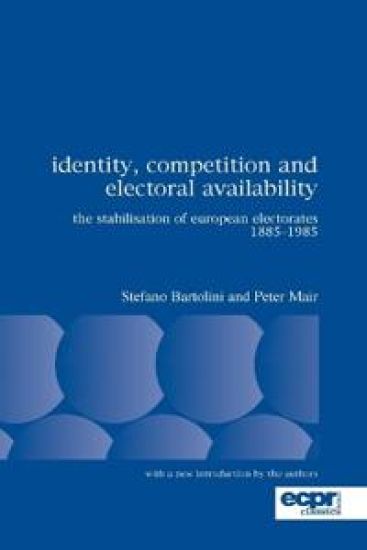
The question of whether Western party systems were becoming more unstable and electorates more volatile had already become central to the study of modern European by the end of the 1970s. Much of the literature at the time stressed how Western Europe was experiencing a phase of party breakdown, dealignment and decay, and how traditional mass politics was in the process of transformation. In this first book-length analysis of the subject, Stefano Bartolini and Peter Mair convincingly demonstrated how this emphasis on change had been largely misconceived and misplaced. This was the first systematic and conceptually sophisticated work to bring together the study of electoral change and cleavage persistence, and has since become one of the landmark volumes in the study of electoral politics in Europe. The authors examine patterns of electoral persistence and change in Western Europe between 1885 and 1985. They assess both what these patterns indicate with regard to the persistence of traditional cleavages, particularly the class cleavage, and how these patterns vary according to political, institutional and social factors. They analyse the various patterns of competition which have characterised elections across the different European countries and in different historical periods, and how cleavages can persist and re-emerge even in the face of widespread social change. They develop a sophisticated model of aggregate electoral change, in which national electorates are conceived as being torn between the stability brought about by cultural identities and organisational structures and the stimuli for change that are provoked by party competition and institutional change. Identity, Competition and Electoral Availability was awarded the Stein Rokkan Prize for Comparative Social Science Research and is now reprinted for the first time in paperback.
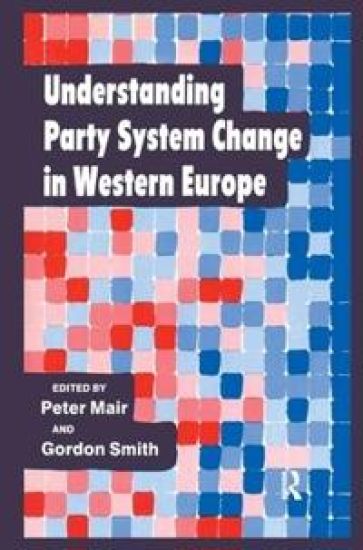
This unique and important new book looks at how we interpret the evidence of change and stability in modern parties and party systems. Focusing primarily on processes of political adaptation and control, it also concerns how parties and party systems generate their own momentum and 'freeze' themselves into place. Amidst the widespread contemporary discussion of the challenge to modern democracy and the crisis of traditional forms of political representation, it offers a welcome emphasis on how party systems survive, and on how change, when it does occur, may be analysed and understood. The first part of the book deals with questions of persistence and change, and with the vulnerability and endurance of traditional parties. In the second part, attention shifts to the question of party organization, and to the ways in which the established parties are increasingly coming to invade the state, finding there a new source of privilege and a new means of ensuring their own survival. The third part of the book focuses on structures of competition in Western party systems, as well as on the problems associated with the consolidation of the new party systems in post-communist Europe. This is the first book to be entirely devoted to the question of party and party system change, and offers and essential guide to the understanding of this crucial theme. 'Peter Mair has produced a book that represents political science at its most erudite . . . It is a learned work based on wide reading. It is brimming with references to the contributions of other scholars.' Times Higher Education Supplement 'Building on several previously published essays of his, Mair has produced a precious little book. I particularly admire his ability to construct his argument with reference to the existing theories and to buttress it resorting to the available data. Moreover, he cleverly suggests different lines of interpretation and areas where new research is needed....there is a lot to be learned and to be utilised in Mair's analysis. The book is to be commended both for what it says and for what it suggests'. Gianfranco Pasquino, West European Politics 'With this volume Peter Mair brings together nearly a decade's worth of his work on European political parties. All but two chapters have been previously published, but in such a range of locations that the breadth and depth of his scholarship will likely have been underappreciated by all but the most dedicated students of European political parties. . . . The book has many strengths. It offers an important counterpoint to a literature that has become perhaps too focused on survey research and the behaviour of voters. The distinctions made between party system, party as organization and party in the electorate, while not completely novel, have been used with good effect to clarify the analysis of electoral change. Mair has drawn our attention, once again, to the intriguing notion of party autonomy vis-(-vis the state and civil society. The book is exceptionally clearly written and displays the author's encyclopedic knowledge of European political parties. Donald E. Blake, Canadian Journal of Political Science
This unique and important new book looks at how we interpret the evidence of change and stability in modern parties and party systems. Focusing primarily on processes of political adaptation and control, it also concerns how parties and party systems generate their own momentum and `freeze' themselves into place. Amidst the widespread contemporary discussion of the challenge to modern democracy and the crisis of traditional forms of political representation, it offers a welcome emphasis on how party systems survive, and on how change, when it does occur, may be analysed and understood. The first part of the book deals with questions of persistence and change, and with the vulnerability and endurance of traditional parties. In the second part, attention shifts to the question of party organization, and to the ways in which the established parties are increasingly coming to invade the state, finding there a new source of privilege and a new means of ensuring their own survival. The third part of the book focuses on structures of competition in Western party systems, as well as on the problems associated with the consolidation of the new party systems in post-communist Europe. This is the first book to be entirely devoted to the question of party and party system change, and offers and essential guide to the understanding of this crucial theme.