Kirjojen hintavertailu. Mukana 12 657 676 kirjaa ja 12 kauppaa.

Kirjailija

Peter Nijkamp

Kirjat ja teokset yhdessä paikassa: 26 kirjaa, julkaisuja vuosilta 1977-2019, suosituimpien joukossa Meta-Analysis in Environmental Economics. Vertaile teosten hintoja ja tarkista saatavuus suomalaisista kirjakaupoista.

26 kirjaa

Kirjojen julkaisuhaarukka 1977-2019.

European Transport Policy and Sustainable Mobility

European Transport Policy and Sustainable Mobility

Jonas Akerman; David Banister; Karl Dreborg; Peter Nijkamp; Ruggero Schleicher-Tappeser; Dominic Stead; Peter Steen

Routledge
2000
nidottu
It is now widely accepted that transport is becoming increasingly unsustainable and that strong policy intervention is required to reduce both the growth in transport demand and the environmental costs of transport. This book challenges conventional approaches to transport by moving away from trend based analysis towards the use of scenarios to identify alternative sustainable transport futures. It both summaries the development of EU transport policy and presents a critique. The policy context is widened to include the global changes taking place in economics, society and technology. It develops new methodologies for policy making for the next 25 years.
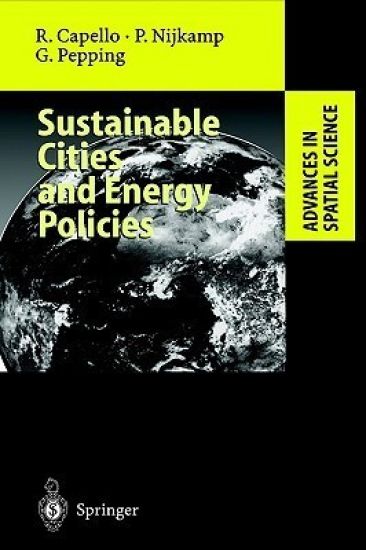
Sustainable Cities and Energy Policies

Sustainable Cities and Energy Policies

Roberta Capello; Peter Nijkamp; Gerard Pepping

Springer-Verlag Berlin and Heidelberg GmbH Co. K
1999
sidottu
The aim of this book is to highlight the great potential of decentralized (i.e. local or urban) energy policies in achieving environmentally-benign developments for modern cities. Urban sustainability is placed in the context of the debate on global sustainable development. A wide array of policy initiatives is discussed and evaluated, ranging from market-based energy policies to technological innovation policies for the energy sector. A theoretical framework for technology adoption processes is developed and empirically tested. The main question addressed is: which are the critical success factors for successful urban energy policies? This question is also dealt with in a meta-analytic context by assessing and comparing the performance of energy policies in various European cities, with a particular view to renewable energy.
Transportation Planning and the Future

Transportation Planning and the Future

Peter Nijkamp; Sytze A. Rienstra; Jaap M. Vleugel

John Wiley Sons Inc
1998
sidottu
Current trends in transport, particularly the rise in CO2 emissions, indicate that major changes in technology, public policy and individual behaviour are necessary to make the transport system more compatible with environmental sustainability. What then are the possible futures for sustainable systems of transport? In this book future scenarios are constructed on the basis of the recently developed ‘spider model’. This model constructs an evaluation framework — based along spatial, institutional, economic and socio-psychological axes — which visualises the core factors that influence transport systems. These factors can operate either separately or in combination — this interaction creates scenarios which range from market-oriented to regulatory systems, and from individual to collective modes of transport. Drawing on the work of a range of transport analysts, the book suggests that the current trend away from sustainability and collective systems is likely to continue, but when sound policies are introduced, a sustainable transport system becomes a feasible option.
Sustainable Cities in Europe

Sustainable Cities in Europe

Peter Nijkamp; Adriaan Perrels

Earthscan Ltd
1994
sidottu
Although urbanization steadily increases, many modern cities are finding the accommodation of their populations an increasingly difficult task. Planners and policy-makers battling to alleviate the problem with a host of urban renewal initiatives have made environmental issues and policies central to their quest for urban sustainability.;Drawing on the CITIES programme of the EC, this study describes the urban energy and environmental policies now available. Through detailed case studies of various European cities, it explains how to devise and implement strategies for urban growth and development.
Impact Assessment and Evaluation in Transportation Planning
Impact Assessment and Evaluation in Transportation Planning contains a refreshing approach to transportation planning by integrating impact analysis and evaluation methodology. It is original in that impact assessment and evaluation are brought together in a coherent framework. It is novel in the history of transportation science and particularly suitable as a pedagogical text, since methodologies are illustrated with various case studies and examples. It is particularly suitable for practitioners and students who want to become acquainted with conflict analysis and plan/project evaluation in the area of transportation planning.