Kirjojen hintavertailu. Mukana 12 595 353 kirjaa ja 12 kauppaa.

Kirjailija

Peter Salovey

Kirjat ja teokset yhdessä paikassa: 7 kirjaa, julkaisuja vuosilta 1997-2026, suosituimpien joukossa Yale and Slavery. Vertaile teosten hintoja ja tarkista saatavuus suomalaisista kirjakaupoista.

7 kirjaa

Kirjojen julkaisuhaarukka 1997-2026.

Yale and Slavery

Yale and Slavery

David W. Blight; Peter Salovey

YALE UNIVERSITY PRESS
2025
pokkari
A comprehensive look at how slavery and resistance to it have shaped Yale University “The most mature examination ever made of the role of slavery in a university’s past.”—John Samuel Harpham, Times Literary Supplement Award-winning historian David W. Blight, with the Yale and Slavery Research Project, answers the call to investigate Yale University’s historical involvement with slavery, the slave trade, and abolition. This narrative history demonstrates the importance of slavery in the making of this renowned American institution of higher learning. Drawing on wide-ranging archival materials, Yale and Slavery extends from the century before the college’s founding in 1701 to the dedication of its Civil War memorial in 1915, while engaging with the legacies and remembrance of this complex story. The book brings into focus the enslaved and free Black people who have been part of Yale’s history from the beginning—but too often ignored in official accounts. These individuals and their descendants worked at Yale; petitioned and fought for freedom and dignity; built churches, schools, and antislavery organizations; and were among the first Black students to transform the university from the inside. Always alive to the surprises and ironies of the past, Yale and Slavery presents a richer and more complete history of Yale, the third-oldest college in the country, showing how pillars of American higher education, even in New England, emerged over time intertwined with the national and international history of racial slavery.

Yale and Slavery

Yale and Slavery

David W. Blight; Peter Salovey

YALE UNIVERSITY PRESS
2024
sidottu
A comprehensive look at how slavery and resistance to it have shaped Yale University “The most mature examination ever made of the role of slavery in a university’s past.”—John Samuel Harpham, Times Literary Supplement Award-winning historian David W. Blight, with the Yale and Slavery Research Project, answers the call to investigate Yale University’s historical involvement with slavery, the slave trade, and abolition. This narrative history demonstrates the importance of slavery in the making of this renowned American institution of higher learning. Drawing on wide-ranging archival materials, Yale and Slavery extends from the century before the college’s founding in 1701 to the dedication of its Civil War memorial in 1915, while engaging with the legacies and remembrance of this complex story. The book brings into focus the enslaved and free Black people who have been part of Yale’s history from the beginning—but too often ignored in official accounts. These individuals and their descendants worked at Yale; petitioned and fought for freedom and dignity; built churches, schools, and antislavery organizations; and were among the first Black students to transform the university from the inside. Always alive to the surprises and ironies of the past, Yale and Slavery presents a richer and more complete history of Yale, the third-oldest college in the country, showing how pillars of American higher education, even in New England, emerged over time intertwined with the national and international history of racial slavery.
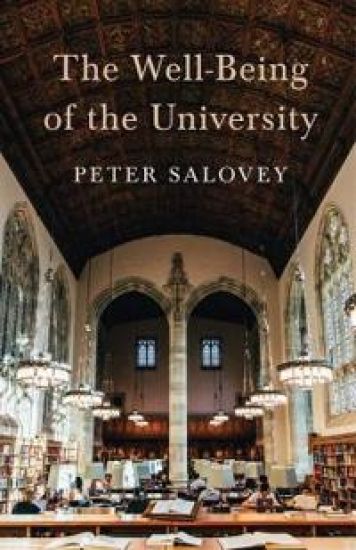
The Well-Being of the University

The Well-Being of the University

Peter Salovey

YALE UNIVERSITY PRESS
2026
sidottu
The speeches of Peter Salovey, twenty-third president of Yale University, organized thematically From 2013 to 2024, Peter Salovey served as the twenty-third president of Yale; prior to his presidency he served as dean and provost. The speeches compiled in this volume, many of which were delivered to bodies of students either entering or graduating from the university, articulate Salovey’s vision for a unified, innovative, and inclusive institution and reflect his experience as an award-winning teacher of introductory psychology earlier in his career. Recurring motifs include fostering interdisciplinary collaboration, embracing innovation in academia, and increasing accessibility for diverse and first-generation students. Salovey advocates for excellence, inclusion, gratitude, and compassion within the Yale community, promoting free expression and open dialogue. He also underscores the university’s commitment to local and global engagement, encouraging impactful contributions to society. The book encapsulates Salovey’s comprehensive and forward-thinking leadership, aimed at creating a cohesive, pioneering, and welcoming academic environment.
The Emotionally Intelligent Manager

The Emotionally Intelligent Manager

David R Caruso; Peter Salovey

ReadHowYouWant
2019
pokkari
We have long been taught that emotions should be felt and expressed in carefully controlled ways, and then only in certain environments and at certain times. This is especially true when at work, particularly when managing others. It is considered terribly unprofessional to express emotion while on the job, and many of us believe that our biggest mistakes and regrets are due to our reactions at those times when our emotions get the better of us. David R. Caruso and Peter Salovey believe that this view of emotion is not correct. The emotion centers of the brain, they argue, are not relegated to a secondary place in our thinking and reasoning, but instead are an integral part of what it means to think, reason, and to be intelligent. In The Emotionally Intelligent Manager, they show that emotion is not just important, but absolutely necessary for us to make good decisions, take action to solve problems, cope with change, and succeed. The authors detail a practical four-part hierarchy of emotional skills: identifying emotions, using emotions to facilitate thinking, understanding emotions, and managing emotions-and show how we can measure, learn, and develop each skill and employ them in an integrated way to solve our most difficult work-related problems.
The Emotionally Intelligent Manager

The Emotionally Intelligent Manager

David R. Caruso; Peter Salovey

Jossey-Bass Inc.,U.S.
2004
sidottu
We have long been taught that emotions should be felt and expressed in carefully controlled ways, and then only in certain environments and at certain times. This is especially true when at work, particularly when managing others. It is considered terribly unprofessional to express emotion while on the job, and many of us believe that our biggest mistakes and regrets are due to our reactions at those times when our emotions get the better of us. David R. Caruso and Peter Salovey believe that this view of emotion is not correct. The emotion centers of the brain, they argue, are not relegated to a secondary place in our thinking and reasoning, but instead are an integral part of what it means to think, reason, and to be intelligent. In The Emotionally Intelligent Manager , they show that emotion is not just important, but absolutely necessary for us to make good decisions, take action to solve problems, cope with change, and succeed. The authors detail a practical four-part hierarchy of emotional skills: identifying emotions, using emotions to facilitate thinking, understanding emotions, and managing emotions—and show how we can measure, learn, and develop each skill and employ them in an integrated way to solve our most difficult work-related problems.
Emotional Development And Emotional Intelligence
In recent years, innovative schools have developed courses in what has been termed emotional literacy, emotional intelligence, or emotional competence. This volume evaluates these developments scientifically, pairing the perspectives of psychologists with those of educators who offer valuable commentary on the latest research. It is an authoritative study that describes the scientific basis for our knowledge about emotion as it relates specifically to children, the classroom environment, and emotional literacy.Key topics include: historical perspectives on emotional intelligence neurological bases for emotional development the development of social skills and childhood socialization of emotion. Experts in psychology and education have long viewed thinking and feeling as polar opposites reason on the one hand, and passion on the other. And emotion, often labeled as chaotic, haphazard, and immature, has not traditionally been seen as assisting reason.All that changed in 1990, when Peter Salovey and John D. Mayer coined the term emotional intelligence as a challenge to the belief that intelligence is not based on processing emotion-laden information. Salovey and Mayer defined emotional intelligence as the ability to monitor one's own and others' feelings and emotions, to discriminate among them, and to use motivated scientists, educators, parents, and many others to consider the ways in which emotions themselves comprise an intelligent system.With this ground-breaking volume, invited contributors present cutting-edge research on emotions and emotional development in a manner useful to educators, psychologists, and anyone interested in the unfolding of emotions during childhood. In recent years, innovative schools have developed courses in emotional literacy" that making these classes teach children how to understand and manage their feelings and how to get along with one another. Many such programs have achieved national prominence, and preliminary scientific evaluations have shown promising results.Until recently, however, there has been little contact between educators developing these types of programs and psychologists studying the neurological underpinnings and development of human emotions. This unique book links theory and practice by juxtaposing scientific explanations of emotion with short commentaries from educators who elabourate on how these advances can be put to use in the classroom.Accessible and enlightening, Emotional Development and Emotional Intelligence provides ample evidence about emotional intelligence as well as sound information on the potential efficacy of educational programs based on this idea.