
Kirjailija
Peter Schneider
Kirjat ja teokset yhdessä paikassa: 80 kirjaa, julkaisuja vuosilta 1972-2026, suosituimpien joukossa Ich bin Wirt. Vertaile teosten hintoja ja tarkista saatavuus suomalaisista kirjakaupoista.
80 kirjaa
Kirjojen julkaisuhaarukka 1972-2026.




Extragalactic Astronomy and Cosmology
Peter Schneider
Springer-Verlag Berlin and Heidelberg GmbH Co. K
2014
sidottu
This second edition has been updated and substantially expanded. Starting with the description of our home galaxy, the Milky Way, this cogently written textbook introduces the reader to the astronomy of galaxies, their structure, active galactic nuclei, evolution and large scale distribution in the Universe. After an extensive and thorough introduction to modern observational and theoretical cosmology, the focus turns to the formation of structures and astronomical objects in the early Universe. The basics of classical astronomy and stellar astrophysics needed for extragalactic astronomy are provided in the appendix.While this book has grown out of introductory university courses on astronomy and astrophysics and includes a set of problems and solutions, it will not only benefit undergraduate students and lecturers; thanks to the comprehensive coverage of the field, even graduate students and researchers specializing in related fields will appreciate it as a valuable reference work.

In Berlin Now, and on the 25th Anniversary of the fall of the Wall, a legendary Berliner tells the inside story of the city.Over the last five decades, no other city has changed more than Berlin. Divided in 1961, reunited in 1989, it has morphed over the last twenty-five years into Europe's most vibrant melting-pot of artists, immigrants and entrepreneurs. Pieces of the wall are collected around the world. Blending memoir, history, anecdote and reportage, this legendary Berliner takes us behind the scenes - from wrenching stories of life under the Stasi, to the difference between East and West Berliners' sex-lives, to a present-day investigation of its arts scene, night-life, tumultuous politics and hidden quirks - revealing what makes Berlin the uniquely fascinating place it is.Peter Schneider makes the city come alive. He knows his stuff and shares it beautifully, elegantly, generously and informatively. Berlin has found its bard'Breyten Breytenbach, author of 'Notes from the Middle World'Praise for The Wall Jumper:'Marvelous . . . creates, in very few words, the unreal reality of Berlin' Salman Rushdie, New York Times Book Review 'Schneider's description of the Berlin wall from both sides . . . is the ultimate depiction of this structure. Nothing more need be said' Werner Herzog'Wonderful' Ian McEwanPeter Schneider was born in Lübeck, Germany, in 1940, and has lived in Berlin on and off since the 1960s, when he was a key spokesperson for its radical student movement. Renowned as a novelist and essayist, he is now the author of more than twenty books, including the Penguin Modern Classic The Wall Jumper. He has taught at many universities, including Stanford, Princeton and Harvard, and written for many international newspapers, including Der Spiegel, The New York Times, Le Monde and La Repubblica.



Bibliotherapeutische Thematisierung von Sterben und Tod unter Berücksichtigung religiöser Vielfalt an der Schule mit Förderschwerpunkt körperliche und motorische Entwicklung
Peter Schneider
Bachelor + Master Publishing
2014
pokkari


Wenn Delfine keine Kiemen haben, welches Tier mit scharfer R ckenflosse und Kiemen folgt dann den Kajaks? Wie frei f hlt man sich, wenn man neben der Freiheitsstatue paddelt? Und f llt Schnee immer in Richtung Erde, oder kann die Physik auch mal auf den Kopf gestellt werden? Peter Schneider beantwortet diese und weitere Fragen in einem am santen und packenden Reisebericht, garniert mit einigen Informationen zu Land und Geschichte. Eine Anregung f r den n chsten Outdoor-Urlaub, zum Schm kern, Mitfiebern und Tr umen. Gehen Sie mit ihm auf die Reise

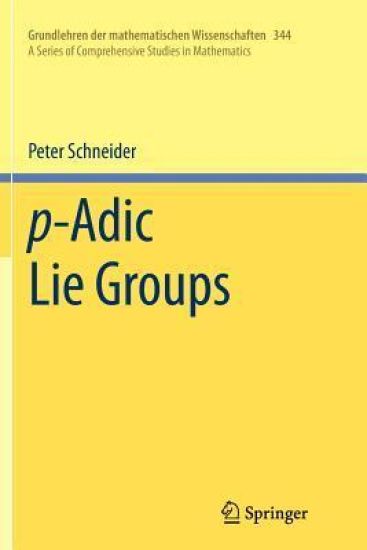
Manifolds over complete nonarchimedean fields together with notions like tangent spaces and vector fields form a convenient geometric language to express the basic formalism of p-adic analysis. The volume starts with a self-contained and detailed introduction to this language. This includes the discussion of spaces of locally analytic functions as topological vector spaces, important for applications in representation theory. The author then sets up the analytic foundations of the theory of p-adic Lie groups and develops the relation between p-adic Lie groups and their Lie algebras. The second part of the book contains, for the first time in a textbook, a detailed exposition of Lazard's algebraic approach to compact p-adic Lie groups, via his notion of a p-valuation, together with its application to the structure of completed group rings.

Representation theory studies maps from groups into the general linear group of a finite-dimensional vector space. For finite groups the theory comes in two distinct flavours. In the 'semisimple case' (for example over the field of complex numbers) one can use character theory to completely understand the representations. This by far is not sufficient when the characteristic of the field divides the order of the group.Modular Representation Theory of finite Groups comprises this second situation. Many additional tools are needed for this case. To mention some, there is the systematic use of Grothendieck groups leading to the Cartan matrix and the decomposition matrix of the group as well as Green's direct analysis of indecomposable representations. There is also the strategy of writing the category of all representations as the direct product of certain subcategories, the so-called 'blocks' of the group. Brauer's work then establishes correspondences between the blocksof the original group and blocks of certain subgroups the philosophy being that one is thereby reduced to a simpler situation. In particular, one can measure how nonsemisimple a category a block is by the size and structure of its so-called 'defect group'. All these concepts are made explicit for the example of the special linear group of two-by-two matrices over a finite prime field.Although the presentation is strongly biased towards the module theoretic point of view an attempt is made to strike a certain balance by also showing the reader the group theoretic approach. In particular, in the case of defect groups a detailed proof of the equivalence of the two approaches is given. This book aims to familiarize students at the masters level with the basic results, tools, and techniques of a beautiful and important algebraic theory. Some basic algebra together with the semisimple case are assumed to be known, although all facts to be used are restated (without proofs) inthe text. Otherwise the book is entirely self-contained.


This beautifully illustrated storybook has been written for children who stutter and their parents, carers and teachers. It tells the story of a young hedgehog who stutters and his encounters with several woodland creatures, some of whom stutter and others who do not. In the end they all work together to defeat a monster who lurks in the wood. The story makes clear that it is more important to listen to what someone says rather than the way they say it. It offers a positive message to children who stutter and shows other people, both adults and children, how best to react when talking to a child who stutters and the kind of responses to avoid. The book includes information about stuttering for adults and list of relevant organisations.

Gravitational Lenses
Peter Schneider; Jürgen Ehlers; Emilio E. Falco
Springer-Verlag New York Inc.
2011
nidottu
The theory, observations, and applications ofgravitational lensingconstitute one ofthe most rapidly growing branches ofextragalactic astrophysics. The deflection of light from very distant sources by intervening masses provides a unique possibility for the investigation of both background sources and lens mass distributions. Gravitational lensing manifestsitselfmost distinctly through multiply imaged QSOs and the formation of highly elongated im ages of distant galaxies ('arcs') and spectacular ring-like images of extra galactic radio sources. But the effects of gravitational light deflection are not limited to these prominent image configurations; more subtle, since not directly observable, consequences of lensing are the, possibly strong, mag nification of sources, which may permit observation of intrinsically fainter, or more distant, sources than would be visible without these natural tele scopes. Such light deflection can also affect the source counts of QSOs and of other compact extragalactic sources, and can lead to flux variability of sources owing to propagation effects. Trying to summarizethe theory and observationalstatus ofgravitational lensing in a monograph turned out to be a bigger problem than any of the authors anticipated when we started this project at the end of 1987, encour aged by Martin Harwit, who originally approached us. The development in the field has been very rapid during the last four years, both through the ory and through observation, and many sections have been rewritten several times, as the previous versions became out of date.

Manifolds over complete nonarchimedean fields together with notions like tangent spaces and vector fields form a convenient geometric language to express the basic formalism of p-adic analysis. The volume starts with a self-contained and detailed introduction to this language. This includes the discussion of spaces of locally analytic functions as topological vector spaces, important for applications in representation theory. The author then sets up the analytic foundations of the theory of p-adic Lie groups and develops the relation between p-adic Lie groups and their Lie algebras. The second part of the book contains, for the first time in a textbook, a detailed exposition of Lazard's algebraic approach to compact p-adic Lie groups, via his notion of a p-valuation, together with its application to the structure of completed group rings.