

Kirjailija
Peter Thomas
Kirjat ja teokset yhdessä paikassa: 36 kirjaa, julkaisuja vuosilta 1996-2026, suosituimpien joukossa Approaches to Learning and Teaching Whole Series Pack (12 Titles). Vertaile teosten hintoja ja tarkista saatavuus suomalaisista kirjakaupoista.
36 kirjaa
Kirjojen julkaisuhaarukka 1996-2026.

When Adnams celebrated 650 years of brewing at Southwold in 1995 there had been an unbroken traditional way of life. Adnams country extends beyond the borders of Suffolk, but this book concentrates on this fine county and its history - from Southwold to Sudbury and Lowestoft to Lavenham. There are profound contrasts within Suffolk: Felixstowe's huge container port and ferry terminal and its near neighbour Ipswich, the busy county town just a stone's throw from the villages of the Gipping Valley. The wool towns of the Stour valley, such as Long Melford, are as handsome as they were hundreds of years ago and the coastline, some sixty miles of it, has some of the loneliest places in England, such as Shingle Street, and some of the most picturesque, like the Deben Estuary leading to Woodbridge and to Sutton Hoo - site of the famous burial now in the care of the National Trust.

A Century of Exeter offers an insight into the daily lives and living conditions of local people and gives the reader glimpses and details of familiar places during a century of unprecedented change. Many aspects of Exeter's recent history are covered, famous occasions and individuals are remembered and the impact of national and international events is witnessed. A Century of Exeter provides a striking account of the changes that have so altered the city's appearance and records the process of transformation. Drawing on detailed local knowledge of the community, and illustrated with a wealth of black-and-white photographs, this book recalls what Exeter has lost in terms of buildings, traditions and ways of life. It also acknowledges the regeneration that has taken place and celebrates the character and energy of local people as they move through the first years of this new century.

Taking a functional rather than an ecosystem or a utilitarian approach, Thomas and Packham provide a concise account of the structure of woodlands and forests. Using examples from around the world - from polar treelines to savannahs to tropical rain forests - the authors explain the structure of the soil and the hidden world of the roots; how the main groups of organisms which live within them interact both positively and negatively. There is particular emphasis on woodland and forest processes, especially those involving the flow and cycling of nutrients, as well as the dynamics of wooded areas, considering how and why they have changed through geological time and continue to do so. This clear, non-technical, 2007 text will be of interest to undergraduates, foresters, ecologists and land managers.

Taking a functional rather than an ecosystem or a utilitarian approach, Thomas and Packham provide a concise account of the structure of woodlands and forests. Using examples from around the world - from polar treelines to savannahs to tropical rain forests - the authors explain the structure of the soil and the hidden world of the roots; how the main groups of organisms which live within them interact both positively and negatively. There is particular emphasis on woodland and forest processes, especially those involving the flow and cycling of nutrients, as well as the dynamics of wooded areas, considering how and why they have changed through geological time and continue to do so. This clear, non-technical, 2007 text will be of interest to undergraduates, foresters, ecologists and land managers.
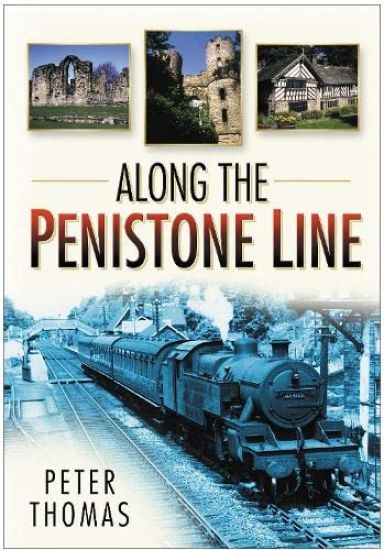
It is curious that the nineteenth-century railway builders should even have thought of a line linking Huddersfield with Sheffield, now known as the Penistone Line, with the risk of all sorts of disasters. As Along the Penistone Line makes clear, collisions, runaway trains, collapsed tunnels and viaducts: the Penistone Line had them all.

Coherent Semiconductor Optics
Torsten Meier; Peter Thomas; Stephan W. Koch
Springer-Verlag Berlin and Heidelberg GmbH Co. K
2006
sidottu
This book could not have been written without the extensive work of many diploma and Ph.D. students in our Theoretical Semiconductor Physics Group at the Philipps-Universit¨ at in Marburg. They have contributed to the f- damental understanding and to many applications in the area of coherent semiconductor optics. The one-dimensional tight-binding model, which is exclusively treated in the present book, has been the basis of many of their diploma and Ph.D. theses. The reader will ?nd references to their results and also their names as authors of the publications listed in the sections “S- gested Reading”. In particular, the authors wish to thank Irina Kuznetsova, who prepared a large number of the ?gures and recalculated the underlying data on the basis of the equations presented in this book in cases where parameters or presentation had to be changed and/or optimized. Someoftheproblems,inparticular,thoseconnectedtothemoreintrod- tory chapters, were solved by Swantje Horst and Joachim Kalden. They made valuable suggestions for improved formulation of the problems and pointed out a number of hints we should give our readers in order to help them with the solutions. Furthermore, we wish to thank all our numerous collaborators, together with whom we have performed research in the area of coherent semiconductor optics in the past and present, for many valuable discussions. In particular, without the close cooperation between experiment and theory this research ?eld would not have advanced to the present level.
In July 2006, John W. Dean published "Conservatives Without Conscience," a book condemning the modern conservative movement for being authoritarian. Dean's book became an instant bestseller. But does it really prove that today's conservatives lack conscience? In his latest book, Peter Thomas explains why "Conservatives Without Conscience" is not persuasive to rational readers. Whether you've read Dean's book or not, you owe it to yourself to read "Liberals Without Logic."

If you enjoy the occasional pub meal, a drink at the bar, or if you're interested in Lancashire's social history, you're sure to find something entertaining in Peter Thomas's introduction to the county's pubs. It opens with a round-up of the history of brewing, pubs and ale-selling, and a section on Lancashire's pub signs, though most of the book is dedicated to an A-Z of over fifty of the most interesting inns. Their history, architecture, ghosts and associated legends are all featured, as well as the exploits of their famous and infamous landlords and landladies.Peter's exhaustive research has resulted in a gem of a book which brings together the proud history, traditions and customs associated with Lancashire hostelries; from ale tasting at the Plough at Eaves to the Britannia Coconut Dancers at the Crown Inn at Bacup. A fascinating journey, with plenty of refreshment stops along the way, this will appeal to anyone with an interest in local history, and those who'd like to know more about the convival surroundings in which they might enjoy a pint.

Peter Thomas's introduction to the county's pubs opens with a brief chapter about the history of brewing and pubs, and a short history of pub signs in Yorkshire. Most of the book is dedicated to a round-up of interesting inns - their history and architecture, ghosts and legends associated with them, and famous and infamous landlords and landladies.

Professional Content Management Systems
Andreas Mauthe; Peter Thomas
John Wiley Sons Inc
2004
sidottu
Content and Content Management are core topics in the IT and broadcast industry. However these terms have not been clearly defined for those learning the field. The topic is complex and users from different industries have different backgrounds and a varied understanding of content issues. Multimedia Content Management helps to clarify the subject area, define problematic issues and establish a universal understanding of content and its management. Provides clarity in the subject area Defines potential problems and establishes a universal understanding Builds an architectural framework upon this account and different aspects of the industry and solutions are reviewed Comprehensively describes the different users working and accessing content, the applications and workflows Essential reading for students, engineers and technical managers, in the area of data, storage management and multimedia, requiring an overview of this complex topic. The topics discussed will also prove highly insightful for executive managers and media professionals with a technical understanding and broadcast executives in the field.

The eighteenth-century was long deemed 'the classical age of the constitution' in Britain, with cabinet government based on a two-party system of Whigs and Tories in Parliament, and a monarchy whose powers had been emasculated by the Glorious Revolution o. This study furthers the work of Sir Lewis Namier who argued in 1929 that no such party system existed, George III was not a cypher and that Parliament was an administration comprising of factions and opposition. George III was a high-profile and well-known character in British history whose policies have often been blamed for the loss of Britain's American colonies, around whom rages a perennial dispute over his aims: was he seeking to restore royal power, or merely excercising his constitutional rights?. The first chronological survey of the first ten years of George III’s reign through power politics and policy-making.An electronic edition of this book is freely available under a Creative Commons (CC BY-NC-ND) licence.
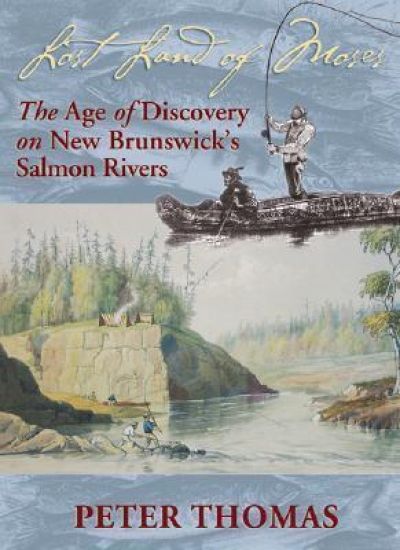
In the middle of the nineteenth century, most of New Brunswick was pristine wilderness. But by the end of the century the map of eastern Canada would be changed forever by the sport of salmon angling, and by the adventurers, gentlemen, rakes, and royalty, who were drawn together in their lust for the finest of fish. In Lost Land of Moses, Peter Thomas recounts the dramatic changes that occurred between 1840 and 1880, as strenuous wilderness idylls became the Victorian equivalent of adventure tourism. To illustrate his story, he has chosen more than fifty engravings, cartoons, maps, and photographs from archival collections and 19th century books and magazines. Moses Perley was a New Brunswick lawyer with a gift for contagious enthusiasm. Between 1839 and 1841, he published a series of articles in the British magazine Sporting Review describing his canoe trips with Mi'kmaq or Maliseet companions. The articles inspired a generation of young adventurers to visit New Brunswick. Soon, these young British gentlemen were joined by the rich and famous, as steamships brought fishermen right to the rivers, and needs were supplied by professional outfitters. In 1879, the Marquess of Lorne, then Governor General of Canada, and his daring wife, Princess Louise, spent two glorious weeks on the Restigouche, complete with a vice-regal retinue, a houseboat called Great Caesar's Ghost, and carpeted tents. The New Brunswick salmon waters were open for business. Many of the consequences of this influx were dire. Leases were let on the rivers, allowing only wealthy people to fish them. They founded clubs, built expansive camps, and hired wardens to patrol the pools. Most troubling of all, by the 1880s, the Mi'kmaq and Maliseet, at first respected as knowledgeable guides into their own territory, had been reduced to being perceived as mere servants. Moses Perley never foresaw the changes that large numbers of visitors would bring to New Brunswick's teeming salmon rivers. Lost Land of Moses reveals the consequences of his crusade to lure fly fishermen to New Brunswick. For good and ill, the legacy of those forty years is with us today.
Electronic mail, personal organizers, voice mail, all were introduced as time-saving devices designed to promote an easier and more efficient workplace. Yet many professionals find that making effective use of these new forms of communication technology can become a time-consuming task. In this handbook written for the office of the 21st century, Barbara Etzel and Peter J. Thomas provide guidance for those struggling to manage the growing volume of mail, memos, e-mail messages, and electronic documents that arrives daily. Personal Information Management details the skills professionals need to process this information, save time, and work more effectively. Etzel and Thomas present common organizational difficulties and enumerate concrete techniques for overcoming them. They guide the reader through a variety of computer software and hardware products, paper-based information products, and personal time management techniques, helping the reader to develop and individually-tailored Personal Information Management Strategy.Technologies covered include accounting and business software, word processors, databases, personal organizers, e-mail programs, tracking and storage packages, personal digital assistants, CD-Roms, computer backup devices, scanning device, voice mail, cellular phones, beepers, and fax machines, to name only a few. including an appendix listing the names and addresses of companies that Produce information technologies, Personal Information Technologies is essential reading for anyone suffering from information overload. Designed to be adaptable to emerging technologies, the techniques they provide will be applicable regardless for what the information age brings next.

Essential HTML fast
Duncan Reed; Peter Thomas
Springer-Verlag Berlin and Heidelberg GmbH Co. K
1997
nidottu
Introduction One of the most often-repeated questions of recent years is 'Are you on the Web?' The growth ofthe World Wide Web (WWW or simply 'Web') has been phenomenal. It seems that everyone has a web site, or is at least planning have one, and everyone wants to get on-line with their products and services, accounts of their favourite hobbies, their resumes, or pictures of their loved ones. So that you too can join in the on-line revolution, this book will help you get onto the web: to make informed decisions about developing your own web site, how to plan and design the site, and then how to get the site on-line for the world to see. Essential HTML Fast 2 Why use the Web? There are many reasons why you would want to use the Web, and why the web is becoming an essential tool for business. Some of these are: • It is cross-platform: If you're reading this at work, you're probably painfully aware of some of the problems caused by being tied to a particular type of computer. You might have come across some software that would make your job easier, but then discover that the software is only available for a different computer running a different operating system. You may have been sent some documents by a client which you subsequently discover you can't read, as the disk seems to be of the wrong type.
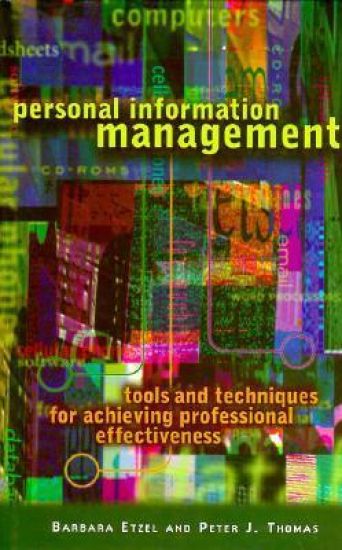
Electronic mail, personal organizers, voice mail, all were introduced as time-saving devices designed to promote an easier and more efficient workplace. Yet many professionals find that making effective use of these new forms of communication technology can become a time-consuming task. In this handbook written for the office of the 21st century, Barbara Etzel and Peter J. Thomas provide guidance for those struggling to manage the growing volume of mail, memos, e-mail messages, and electronic documents that arrives daily. Personal Information Management details the skills professionals need to process this information, save time, and work more effectively. Etzel and Thomas present common organizational difficulties and enumerate concrete techniques for overcoming them. They guide the reader through a variety of computer software and hardware products, paper-based information products, and personal time management techniques, helping the reader to develop and individually-tailored Personal Information Management Strategy.Technologies covered include accounting and business software, word processors, databases, personal organizers, e-mail programs, tracking and storage packages, personal digital assistants, CD-Roms, computer backup devices, scanning device, voice mail, cellular phones, beepers, and fax machines, to name only a few. including an appendix listing the names and addresses of companies that Produce information technologies, Personal Information Technologies is essential reading for anyone suffering from information overload. Designed to be adaptable to emerging technologies, the techniques they provide will be applicable regardless for what the information age brings next.