Kirjojen hintavertailu. Mukana 12 519 589 kirjaa ja 12 kauppaa.

Kirjailija

Peter Trower

Kirjat ja teokset yhdessä paikassa: 13 kirjaa, julkaisuja vuosilta 1983-2015, suosituimpien joukossa Social Skills and Mental Health (Psychology Revivals). Vertaile teosten hintoja ja tarkista saatavuus suomalaisista kirjakaupoista.

13 kirjaa

Kirjojen julkaisuhaarukka 1983-2015.

Social Skills and Mental Health (Psychology Revivals)

Social Skills and Mental Health (Psychology Revivals)

Peter Trower; Bridget Bryant; Michael Argyle

Routledge
2015
nidottu
In the 10 years or so prior to original publication in 1978 new theories and discoveries in the social sciences had given a scientific basis and new impetus to the development of social skills training as a form of therapy. This book explores the progress made with this idea and gives practical guidance for therapists based on several years’ experience with the technique.The book provides an account of the latest ideas at the time, about the analysis of social behaviour – non-verbal communication, social skill, rules, analysis of situations, etc. The different techniques for training and modifying social behaviour – some old, some very new – are described and compared, with detailed accounts.There is a careful critical review of follow-up studies of social skills training and other forms of social therapy on in-patients, out-patients and volunteer subjects.The second part of the book consists of a manual for assessing deficits and difficulties, and for training in ten main areas of social deficiency such as observation, listening, speaking, asserting and planning. A rating scale, questionnaire and user’s booklet of training exercises is included.The book should be of interest, not only to psychiatric professionals – psychiatrists, clinical psychologists, psychiatric nurses, occupational therapists – but to many others, such as social and community workers, teachers, prison officers, and lay people who may be interested in forming self-help groups, either on their own or with professional guidance.

Social Skills and Mental Health (Psychology Revivals)

Social Skills and Mental Health (Psychology Revivals)

Peter Trower; Bridget Bryant; Michael Argyle

Routledge
2013
sidottu
In the 10 years or so prior to original publication in 1978 new theories and discoveries in the social sciences had given a scientific basis and new impetus to the development of social skills training as a form of therapy. This book explores the progress made with this idea and gives practical guidance for therapists based on several years’ experience with the technique.The book provides an account of the latest ideas at the time, about the analysis of social behaviour – non-verbal communication, social skill, rules, analysis of situations, etc. The different techniques for training and modifying social behaviour – some old, some very new – are described and compared, with detailed accounts.There is a careful critical review of follow-up studies of social skills training and other forms of social therapy on in-patients, out-patients and volunteer subjects.The second part of the book consists of a manual for assessing deficits and difficulties, and for training in ten main areas of social deficiency such as observation, listening, speaking, asserting and planning. A rating scale, questionnaire and user’s booklet of training exercises is included.The book should be of interest, not only to psychiatric professionals – psychiatrists, clinical psychologists, psychiatric nurses, occupational therapists – but to many others, such as social and community workers, teachers, prison officers, and lay people who may be interested in forming self-help groups, either on their own or with professional guidance.
Cognitive Behavioural Counselling in Action

Cognitive Behavioural Counselling in Action

Peter Trower; Jason Jones; Windy Dryden

SAGE Publications Ltd
2015
sidottu
This best-selling, practical, evidence-based guide to the cognitive behavioural approach takes you step-by-step through the process of counselling, from initial contact with the client to termination and follow up. The book follows a skills-based format based around the Bordin and Dryden model of bonds, goals, tasks and views, with expanded case material to further illustrate links between theory and practice. This third edition includes new content on: · the working alliance – what it is and why it is so important · challenges and pitfalls in the counselling process · when to challenge and when not to challenge clients beliefs · emotional problems such as shame, guilt and jealousy as well as anxiety, depression and anger. Drawing on their own extensive experience and contemporary research, the authors provide a concise overview of the cognitive behavioural approach, with new material on emotional problems rarely covered in practitioner guides, a strong emphasis on the therapeutic alliance, and updated bibliographic references throughout. Praise for the Previous Edition: "An elegant and informative guide to the practice of cognitive behavioural counselling … recommended for all CBT practitioners." - Mick Power, Professor of Clinical Psychology, University of Edinburgh "A deserved best-seller for over 20 years. Peter Trower and colleagues have completely revised and updated the book in light of the enormous scientific achievements of CBT in this time. This brilliant book is essential reading for all cognitive behavioural practitioners." - Max Birchwood, Professor of Youth Mental Health, University of Birmingham ?"An absolutely wonderful book on cognitive behavioural counselling. It includes not only the basic information but also recent conceptual advances in the field. Truly, I cannot recommend this book highly enough!" - E. Thomas Dowd, International Editor, Journal of Cognitive Psychotherapy
Cognitive Behavioural Counselling in Action

Cognitive Behavioural Counselling in Action

Peter Trower; Jason Jones; Windy Dryden

SAGE Publications Ltd
2015
nidottu
This best-selling, practical, evidence-based guide to the cognitive behavioural approach takes you step-by-step through the process of counselling, from initial contact with the client to termination and follow up. The book follows a skills-based format based around the Bordin and Dryden model of bonds, goals, tasks and views, with expanded case material to further illustrate links between theory and practice. This third edition includes new content on: · the working alliance – what it is and why it is so important · challenges and pitfalls in the counselling process · when to challenge and when not to challenge clients beliefs · emotional problems such as shame, guilt and jealousy as well as anxiety, depression and anger. Drawing on their own extensive experience and contemporary research, the authors provide a concise overview of the cognitive behavioural approach, with new material on emotional problems rarely covered in practitioner guides, a strong emphasis on the therapeutic alliance, and updated bibliographic references throughout. Praise for the Previous Edition: "An elegant and informative guide to the practice of cognitive behavioural counselling … recommended for all CBT practitioners." - Mick Power, Professor of Clinical Psychology, University of Edinburgh "A deserved best-seller for over 20 years. Peter Trower and colleagues have completely revised and updated the book in light of the enormous scientific achievements of CBT in this time. This brilliant book is essential reading for all cognitive behavioural practitioners." - Max Birchwood, Professor of Youth Mental Health, University of Birmingham ?"An absolutely wonderful book on cognitive behavioural counselling. It includes not only the basic information but also recent conceptual advances in the field. Truly, I cannot recommend this book highly enough!" - E. Thomas Dowd, International Editor, Journal of Cognitive Psychotherapy
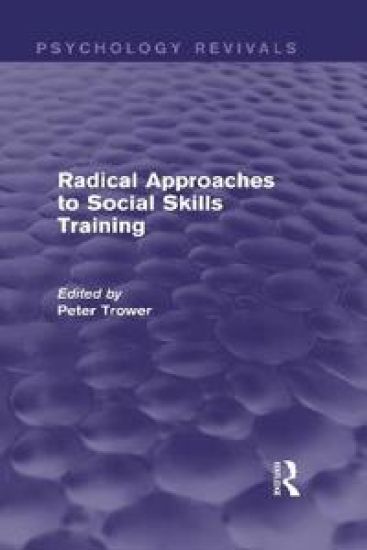
Radical Approaches to Social Skills Training (Psychology Revivals)
Originally published in 1984, one of the few facts that emerged clearly in the beleaguered field of psychology and mental health at the time was the extent of poor social skills in psychiatric patients, the mentally handicapped and problem adolescents. As a result, during the 1970s, social skills training – espoused as a form of behaviour therapy – seemed to offer great promise, based on the notion that social skills, like any other skills, are learnt and can be taught if lacking. However, in evaluating social skills training, many investigators found that skills did not endure and generalise.This book attempts a major re-assessment of social skills training. It examines the underlying paradigms, which are shown to be fundamentally behaviourist. Such paradigms, it is argued, severely constrain the aims and method of current types of training. Thus the book develops what is termed an ‘agency’ approach, based on man as a social agent who actively constructs his own experiences and generates his own goal-directed behaviour on the basis of those constructs. This new model is developed in both theoretical and practical ways in the main body of the book and should, even today, be of great interest to all those involved with social skills training.
Radical Approaches to Social Skills Training (Psychology Revivals)
Originally published in 1984, one of the few facts that emerged clearly in the beleaguered field of psychology and mental health at the time was the extent of poor social skills in psychiatric patients, the mentally handicapped and problem adolescents. As a result, during the 1970s, social skills training – espoused as a form of behaviour therapy – seemed to offer great promise, based on the notion that social skills, like any other skills, are learnt and can be taught if lacking. However, in evaluating social skills training, many investigators found that skills did not endure and generalise.This book attempts a major re-assessment of social skills training. It examines the underlying paradigms, which are shown to be fundamentally behaviourist. Such paradigms, it is argued, severely constrain the aims and method of current types of training. Thus the book develops what is termed an ‘agency’ approach, based on man as a social agent who actively constructs his own experiences and generates his own goal-directed behaviour on the basis of those constructs. This new model is developed in both theoretical and practical ways in the main body of the book and should, even today, be of great interest to all those involved with social skills training.
Haunted Hills and Hanging Valleys

Haunted Hills and Hanging Valleys

Peter Trower; Don MaKay

Harbour Publishing
2004
pokkari
Thirty-five years after the publication of his first book, Peter Trower has brought together his finest poems for the beautiful, thorough and definitive volume Haunted Hills and Hanging Valleys.From whistle punk to smelter worker to faller to crane operator, Trower worked up and down the West Coast for 22 years collecting the stories and soaking in the vivid imagery and personalities that would characterize much of his perceptively crafted, musical poetry. Haunted Hills and Hanging Valleys presents for the first time the best work of a writing career that has drawn Trower praise as "the poet laureate of this mountain kingdom" from Al Purdy and for "heft and passion and a gift for telling place and detail" from Irving Layton. This long-awaited book will confirm Trower's place as one of our country's most important poets.
Why Does Schizophrenia Develop at Late Adolescence?

Why Does Schizophrenia Develop at Late Adolescence?

Chris Harrop; Peter Trower

John Wiley Sons Inc
2003
sidottu
What is schizophrenia? Is it a nervous breakdown or a neurochemical malfunction? Why does it develop mostly in late adolescence? In this groundbreaking and innovative book, Chris Harrop and Peter Trower outline a whole new way of understanding schizophrenia. Controversially, they argue that symptoms seen as psychosis can be linked to the typical psychological development of adolescence and, in particular, to problems constructing an independent, adult self. This unique psychological account of schizophrenia, written in accessible language, offers insights and practical therapeutic techniques that will be of value to young people with this problem, their families and anyone working with adolescents. For therapists and all those working in mental health services, particularly those interested in early intervention, this book is essential reading. ‘… a valuable contribution to what remains one of the most problematical issues for health providers, receivers and researchers.’ Dr Paul Patterson ‘… what Peter and Chris have to say is controversial, but I suspect this work will be regarded in time to come as "trail-blazing".’ Professor Max Birchwood
The Judas Hills

The Judas Hills

Peter Trower

Harbour Publishing
2000
pokkari
It's the 1950s, and just when Terry Belshaw -- the unlikely hero of Peter Trower's two previous novels, Grogan's Caf and Dead Man's Ticket -- vows never to log again, his circumstances change and he needs to return to BC's backwoods to get a stake, and fast.His newest adventures -- gripping and ominous -- are detailed in The Judas Hills, in which Terry is hired out to a remote logging camp in the brooding shadow of Mesachie Mountain. Trower takes the most memorable loggers he ever met during his own career in the woods and casts them all in this fast-paced thriller: from Garfield "Timber Wolf" Hobson, the tenacious camp boss who wants to harvest all the trees from the Mesachie hills at any cost, to Albert "Ox" Tully, a hulking and menacing logger who reads philosophy and poetry in his spare time, to Gordy "Grandaddy Tough" Dower, Hobson's formidable foreman.As the story unfolds, it soon becomes clear that what these loggers face is more than the usual dose of danger they find on the job. Mesachie Mountain and the whole valley seem to be under a curse with supernatural forces at work. A half-mad camp watchman, a series of unlucky logging accidents, an abandoned Aboriginal village and a ghost camp all point toward a sinister mystery that must be solved. The story moves from one inevitable crisis to another and concludes with a nerve-shattering climax."It isn't often you come across a poetic voice that truly reflects the history and feeling of the land and its folk - a poet of the people."-The Globe and Mail
Cognitive Therapy for Delusions, Voices and Paranoia

Cognitive Therapy for Delusions, Voices and Paranoia

Paul Chadwick; Max J. Birchwood; Peter Trower

John Wiley Sons Inc
1996
nidottu
Internationally respected authors, actively working in this area, establish theoretical reasons for extending cognitive therapy to these symptoms. This includes a justification for looking at symptoms rather than syndromes, first-person accounts of delusions and hallucinations along with an analysis of why the cognitive approach is ideally suited to the study and treatment of these disabling disorders. Describes how to make a cognitive assessment of both hallucinations and delusions and which measures to use. Contains new research and methods of managing these severe psychoses.
Unmarked Doorways

Unmarked Doorways

Peter Trower

Harbour Publishing
1989
pokkari
Once regarded as British Columbia's "voice from the bunkhouse" for his powerful logging poems, Peter Trower, has produced a new collection about life "after the bunkhouse" - seventy new poems about cities and small towns, travel and love.
Goosequill Snags

Goosequill Snags

Peter Trower

Harbour Publishing
1983
pokkari
Peter Trower is a poet known for what he writes about: the lives of west coast loggers, the rural culture of the B.C. Coast, skidroad life in Vancouver, and his personal love of the western landscape. He has established himself as a unique voice, lyircal and regional, a Canadian original. Goosequill Snags is the first major collection of poems since Ragged Horizons and to be placed among the best of his seven books. The work here represents a considerable extension of range, both geographical and emotional, encompassing recent travels across Canada and abandoning the author's charateristic blue mood and to run the gamut from deep despair to ecstatic love to light-hearted self-parody.