Kirjojen hintavertailu. Mukana 12 390 323 kirjaa ja 12 kauppaa.

Kirjailija

Peter Viereck

Kirjat ja teokset yhdessä paikassa: 25 kirjaa, julkaisuja vuosilta 1978-2018, suosituimpien joukossa Shame and Glory of the Intellectuals. Vertaile teosten hintoja ja tarkista saatavuus suomalaisista kirjakaupoista.

25 kirjaa

Kirjojen julkaisuhaarukka 1978-2018.

Unadjusted Man in the Age of Overadjustment
The great critic Peter Viereck, in a volume that both reproduces an earlier effort and presents an entirely new work on the intersection of history and literature, offers a biting critique of the American desire for normalcy that leads to a culture of the surrender of personality. In contrast to this voluntary thought control process is the unadjusted person. Cast in the mold of great individualists from Thomas More to Friedrich Nietzsche, such a person responds to fundamental values of conscience rather than conformity built exclusively on ego gratification and icon worship.Viereck's book is a stinging critique of the liberal presumption of a monopoly in critical thought. He argues to the contrary, that most varieties of liberal expression offer little else than the common platitude dressed up as critique. In such a cultural environment, conservatism is the skeleton in the liberal closet. The virtue of conservatism is that in its very stress on liberty as dependent on tradition and law, it permits the human being an opportunity to test all transient things by the touchstone of all lasting ideas. Unadjusted Man cuts deep and in many directions: against left totalitarian regimes of Europe and right wannabes like McCarthyism in America. For Viereck, the art of conserving is not an embrace of utopias to come or empires that were, but retaining the sense of individuality over against the senselessness of the "massman." Civil liberties in this approach are a right to non-conspiratorial dissent informed by fundamental values.The new material is presented unabashedly--without an attempt to rewrite personal history, and with an admission that not every prediction made in the original edition has come to fruition. That said, the underlying themes of the original are not so much repeated as expanded upon. For those seeking a work in the classic mold of conservatism, rather than the strident reactionary views that have come to dominate much of the conservative dialogue, this will be a special book, a special entrance to the mind of a great figure in American culture wars of present as well as past.

Strict Wildness

Strict Wildness

Peter Viereck

Routledge
2017
nidottu
A reviewer once called Peter Viereck's thought "not common sense but inspired, electric common sense." This volume of Viereck's selected essays on poetry and on history, written between 1938 through 2004, exemplifies this quality. Its main theme is suggested in Viereck's coined phrase "strict wildness," which suggests a balance between restraint (which by itself is staid and rigid) and passion (which by itself is incoherent). Frost called free verse tennis without the net. Viereck calls dead mechanical form "net without the tennis." Strict wildness, then, is spontaneity of feeling within strict organic form.The book explores questions of modernism and poetic craft with respect to American poetry. It discusses the controversy over Ezra Pound's politics and its relation to his poetics, and the nearly forgotten poet Vachel Lindsay. Viereck offers more general views on poetics, including the fruitful tensions between form and content, and the impact of modern technology on poetic expression. This book also discusses history and politics, and contains essays on McCarthyism, the Cold War, political conformity of the Left and Right, and issues of historiography and culture that define Viereck's highly individual, often critical brand of conservatism. In treating representative trends and figures in conservative thought, Viereck insists on clear awareness of what exists to conserve, what ought to be conserved, and why it should be conserved. In their range and originality, the writings brought together in Strict Wildness constitute an ideal introduction to Peter Viereck's literary and political thought. It will be of interest to literary scholars, intellectual historians, and political scientists.
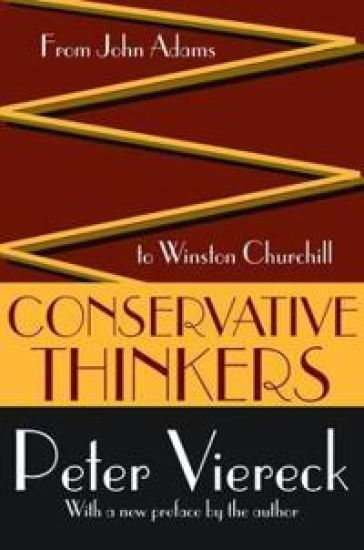
Conservative Thinkers

Conservative Thinkers

Peter Viereck

Routledge
2017
sidottu
Across America today, conservatism is being hotly debated both across the political spectrum and within the conservative movement itself. Much of the public debate is without definition or historical context. This history of conservatism by renowned historian, social critic, and poet Peter Viereck aims to meet the need for a concise, balanced picture of conservative thought in all its different shadings and cultural contexts.The analytical portion of the book provides a succinct but thorough critical overview of conservatism's most representative figures. Viereck begins with chapters defining conservatism itself, its special technical terms, and its changing historical circumstances. The rest deals with its actual thinkers and statesmen. After each main conservative thesis, the anti-conservative rebuttal is summarized, and the reader is allowed to reach his own conclusions. Though the first stress is on conservative political philosophy (from John Adams to Churchill), key sections also stress non-political conservatism: in religion (Cardinal Newman) and in the primarily cultural protest against material progress (Coleridge, Dostoyevsky, Melville, Henry Adams).Every major point is concretely illustrated by an appended cross-reference to a primary source in the second half, a well-chosen anthology of key conservative documents. Criteria for inclusion are three, representativeness, depth of perception, importance of influence. The result is not uniformity but a gamut: from extreme intolerant reaction to an evolutionary moderate spirit. The former passes imperceptibly into authoritarianism; the latter, into liberalism.
Shopping Centers

Shopping Centers

Peter Viereck; James Hughes

Routledge
2017
sidottu
Are there potentials in central city revitalization? What role will the federal government play in determining future retail locational choices? Shopping center development has never been more popular - or more hazardous than it is today. Retail distribution in the United States has greater efficiency than anywhere else in the world, a tribute to the adaptability and rationalization of systems which have characterized the field. The pressures of the future, however, require greater exertion if they are to be adequately met.The industry drive to the new "middle markets" may change the face of small city America - or it may lead to a blind alley. As central cities, aided by EDA (Economic Development Administration) and UDAG (Urban Development Action Grant), gird up for revitalization in the face of reduced real buying power, these issues take on increased vigor.A whole new legal fabric is evolving in the development of major commercial facilities. Does it mark the path of the future - or is it an ineffectual last gasp effort to reshape the basic overwhelming trend lines of American life? How do we get a grasp on these parameters? Whether city planner, economic or marketing consultant, investor, or developer - much of our future depends on the answers. The authorities brought together for these specially sponsored papers are the best in the business - and provide key insights into this dynamic field. Demographics and consumer response that challenge marketing and planning professionals are also included.
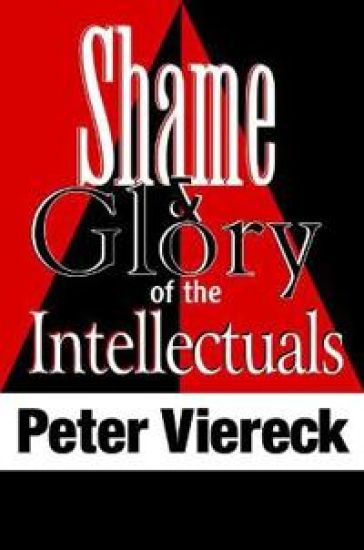
Shame and Glory of the Intellectuals
In this classic volume, written at the height of the Cold War, with a new preface of 2006, Peter Viereck, one of the foremost intellectual spokesmen of modern conservatism, examines the differing responses of American and European intellectuals to the twin threats of Nazism and Soviet communism. In so doing, he seeks to formulate a humanistic conservatism with which to counter the danger of totalitarian thought in the areas of politics, ethics, and art.The glory of the intellectuals was the firm moral stance they took against Nazism at a time when appeasement was the preferred path of many politicians; their shame lay in their failure to recognize the brutality of Stalinism to the extent of becoming apologists for or accomplices of its tyranny. In Viereck's view, this failure is rooted in an abandonment of humane values that he sees as a legacy of nineteenth-century romanticism and certain strands of modernist thought and aesthetics.Among his targets are literary obscurantism as personified by Ezra Pound, the academicization of literary culture, the rigidity of adversarial avant-gardism, and the failure of many writers and cultural institutions to conserve the very heritage their political freedom and security depend on. Viereck represents their attitude in a series of satirical dialogues with Gaylord Babbitt, son of Sinclair Lewis' embodiment of conservative philistinism. Babbitt Junior is as unreflective as his father, but the objects of his credulity are the received ideas of liberal progressivism and avant-garde mandarinism. Ultimately, Viereck's critique stands as a timely rebuke to the extremism of both left and right.
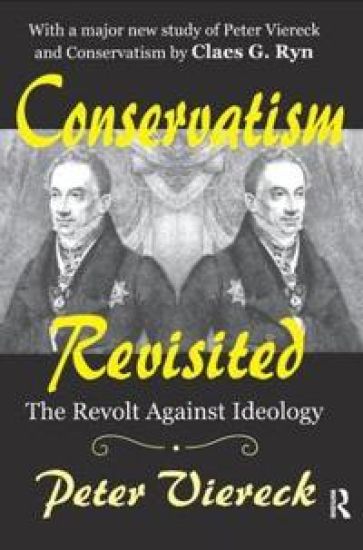
Conservatism Revisited

Conservatism Revisited

Peter Viereck

Routledge
2017
sidottu
Peter Viereck, poet and historian, is one of the principle theoreticians of conservatism in modern American political thought. In this classic work, Viereck undertakes a penetrating and unorthodox analysis of that quintessential conservative, Prince Metternich, and offers evidence that cultural and political conservatism may perhaps be best adapted to sustain a free and reasonable society.According to Viereck's definition, conservatism is not the enemy of economic reform or social progress, nor is it the oppressive instrument of the privileged few. Although conservatism has been attacked from the left and often discredited by exploitation from the right, it remains the historic name for a point of view vital to contemporary society and culture. Divided into three parts, the book opens with a survey of conservatism in its cultural context of classicism and humanism. Rejecting the blind alley of reaction, Viereck calls for a discriminating set of principles that include preservation through reform, self-expression through self-restraint, a fruitful nostalgia for the permanent beneath the flux, and a preference for historical continuity over violent rupture.Viereck locates our idea of Western political unity in Metternich's Concert of Europe whose goal was a cosmopolitan Europe united in peace. This ideal was opposed by both the violent nationalism that resulted in Nazism and the socialist internationalism that became a tool of Soviet Russian expansionism. While not ignoring the extremely negative aspects of Metternich's legacy, Viereck focuses on his attempts to tame the bellicosity of European nationalism and his little-known efforts to reform and modernize the Hapsburg Empire.
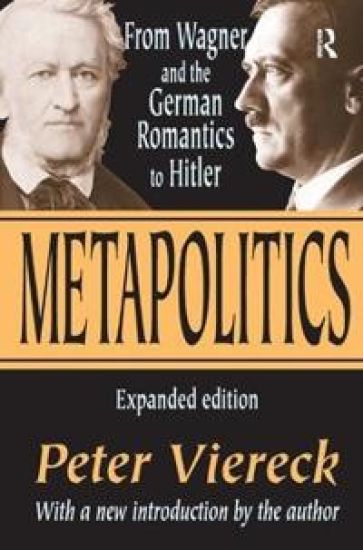
Metapolitics

Metapolitics

Peter Viereck

Routledge
2017
sidottu
More than half a century after the fall of the Third Reich, Nazism, its roots and its essential nature, remain a central and unresolved enigma of the twentieth century. During the period of Hitler's ascendancy, most attempts at explaining this unprecedented phenomenon were framed in "economic," often Marxist, sociological terms and concepts. Peter Viereck's Metapolitics, initially published in 1941, broke with this convention by indicting Hitler in terms of the Judaic-Christian ethical tradition and locating certain elements of the Nazi worldview in German romantic poetry, music, and social thought. Newly expanded, Metapolitics remains a key work in the cultural interpretation of Nazism and totalitarianism and in the psychological interpretation of Hitler as a Wagnerite and failed artist.The term "metapolitics," a coinage from Richard Wagner's nationalist circle, signifies an ideology resulting from five distinct strands: romanticism (embodied chiefly in the Wagnerian ethos), the pseudo-science of race, Fuehrer worship, vague economic socialism, and the alleged supernatural and unconscious force of the Volk collectivity. Together, those elements engendered an emphasis on irrationalism and hysteria and belief in a special German mission to direct the course of the world's history.Viereck analyzes nineteenth-century German thought's conflicting attitudes toward political procedures and social arrangements rooted in classical, rational, legalistic, and Christian traditions. This edition includes an appreciation by Thomas Mann and an exchange with Jacques Barzun debating Viereck's criticism of German romanticism. Viereck's essays on the case of Albert Speer, on Claus von Stauffenberg (the German officer who led the army conspiracy to assassinate Hitler), and on the poets Stefan George and Georg Heym appear here for the first time in book form.
Shopping Centers

Shopping Centers

Peter Viereck; James Hughes

AldineTransaction
2012
nidottu
Are there potentials in central city revitalization? What role will the federal government play in determining future retail locational choices? Shopping center development has never been more popular - or more hazardous than it is today. Retail distribution in the United States has greater efficiency than anywhere else in the world, a tribute to the adaptability and rationalization of systems which have characterized the field. The pressures of the future, however, require greater exertion if they are to be adequately met.The industry drive to the new "middle markets" may change the face of small city America - or it may lead to a blind alley. As central cities, aided by EDA (Economic Development Administration) and UDAG (Urban Development Action Grant), gird up for revitalization in the face of reduced real buying power, these issues take on increased vigor.A whole new legal fabric is evolving in the development of major commercial facilities. Does it mark the path of the future - or is it an ineffectual last gasp effort to reshape the basic overwhelming trend lines of American life? How do we get a grasp on these parameters? Whether city planner, economic or marketing consultant, investor, or developer - much of our future depends on the answers. The authorities brought together for these specially sponsored papers are the best in the business - and provide key insights into this dynamic field. Demographics and consumer response that challenge marketing and planning professionals are also included.
Inner Liberty: The Stubborn Grit in the Machine

Inner Liberty: The Stubborn Grit in the Machine

Peter Viereck

Literary Licensing, LLC
2012
sidottu
Inner Liberty: The Stubborn Grit In The Machine by Peter Viereck is a thought-provoking book that explores the concept of inner freedom and its importance in today's society. The book argues that true freedom is not just about political or economic rights, but also about the ability to think and act independently, to question authority, and to resist conformity. Drawing on the ideas of philosophers, poets, and political thinkers from different eras and cultures, Viereck offers a compelling vision of what it means to be truly free in the modern world. He also examines the challenges and obstacles that can prevent us from achieving inner liberty, such as social pressure, fear, and self-doubt. Through a series of insightful essays, Viereck encourages readers to cultivate the stubborn grit necessary to break free from these constraints and embrace their full potential as individuals. With its powerful message and engaging style, Inner Liberty is a must-read for anyone who values personal freedom and the pursuit of truth.Pendle Hill Pamphlet, No. 95.This scarce antiquarian book is a facsimile reprint of the old original and may contain some imperfections such as library marks and notations. Because we believe this work is culturally important, we have made it available as part of our commitment for protecting, preserving, and promoting the world's literature in affordable, high quality, modern editions, that are true to their original work.
Metapolitics: From the Romantics to Hitler

Metapolitics: From the Romantics to Hitler

Peter Viereck

Literary Licensing, LLC
2011
sidottu
Metapolitics: From The Romantics To Hitler is a book written by Peter Viereck. It is a comprehensive study of the political philosophy of the Romantic era and its impact on the rise of fascism in Europe, particularly in Germany under Adolf Hitler. The book explores the intellectual roots of fascism and its relationship to the Romantic movement, tracing the evolution of political thought from the early Romanticism of Friedrich Schlegel and Novalis to the later, more radical forms of nationalism and racism that emerged in the early 20th century. Viereck argues that fascism was not simply a reactionary movement, but rather a radical transformation of Romanticism that placed the nation and the state above the individual. He examines the works of key figures in the development of fascist ideology, such as Julius Evola, Oswald Spengler, and Carl Schmitt, and shows how their ideas were influenced by the Romantic tradition. The book also explores the role of literature and the arts in the development of fascist ideology, particularly the works of German writers such as Ernst J�����nger and Gottfried Benn. Viereck argues that these writers, along with other intellectuals and artists, played a crucial role in shaping the cultural and intellectual climate that made fascism possible.Overall, Metapolitics: From The Romantics To Hitler is a thought-provoking and insightful exploration of the intellectual roots of fascism and its relationship to Romanticism. It provides a detailed analysis of the key ideas and figures that shaped fascist ideology, and sheds light on the cultural and intellectual forces that contributed to its rise in Europe.This scarce antiquarian book is a facsimile reprint of the old original and may contain some imperfections such as library marks and notations. Because we believe this work is culturally important, we have made it available as part of our commitment for protecting, preserving, and promoting the world's literature in affordable, high quality, modern editions, that are true to their original work.
Conservatism: From John Adams to Churchill

Conservatism: From John Adams to Churchill

Peter Viereck; Louis L. Snyder

Literary Licensing, LLC
2011
sidottu
Conservatism: From John Adams To Churchill is a comprehensive book written by Peter Viereck that explores the evolution of conservative political thought from the founding of the United States to the mid-twentieth century. The book is divided into three parts, each covering a different period of time and examining the conservative ideas and figures that emerged during those periods.The first part of the book focuses on the early years of the United States and the conservative ideas of the founding fathers, particularly John Adams. Viereck argues that Adams' belief in the importance of tradition, religion, and limited government laid the foundation for conservative political thought in America.The second part of the book covers the nineteenth century and the rise of conservatism in Europe, particularly in the form of the conservative reaction to the French Revolution. Viereck examines the conservative ideas of figures such as Edmund Burke, Joseph de Maistre, and Friedrich Nietzsche, and their influence on conservative thought in the United States and Europe.The final part of the book focuses on the twentieth century and the conservative ideas of Winston Churchill. Viereck argues that Churchill's belief in the importance of individual freedom, democracy, and limited government helped to shape modern conservatism.Overall, Conservatism: From John Adams To Churchill is a thorough and insightful exploration of the history of conservative political thought, tracing its evolution from the earliest days of the United States to the mid-twentieth century. It is a must-read for anyone interested in the history of political thought and the development of conservative ideas.This scarce antiquarian book is a facsimile reprint of the old original and may contain some imperfections such as library marks and notations. Because we believe this work is culturally important, we have made it available as part of our commitment for protecting, preserving, and promoting the world's literature in affordable, high quality, modern editions, that are true to their original work.
Strict Wildness

Strict Wildness

Peter Viereck

Transaction Publishers
2008
sidottu
A reviewer once called Peter Viereck's thought "not common sense but inspired, electric common sense." This volume of Viereck's selected essays on poetry and on history, written between 1938 through 2004, exemplifies this quality. Its main theme is suggested in Viereck's coined phrase "strict wildness," which suggests a balance between restraint (which by itself is staid and rigid) and passion (which by itself is incoherent). Frost called free verse tennis without the net. Viereck calls dead mechanical form "net without the tennis." Strict wildness, then, is spontaneity of feeling within strict organic form.The book explores questions of modernism and poetic craft with respect to American poetry. It discusses the controversy over Ezra Pound's politics and its relation to his poetics, and the nearly forgotten poet Vachel Lindsay. Viereck offers more general views on poetics, including the fruitful tensions between form and content, and the impact of modern technology on poetic expression. This book also discusses history and politics, and contains essays on McCarthyism, the Cold War, political conformity of the Left and Right, and issues of historiography and culture that define Viereck's highly individual, often critical brand of conservatism. In treating representative trends and figures in conservative thought, Viereck insists on clear awareness of what exists to conserve, what ought to be conserved, and why it should be conserved. In their range and originality, the writings brought together in Strict Wildness constitute an ideal introduction to Peter Viereck's literary and political thought. It will be of interest to literary scholars, intellectual historians, and political scientists.
Shame and Glory of the Intellectuals

Shame and Glory of the Intellectuals

Peter Viereck

AldineTransaction
2006
nidottu
In this classic volume, written at the height of the Cold War, with a new preface of 2006, Peter Viereck, one of the foremost intellectual spokesmen of modern conservatism, examines the differing responses of American and European intellectuals to the twin threats of Nazism and Soviet communism. In so doing, he seeks to formulate a humanistic conservatism with which to counter the danger of totalitarian thought in the areas of politics, ethics, and art.The glory of the intellectuals was the firm moral stance they took against Nazism at a time when appeasement was the preferred path of many politicians; their shame lay in their failure to recognize the brutality of Stalinism to the extent of becoming apologists for or accomplices of its tyranny. In Viereck's view, this failure is rooted in an abandonment of humane values that he sees as a legacy of nineteenth-century romanticism and certain strands of modernist thought and aesthetics.Among his targets are literary obscurantism as personified by Ezra Pound, the academicization of literary culture, the rigidity of adversarial avant-gardism, and the failure of many writers and cultural institutions to conserve the very heritage their political freedom and security depend on. Viereck represents their attitude in a series of satirical dialogues with Gaylord Babbitt, son of Sinclair Lewis' embodiment of conservative philistinism. Babbitt Junior is as unreflective as his father, but the objects of his credulity are the received ideas of liberal progressivism and avant-garde mandarinism. Ultimately, Viereck's critique stands as a timely rebuke to the extremism of both left and right.
Conservative Thinkers

Conservative Thinkers

Peter Viereck

AldineTransaction
2005
nidottu
Across America today, conservatism is being hotly debated both across the political spectrum and within the conservative movement itself. Much of the public debate is without definition or historical context. This history of conservatism by renowned historian, social critic, and poet Peter Viereck aims to meet the need for a concise, balanced picture of conservative thought in all its different shadings and cultural contexts.The analytical portion of the book provides a succinct but thorough critical overview of conservatism's most representative figures. Viereck begins with chapters defining conservatism itself, its special technical terms, and its changing historical circumstances. The rest deals with its actual thinkers and statesmen. After each main conservative thesis, the anti-conservative rebuttal is summarized, and the reader is allowed to reach his own conclusions. Though the first stress is on conservative political philosophy (from John Adams to Churchill), key sections also stress non-political conservatism: in religion (Cardinal Newman) and in the primarily cultural protest against material progress (Coleridge, Dostoyevsky, Melville, Henry Adams).Every major point is concretely illustrated by an appended cross-reference to a primary source in the second half, a well-chosen anthology of key conservative documents. Criteria for inclusion are three, representativeness, depth of perception, importance of influence. The result is not uniformity but a gamut: from extreme intolerant reaction to an evolutionary moderate spirit. The former passes imperceptibly into authoritarianism; the latter, into liberalism.
Conservatism Revisited

Conservatism Revisited

Peter Viereck

Transaction Publishers
2004
nidottu
Peter Viereck, poet and historian, is one of the principle theoreticians of conservatism in modern American political thought. In this classic work, Viereck undertakes a penetrating and unorthodox analysis of that quintessential conservative, Prince Metternich, and offers evidence that cultural and political conservatism may perhaps be best adapted to sustain a free and reasonable society.According to Viereck's definition, conservatism is not the enemy of economic reform or social progress, nor is it the oppressive instrument of the privileged few. Although conservatism has been attacked from the left and often discredited by exploitation from the right, it remains the historic name for a point of view vital to contemporary society and culture. Divided into three parts, the book opens with a survey of conservatism in its cultural context of classicism and humanism. Rejecting the blind alley of reaction, Viereck calls for a discriminating set of principles that include preservation through reform, self-expression through self-restraint, a fruitful nostalgia for the permanent beneath the flux, and a preference for historical continuity over violent rupture.Viereck locates our idea of Western political unity in Metternich's Concert of Europe whose goal was a cosmopolitan Europe united in peace. This ideal was opposed by both the violent nationalism that resulted in Nazism and the socialist internationalism that became a tool of Soviet Russian expansionism. While not ignoring the extremely negative aspects of Metternich's legacy, Viereck focuses on his attempts to tame the bellicosity of European nationalism and his little-known efforts to reform and modernize the Hapsburg Empire.