
Kirjailija
Peter Weill
Kirjat ja teokset yhdessä paikassa: 9 kirjaa, julkaisuja vuosilta 1998-2025, suosituimpien joukossa Management by Maxim. Vertaile teosten hintoja ja tarkista saatavuus suomalaisista kirjakaupoista.
9 kirjaa
Kirjojen julkaisuhaarukka 1998-2025.
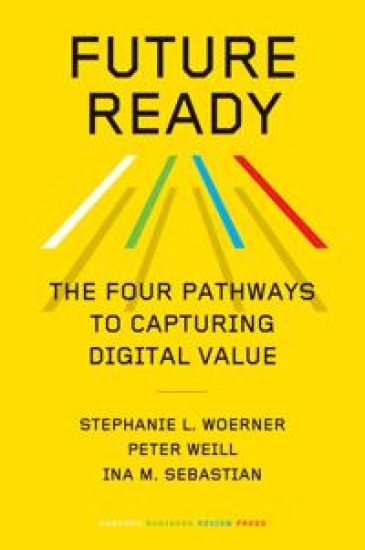
Future Ready
Stephanie L. Woerner; Peter Weill; Ina M. Sebastian
Harvard Business Review Press
2022
sidottu
To be a top performer in the digital economy—to become truly future ready—you need a playbook. Now you have one.It seems like almost every company you can think of—including your own—has embarked on a "digital transformation" journey. The problem is, many companies start down the road without a good sense of where they are going or a clear idea of how they will create and capture digital value. Not surprisingly, this leads to problems: failure to realize the value from digital in their bottom lines, wasted resources and effort, added complexity and dysfunction.This compact, no-nonsense book provides a solution. In their years of working with senior executives around the world, MIT research scientists Stephanie Woerner, Peter Weill, and Ina Sebastian noticed that these leaders knew they had to transform their businesses, but lacked a coherent framework and a common language—a playbook—to guide and motivate their employees and keep everyone focused on a common goal.Future Ready is that playbook. Based on years of rigorous research with data from more than a thousand companies—BBVA, CEMEX, DBS, Fidelity, Maersk, and many others—the book provides a powerful, field-tested "four pathways" framework that offers insights into the important dimensions at which a firm must excel in order to be competitive, as well as the organizational disruptions that every firm must manage as part of the transformation journey.The book includes instructive examples, sharp analyses, assessments to help companies benchmark themselves against top performers, and many illuminating visuals to help crystallize the data and ideas.Woerner, Weill, and Sebastian show that the goal isn't digital transformation but rather a profound business transformation. Future Ready is your essential guide for becoming a top performer in the digital economy.
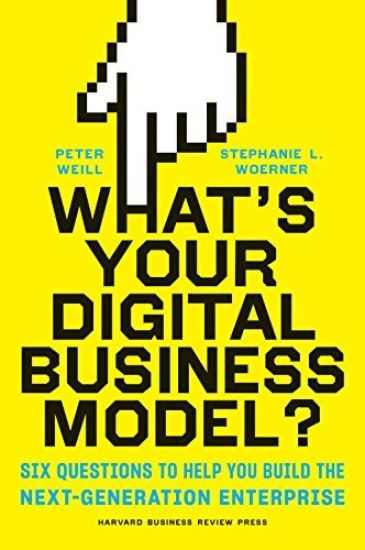
What's Your Digital Business Model?
Peter Weill; Stephanie Woerner
Harvard Business Review Press
2018
sidottu
Digital transformation is not about technology--it's about change.In the rapidly changing digital economy, you can't succeed by merely tweaking management practices that led to past success. And yet, while many leaders and managers recognize the threat from digital--and the potential opportunity--they lack a common language and compelling framework to help them assess it and guide them in responding. They don't know how to think about their digital business model.In this concise, practical book, MIT digital research leaders Peter Weill and Stephanie Woerner provide a powerful yet straightforward framework that has been field-tested globally with dozens of senior management teams. Based on years of study at the MIT Center for Information Systems Research (CISR), the authors find that digitization is moving companies' business models on two dimensions: from value chains to digital ecosystems, and from a fuzzy understanding of the needs of end customers to a sharper one. Looking at these dimensions in combination results in four distinct business models, each with different capabilities. The book then sets out six driving questions, in separate chapters, that help managers and executives clarify where they are currently in an increasingly digital business landscape and highlight what's needed to move toward a higher-value digital business model.Filled with straightforward self-assessments, motivating examples, and sharp financial analyses of where profits are made, this smart book will help you tackle the threats, leverage the opportunities, and create winning digital strategies.

Digitization of business interactions and processes is advancing full bore. But in many organizations, returns from IT investments are flatlining, even as technology spending has skyrocketed. These challenges call for new levels of IT savvy: the ability of all managers-IT or non-IT-to transform their company's technology assets into operational efficiencies that boost margins. Companies with IT-savvy managers are 20 percent more profitable than their competitors. In IT Savvy, Peter Weill and Jeanne Ross-two of the world's foremost authorities on using IT in business-explain how non-IT executives can acquire this savvy. Concise and practical, the book describes the practices, competencies, and leadership skills non-IT managers need to succeed in the digital economy. You'll discover how to: -Define your firm's operating model-how IT can help you do business -Revamp your IT funding model to support your operating model -Build a digitized platform of business processes, IT systems, and data to execute on the model -Determine IT decision rights -Extract more business value from your IT assets Packed with examples and based on research into eighteen hundred organizations in more than sixty countries, IT Savvy is required reading for non-IT managers seeking to push their company's performance to new heights.
Enterprise Architecture As Strategy
Jeanne W. Ross; Peter Weill; David Robertson
Harvard Business Review Press
2006
sidottu
Does it seem you've formulated a rock-solid strategy, yet your firm still can't get ahead? If so, construct a solid foundation for business execution--an IT infrastructure and digitized business processes to automate your company's core capabilities. In Enterprise Architecture as Strategy: Creating a Foundation for Business Execution, authors Jeanne W. Ross, Peter Weill, and David C. Robertson show you how. The key? Make tough decisions about which processes you must execute well, then implement the IT systems needed to digitize those processes. Citing numerous companies worldwide, the authors show how constructing the right enterprise architecture enhances profitability and time to market, improves strategy execution, and even lowers IT costs. Though clear, engaging explanation, they demonstrate how to define your operating model--your vision of how your firm will survive and grow--and implement it through your enterprise architecture. Their counterintuitive but vital message: when it comes to executing your strategy, your enterprise architecture may matter far more than your strategy itself.
Firms with superior IT governance have more than 25% higher profits than firms with poor governance given the same strategic objectives. These top performers have custom designed IT governance for their strategies. Just as corporate governance aims to ensure quality decisions about all corporate assets, IT governance links IT decisions with company objectives and monitors performance and accountability. Based on a study of 250 enterprises worldwide, IT Governance shows how to design and implement a system of decision rights that will transform IT from an expense to a profitable investment.

Place to Space is the essential e-business playbook that will give leaders the insight and confidence they need to operate successfully in both place and space. The book explains how traditional companies can adapt their bricks-and-mortar legacies to complement and bolster their online ventures. Based on extensive research into dozens of e-business initiatives, this book provides the first systematic, practical analysis of eight viable e-business models; an adaptable hybrid model for competing against online pure plays; and revolutionary schematic tools for analyzing current business models and evaluating promising new web initiatives. Through illuminating case studies of Lonely Planet, General Electric, CDNow, Reuters, and others, the authors show how each model works in practice--from how it makes money to the core competencies and critical factors required to implement it.
Leveraging the New Infrastructure
Peter Weill; Marianne Broadbent
Harvard Business Review Press
1998
sidottu
Imagine thinking about your company's information technology in the same way that you think about its investment portfolio: as a bundle of assets that--when managed right--will generate revenues and savings. Here's just such a framework for leveraging IT (technology, networks, data, and software)--one that enables business managers to make the important decisions about the potentially confounding mix of high-technology that influences near- and long-term planning, affects the ability to support customers, and dictates the flow of daily operations. Drawing upon their rigorous research with more than 100 top multinationals, the authors present a rich and varied range of examples of IT investment strategies that have reaped rewards for firms such as Citibank, Honda, Johnson & Johnson, Ralston Purina, the Development Bank of Singapore, and Telstra. This hands-on resource, compete with benchmarks and case studies, creates the common ground where both management and IT can meet, communicate their goals, and agree on the best plan for getting there.