Kirjojen hintavertailu. Mukana 12 390 323 kirjaa ja 12 kauppaa.

Kirjailija

Petre P. Teodorescu

Kirjat ja teokset yhdessä paikassa: 12 kirjaa, julkaisuja vuosilta 2004-2015, suosituimpien joukossa Mechanical Systems, Classical Models. Vertaile teosten hintoja ja tarkista saatavuus suomalaisista kirjakaupoista.

12 kirjaa

Kirjojen julkaisuhaarukka 2004-2015.

Treatise on Classical Elasticity

Treatise on Classical Elasticity

Petre P. Teodorescu

Springer
2015
nidottu
Deformable solids have a particularly complex character; mathematical modeling is not always simple and often leads to inextricable difficulties of computation. One of the simplest mathematical models and, at the same time, the most used model, is that of the elastic body – especially the linear one. But, notwithstanding its simplicity, even this model of a real body may lead to great difficulties of computation.The practical importance of a work about the theory of elasticity, which is also an introduction to the mechanics of deformable solids, consists of the use of scientific methods of computation in a domain in which simplified methods are still used.This treatise takes into account the consideration made above, with special attention to the theoretical study of the state of strain and stress of a deformable solid. The book draws on the known specialized literature, as well as the original results of the author and his 50+ years experience as Professor of Mechanics and Elasticity at the University of Bucharest. The construction of mathematical models is made by treating geometry and kinematics of deformation, mechanics of stresses and constitutive laws. Elastic, plastic and viscous properties are thus put in evidence and the corresponding theories are developed. Space problems are treated and various particular cases are taken into consideration. New solutions for boundary value problems of finite and infinite domains are given and a general theory of concentrated loads is built. Anisotropic and non-homogeneous bodies are studied as well. Cosserat type bodies are also modeled. The connection with thermal and viscous phenomena will be considered too.Audience: researchers in applied mathematics, mechanical and civil engineering.
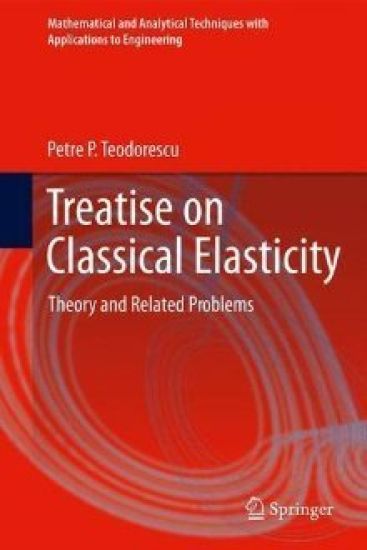
Treatise on Classical Elasticity

Treatise on Classical Elasticity

Petre P. Teodorescu

Springer
2013
sidottu
Deformable solids have a particularly complex character; mathematical modeling is not always simple and often leads to inextricable difficulties of computation. One of the simplest mathematical models and, at the same time, the most used model, is that of the elastic body – especially the linear one. But, notwithstanding its simplicity, even this model of a real body may lead to great difficulties of computation.The practical importance of a work about the theory of elasticity, which is also an introduction to the mechanics of deformable solids, consists of the use of scientific methods of computation in a domain in which simplified methods are still used.This treatise takes into account the consideration made above, with special attention to the theoretical study of the state of strain and stress of a deformable solid. The book draws on the known specialized literature, as well as the original results of the author and his 50+ years experience as Professor of Mechanics and Elasticity at the University of Bucharest. The construction of mathematical models is made by treating geometry and kinematics of deformation, mechanics of stresses and constitutive laws. Elastic, plastic and viscous properties are thus put in evidence and the corresponding theories are developed. Space problems are treated and various particular cases are taken into consideration. New solutions for boundary value problems of finite and infinite domains are given and a general theory of concentrated loads is built. Anisotropic and non-homogeneous bodies are studied as well. Cosserat type bodies are also modeled. The connection with thermal and viscous phenomena will be considered too.Audience: researchers in applied mathematics, mechanical and civil engineering.
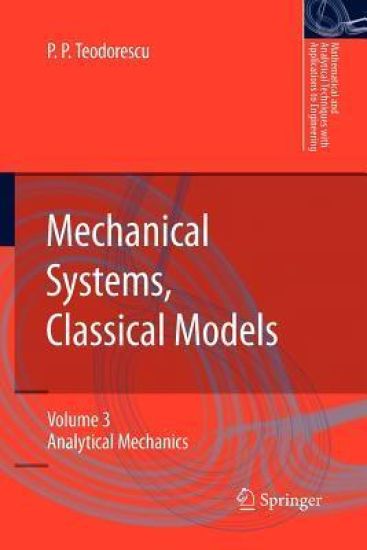
Mechanical Systems, Classical Models

Mechanical Systems, Classical Models

Petre P. Teodorescu

Springer
2012
nidottu
All phenomena in nature are characterized by motion. Mechanics deals with the objective laws of mechanical motion of bodies, the simplest form of motion. In the study of a science of nature, mathematics plays an important rôle. Mechanics is the first science of nature which has been expressed in terms of mathematics, by considering various mathematical models, associated to phenomena of the surrounding nature. Thus, its development was influenced by the use of a strong mathematical tool. As it was already seen in the first two volumes of the present book, its guideline is precisely the mathematical model of mechanics. The classical models which we refer to are in fact models based on the Newtonian model of mechanics, that is on its five principles, i.e.: the inertia, the forces action, the action and reaction, the independence of the forces action and the initial conditions principle, respectively. Other models, e.g., the model of attraction forces between the particles of a discrete mechanical system, are part of the considered Newtonian model. Kepler’s laws brilliantly verify this model in case of velocities much smaller then the light velocity in vacuum.
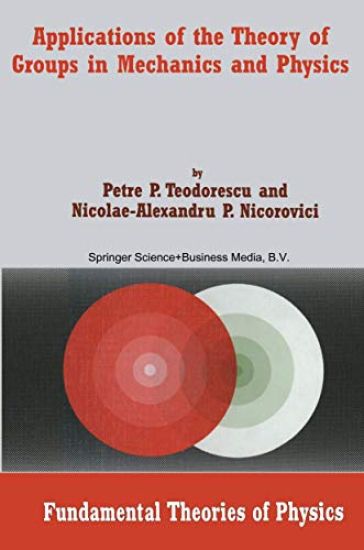
Applications of the Theory of Groups in Mechanics and Physics

Applications of the Theory of Groups in Mechanics and Physics

Petre P. Teodorescu; Nicolae A.P. Nicorovici

Springer
2010
nidottu
The notion of group is fundamental in our days, not only in mathematics, but also in classical mechanics, electromagnetism, theory of relativity, quantum mechanics, theory of elementary particles, etc. This notion has developed during a century and this development is connected with the names of great mathematicians as E. Galois, A. L. Cauchy, C. F. Gauss, W. R. Hamilton, C. Jordan, S. Lie, E. Cartan, H. Weyl, E. Wigner, and of many others. In mathematics, as in other sciences, the simple and fertile ideas make their way with difficulty and slowly; however, this long history would have been of a minor interest, had the notion of group remained connected only with rather restricted domains of mathematics, those in which it occurred at the beginning. But at present, groups have invaded almost all mathematical disciplines, mechanics, the largest part of physics, of chemistry, etc. We may say, without exaggeration, that this is the most important idea that occurred in mathematics since the invention of infinitesimal calculus; indeed, the notion of group expresses, in a precise and operational form, the vague and universal ideas of regularity and symmetry. The notion of group led to a profound understanding of the character of the laws which govern natural phenomena, permitting to formulate new laws, correcting certain inadequate formulations and providing unitary and non­ contradictory formulations for the investigated phenomena.
Mechanical Systems, Classical Models

Mechanical Systems, Classical Models

Petre P. Teodorescu

Springer
2010
nidottu
In the study of a science of nature mathematics plays an important role. Mechanics is the first science of nature which was expressed in terms of mathematics by considering various mathematical models, associated to phenomena of the surrounding nature. Thus, its development was influenced by the use of a strong mathematical tool; on the other hand, we must observe that mechanics also influenced the introduction and the development of many mathematical notions. In this respect, the guideline of the present book is precisely the mathematical model of mechanics. A special accent is put on the solving methodology as well as on the mathematical tools used; vectors, tensors and notions of field theory. Continuous and discontinuous phenomena, various mechanical magnitudes are presented in a unitary form by means of the theory of distributions. Some appendices give the book an autonomy with respect to other works, special previous mathematical knowledge being not necessary. Some applications connected to important phenomena of nature are presented, and this also gives one the possibility to solve problems of interest from the technical, engineering point of view.
Ordinary Differential Equations with Applications to Mechanics

Ordinary Differential Equations with Applications to Mechanics

Mircea Soare; Petre P. Teodorescu; Ileana Toma

Springer
2010
nidottu
The present book has its source in the authors’ wish to create a bridge between mathematics and the technical disciplines that need a good knowledge of a strong mathematical tool. The authors tried to reflect a common experience of the University of Bucharest, Faculty of Mathematics and of the Technical University of Civil Engineering of Bucharest. The necessity of such an interdisciplinary work drove the authors to publish a first book with this aim (“Ecua ?ii diferen ?iale cu aplica ?ii în mecanica construc ?iilor” – Ordinary differential equations with applications to the mechanics of constructions, Editura Tehnic?, Bucharest, Romania). The present book is a new edition of the volume published in 1999. Unfortunately, the first author (M.V. Soare) passed away shortly before the publication of the Romanian edition, so that the present work is only due to the other two authors. It contains many improvements concerning the theoretical (mathematical) information, as well as new topics, using enlarged and updated references. We considered only ordinary differential equations and their solutions in an analytical frame, leaving aside their numerical approach. Compared to the Romanian edition, this volume presents the applications in a new way.
Mechanical Systems, Classical Models

Mechanical Systems, Classical Models

Petre P. Teodorescu

Springer
2010
nidottu
As it was already seen in the first volume of the present book, its guideline is precisely the mathematical model of mechanics. The classical models which we refer to are in fact models based on the Newtonian model of mechanics, on its five principles, i. e. : the inertia, the forces action, the action and reaction, the parallelogram and the initial conditions principle, respectively. Other models, e. g. , the model of attraction forces between the particles of a discrete mechanical system, are part of the considered Newtonian model. Kepler’s laws brilliantly verify this model in case of velocities much smaller than the light velocity in vacuum. The non-classical models are relativistic and quantic. Mechanics has as object of study mechanical systems. The first volume of this book dealt with particle dynamics. The present one deals with discrete mechanical systems for particles in a number greater than the unity, as well as with continuous mechanical systems. We put in evidence the difference between these models, as well as the specificity of the corresponding studies; the generality of the proofs and of the corresponding computations yields a common form of the obtained mechanical results for both discrete and continuous systems. We mention the thoroughness by which the dynamics of the rigid solid with a fixed point has been presented. The discrete or continuous mechanical systems can be non-deformable (e. g.
Mechanical Systems, Classical Models

Mechanical Systems, Classical Models

Petre P. Teodorescu

Springer
2009
sidottu
All phenomena in nature are characterized by motion. Mechanics deals with the objective laws of mechanical motion of bodies, the simplest form of motion. In the study of a science of nature, mathematics plays an important rôle. Mechanics is the first science of nature which has been expressed in terms of mathematics, by considering various mathematical models, associated to phenomena of the surrounding nature. Thus, its development was influenced by the use of a strong mathematical tool. As it was already seen in the first two volumes of the present book, its guideline is precisely the mathematical model of mechanics. The classical models which we refer to are in fact models based on the Newtonian model of mechanics, that is on its five principles, i.e.: the inertia, the forces action, the action and reaction, the independence of the forces action and the initial conditions principle, respectively. Other models, e.g., the model of attraction forces between the particles of a discrete mechanical system, are part of the considered Newtonian model. Kepler’s laws brilliantly verify this model in case of velocities much smaller then the light velocity in vacuum.
Mechanical Systems, Classical Models

Mechanical Systems, Classical Models

Petre P. Teodorescu

Springer-Verlag New York Inc.
2008
sidottu
As it was already seen in the first volume of the present book, its guideline is precisely the mathematical model of mechanics. The classical models which we refer to are in fact models based on the Newtonian model of mechanics, on its five principles, i. e. : the inertia, the forces action, the action and reaction, the parallelogram and the initial conditions principle, respectively. Other models, e. g. , the model of attraction forces between the particles of a discrete mechanical system, are part of the considered Newtonian model. Kepler’s laws brilliantly verify this model in case of velocities much smaller than the light velocity in vacuum. The non-classical models are relativistic and quantic. Mechanics has as object of study mechanical systems. The first volume of this book dealt with particle dynamics. The present one deals with discrete mechanical systems for particles in a number greater than the unity, as well as with continuous mechanical systems. We put in evidence the difference between these models, as well as the specificity of the corresponding studies; the generality of the proofs and of the corresponding computations yields a common form of the obtained mechanical results for both discrete and continuous systems. We mention the thoroughness by which the dynamics of the rigid solid with a fixed point has been presented. The discrete or continuous mechanical systems can be non-deformable (e. g.
Mechanical Systems, Classical Models

Mechanical Systems, Classical Models

Petre P. Teodorescu

Springer-Verlag New York Inc.
2006
sidottu
In the study of a science of nature mathematics plays an important role. Mechanics is the first science of nature which was expressed in terms of mathematics by considering various mathematical models, associated to phenomena of the surrounding nature. Thus, its development was influenced by the use of a strong mathematical tool; on the other hand, we must observe that mechanics also influenced the introduction and the development of many mathematical notions. In this respect, the guideline of the present book is precisely the mathematical model of mechanics. A special accent is put on the solving methodology as well as on the mathematical tools used; vectors, tensors and notions of field theory. Continuous and discontinuous phenomena, various mechanical magnitudes are presented in a unitary form by means of the theory of distributions. Some appendices give the book an autonomy with respect to other works, special previous mathematical knowledge being not necessary. Some applications connected to important phenomena of nature are presented, and this also gives one the possibility to solve problems of interest from the technical, engineering point of view.
Ordinary Differential Equations with Applications to Mechanics

Ordinary Differential Equations with Applications to Mechanics

Mircea Soare; Petre P. Teodorescu; Ileana Toma

Springer-Verlag New York Inc.
2006
sidottu
The present book has its source in the authors’ wish to create a bridge between mathematics and the technical disciplines that need a good knowledge of a strong mathematical tool. The authors tried to reflect a common experience of the University of Bucharest, Faculty of Mathematics and of the Technical University of Civil Engineering of Bucharest. The necessity of such an interdisciplinary work drove the authors to publish a first book with this aim (“Ecua ?ii diferen ?iale cu aplica ?ii în mecanica construc ?iilor” – Ordinary differential equations with applications to the mechanics of constructions, Editura Tehnic?, Bucharest, Romania). The present book is a new edition of the volume published in 1999. Unfortunately, the first author (M.V. Soare) passed away shortly before the publication of the Romanian edition, so that the present work is only due to the other two authors. It contains many improvements concerning the theoretical (mathematical) information, as well as new topics, using enlarged and updated references. We considered only ordinary differential equations and their solutions in an analytical frame, leaving aside their numerical approach. Compared to the Romanian edition, this volume presents the applications in a new way.
Applications of the Theory of Groups in Mechanics and Physics

Applications of the Theory of Groups in Mechanics and Physics

Petre P. Teodorescu; Nicolae-A.P. Nicorovici

Springer-Verlag New York Inc.
2004
sidottu
The notion of group is fundamental in our days, not only in mathematics, but also in classical mechanics, electromagnetism, theory of relativity, quantum mechanics, theory of elementary particles, etc. This notion has developed during a century and this development is connected with the names of great mathematicians as E. Galois, A. L. Cauchy, C. F. Gauss, W. R. Hamilton, C. Jordan, S. Lie, E. Cartan, H. Weyl, E. Wigner, and of many others. In mathematics, as in other sciences, the simple and fertile ideas make their way with difficulty and slowly; however, this long history would have been of a minor interest, had the notion of group remained connected only with rather restricted domains of mathematics, those in which it occurred at the beginning. But at present, groups have invaded almost all mathematical disciplines, mechanics, the largest part of physics, of chemistry, etc. We may say, without exaggeration, that this is the most important idea that occurred in mathematics since the invention of infinitesimal calculus; indeed, the notion of group expresses, in a precise and operational form, the vague and universal ideas of regularity and symmetry. The notion of group led to a profound understanding of the character of the laws which govern natural phenomena, permitting to formulate new laws, correcting certain inadequate formulations and providing unitary and non­ contradictory formulations for the investigated phenomena.