Kirjojen hintavertailu. Mukana 12 478 719 kirjaa ja 12 kauppaa.

Kirjailija

Petru Eles

Kirjat ja teokset yhdessä paikassa: 9 kirjaa, julkaisuja vuosilta 1997-2014, suosituimpien joukossa System Synthesis with VHDL. Vertaile teosten hintoja ja tarkista saatavuus suomalaisista kirjakaupoista.

9 kirjaa

Kirjojen julkaisuhaarukka 1997-2014.

System Synthesis with VHDL

System Synthesis with VHDL

Petru Eles; Krzysztof Kuchcinski; Zebo Peng

Springer
1997
sidottu
Embedded systems are usually composed of several interacting components such as custom or application specific processors, ASICs, memory blocks, and the associated communication infrastructure. The development of tools to support the design of such systems requires a further step from high-level synthesis towards a higher abstraction level. The lack of design tools accepting a system-level specification of a complete system, which may include both hardware and software components, is one of the major bottlenecks in the design of embedded systems. Thus, more and more research efforts have been spent on issues related to system-level synthesis. This book addresses the two most active research areas of design automation today: high-level synthesis and system-level synthesis. In particular, a transformational approach to synthesis from VHDL specifications is described. System Synthesis with VHDL provides a coherent view of system synthesis which includes the high-level and the system-level synthesis tasks. VHDL is used as a specification language and several issues concerning the use of VHDL for high-level and system-level synthesis are discussed. These include aspects from the compilation of VHDL into an internal design representation to the synthesis of systems specified as interacting VHDL processes. The book emphasizes the use of a transformational approach to system synthesis. A Petri net based design representation is rigorously defined and used throughout the book as a basic vehicle for illustration of transformations and other design concepts. Iterative improvement heuristics, such as tabu search, simulated annealing and genetic algorithms, are discussed and illustrated as strategies which are used to guide the optimization process in a transformation-based design environment. Advanced topics, including hardware/software partitioning, test synthesis and low power synthesis are discussed from the perspective of a transformational approach to system synthesis. System Synthesis with VHDL can be used for advanced undergraduate or graduate courses in the area of design automation and, more specifically, of high-level and system-level synthesis. At the same time the book is intended for CAD developers and researchers as well as industrial designers of digital systems who are interested in new algorithms and techniques supporting modern design tools and methodologies.
Real-Time Applications with Stochastic Task Execution Times

Real-Time Applications with Stochastic Task Execution Times

Sorin Manolache; Petru Eles; Zebo Peng

Springer
2014
nidottu
Real-Time Applications with Stochastic Task Execution Times presents three approaches to the analysis of the deadline miss ratio of applications with stochastic task execution times. Each of the three approaches fits best to a different context. The first approach is an exact one and is efficiently applicable to monoprocessor systems. The second approach is an approximate one, which allows for designer-controlled trade-off between analysis accuracy and analysis speed. It is efficiently applicable to multiprocessor systems. The third approach is less accurate but sufficiently fast in order to be placed inside optimisation loops. Based on the last approach, we propose a heuristic for task mapping and priority assignment for deadline miss ratio minimisation.
Time-Predictable Embedded Software on Multi-Core Platforms

Time-Predictable Embedded Software on Multi-Core Platforms

Sudipta Chattopadhyay; Abhik Roychoudhury; Jakob Rosén; Petru Eles; Zebo Peng

now publishers Inc
2014
nidottu
Multi-core architectures have recently gained in popularity due to their high-performance and low-power characteristics. Most modern desktop systems are now equipped with multi-core processors. Despite the wide-spread adaptation of multi-core processors in desktop systems, using such processors in embedded systems still poses several challenges. Real-time, embedded systems often need to satisfy several extra-functional constraints, such as timing. In particular, for hard real-time systems, such timing constraints are strictly enforced. Violation of these timing constraints may have serious consequences, potentially costing human lives. Therefore, static timing-analysis of hard real-time systems has emerged as a critical problem to solve.This monograph first discusses the challenges imposed by multi-core architectures in designing time-predictable embedded systems. It goes on to describe, in detail, a comprehensive solution to guarantee time-predictable execution on multi-core platforms. It also discusses various techniques and surveys the state-of-the-art in terms of available solutions. Throughout the text, the aim is to provide a solid background on recent trends in research towards achieving time-predictability on multi-cores.It also highlights the limitations of the state-of-the-art and discusses future research opportunities and challenges to accomplish time-predictable execution on multi-core platforms. The monograph is an ideal reference for embedded systems designers and researchers interested in having a foundation for building time-predictable software on multi-core platforms. It will also help the research community to address the existing challenges in this area.
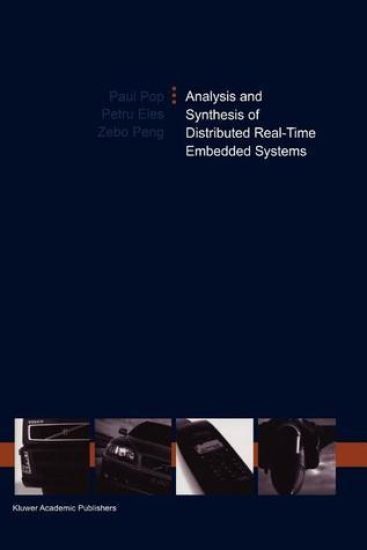
Analysis and Synthesis of Distributed Real-Time Embedded Systems

Analysis and Synthesis of Distributed Real-Time Embedded Systems

Paul Pop; Petru Eles; Zebo Peng

Springer-Verlag New York Inc.
2011
nidottu
Embedded computer systems are now everywhere: from alarm clocks to PDAs, from mobile phones to cars, almost all the devices we use are controlled by embedded computers. An important class of embedded computer systems is that of hard real-time systems, which have to fulfill strict timing requirements. As real-time systems become more complex, they are often implemented using distributed heterogeneous architectures. Analysis and Synthesis of Distributed Real-Time Embedded Systems addresses the design of real-time applications implemented using distributed heterogeneous architectures. The systems are heterogeneous not only in terms of hardware components, but also in terms of communication protocols and scheduling policies. Regarding this last aspect, time-driven and event-driven systems, as well as a combination of the two, are considered. Such systems are used in many application areas like automotive electronics, real-time multimedia, avionics, medical equipment, and factory systems. The proposed analysis and synthesis techniques derive optimized implementations that fulfill the imposed design constraints. An important part of the implementation process is the synthesis of the communication infrastructure, which has a significant impact on the overall system performance and cost. Analysis and Synthesis of Distributed Real-Time Embedded Systems considers the mapping and scheduling tasks within an incremental design process. To reduce the time-to-market of products, the design of real-time systems seldom starts from scratch. Typically, designers start from an already existing system, running certain applications, and the design problem is to implement new functionality on top of this system. Supporting such an incremental design process provides a high degree of flexibility, and can result in important reductions of design costs. Analysis and Synthesis of Distributed Real-Time Embedded Systems will be of interest to advanced undergraduates, graduate students, researchers and designers involved in the field of embedded systems.
System Synthesis with VHDL

System Synthesis with VHDL

Petru Eles; Krzysztof Kuchcinski; Zebo Peng

Springer-Verlag New York Inc.
2010
nidottu
Embedded systems are usually composed of several interacting components such as custom or application specific processors, ASICs, memory blocks, and the associated communication infrastructure. The development of tools to support the design of such systems requires a further step from high-level synthesis towards a higher abstraction level. The lack of design tools accepting a system-level specification of a complete system, which may include both hardware and software components, is one of the major bottlenecks in the design of embedded systems. Thus, more and more research efforts have been spent on issues related to system-level synthesis. This book addresses the two most active research areas of design automation today: high-level synthesis and system-level synthesis. In particular, a transformational approach to synthesis from VHDL specifications is described. System Synthesis with VHDL provides a coherent view of system synthesis which includes the high-level and the system-level synthesis tasks. VHDL is used as a specification language and several issues concerning the use of VHDL for high-level and system-level synthesis are discussed. These include aspects from the compilation of VHDL into an internal design representation to the synthesis of systems specified as interacting VHDL processes. The book emphasizes the use of a transformational approach to system synthesis. A Petri net based design representation is rigorously defined and used throughout the book as a basic vehicle for illustration of transformations and other design concepts. Iterative improvement heuristics, such as tabu search, simulated annealing and genetic algorithms, are discussed and illustrated as strategies which are used to guide the optimization process in a transformation-based design environment. Advanced topics, including hardware/software partitioning, test synthesis and low power synthesis are discussed from the perspective of a transformational approach to system synthesis. System Synthesis with VHDL can be used for advanced undergraduate or graduate courses in the area of design automation and, more specifically, of high-level and system-level synthesis. At the same time the book is intended for CAD developers and researchers as well as industrial designers of digital systems who are interested in new algorithms and techniques supporting modern design tools and methodologies.
System-Level Design Techniques for Energy-Efficient Embedded Systems

System-Level Design Techniques for Energy-Efficient Embedded Systems

Marcus T. Schmitz; Bashir M. Al-Hashimi; Petru Eles

Springer-Verlag New York Inc.
2010
nidottu
System-Level Design Techniques for Energy-Efficient Embedded Systems addresses the development and validation of co-synthesis techniques that allow an effective design of embedded systems with low energy dissipation. The book provides an overview of a system-level co-design flow, illustrating through examples how system performance is influenced at various steps of the flow including allocation, mapping, and scheduling. The book places special emphasis upon system-level co-synthesis techniques for architectures that contain voltage scalable processors, which can dynamically trade off between computational performance and power consumption. Throughout the book, the introduced co-synthesis techniques, which target both single-mode systems and emerging multi-mode applications, are applied to numerous benchmarks and real-life examples including a realistic smart phone.
Real-Time Applications with Stochastic Task Execution Times

Real-Time Applications with Stochastic Task Execution Times

Sorin Manolache; Petru Eles; Zebo Peng

Springer-Verlag New York Inc.
2007
sidottu
Real-Time Applications with Stochastic Task Execution Times presents three approaches to the analysis of the deadline miss ratio of applications with stochastic task execution times. Each of the three approaches fits best to a different context. The first approach is an exact one and is efficiently applicable to monoprocessor systems. The second approach is an approximate one, which allows for designer-controlled trade-off between analysis accuracy and analysis speed. It is efficiently applicable to multiprocessor systems. The third approach is less accurate but sufficiently fast in order to be placed inside optimisation loops. Based on the last approach, we propose a heuristic for task mapping and priority assignment for deadline miss ratio minimisation.
Analysis and Synthesis of Distributed Real-Time Embedded Systems

Analysis and Synthesis of Distributed Real-Time Embedded Systems

Paul Pop; Petru Eles; Zebo Peng

Springer-Verlag New York Inc.
2004
sidottu
Embedded computer systems are now everywhere: from alarm clocks to PDAs, from mobile phones to cars, almost all the devices we use are controlled by embedded computers. An important class of embedded computer systems is that of hard real-time systems, which have to fulfill strict timing requirements. As real-time systems become more complex, they are often implemented using distributed heterogeneous architectures. Analysis and Synthesis of Distributed Real-Time Embedded Systems addresses the design of real-time applications implemented using distributed heterogeneous architectures. The systems are heterogeneous not only in terms of hardware components, but also in terms of communication protocols and scheduling policies. Regarding this last aspect, time-driven and event-driven systems, as well as a combination of the two, are considered. Such systems are used in many application areas like automotive electronics, real-time multimedia, avionics, medical equipment, and factory systems. The proposed analysis and synthesis techniques derive optimized implementations that fulfill the imposed design constraints. An important part of the implementation process is the synthesis of the communication infrastructure, which has a significant impact on the overall system performance and cost. Analysis and Synthesis of Distributed Real-Time Embedded Systems considers the mapping and scheduling tasks within an incremental design process. To reduce the time-to-market of products, the design of real-time systems seldom starts from scratch. Typically, designers start from an already existing system, running certain applications, and the design problem is to implement new functionality on top of this system. Supporting such an incremental design process provides a high degree of flexibility, and can result in important reductions of design costs. Analysis and Synthesis of Distributed Real-Time Embedded Systems will be of interest to advanced undergraduates, graduate students, researchers and designers involved in the field of embedded systems.
System-Level Design Techniques for Energy-Efficient Embedded Systems

System-Level Design Techniques for Energy-Efficient Embedded Systems

Marcus T. Schmitz; Bashir M. Al-Hashimi; Petru Eles

Springer-Verlag New York Inc.
2003
sidottu
System-Level Design Techniques for Energy-Efficient Embedded Systems addresses the development and validation of co-synthesis techniques that allow an effective design of embedded systems with low energy dissipation. The book provides an overview of a system-level co-design flow, illustrating through examples how system performance is influenced at various steps of the flow including allocation, mapping, and scheduling. The book places special emphasis upon system-level co-synthesis techniques for architectures that contain voltage scalable processors, which can dynamically trade off between computational performance and power consumption. Throughout the book, the introduced co-synthesis techniques, which target both single-mode systems and emerging multi-mode applications, are applied to numerous benchmarks and real-life examples including a realistic smart phone.