Kirjojen hintavertailu. Mukana 12 595 353 kirjaa ja 12 kauppaa.

Kirjailija

Phil Bagge

Kirjat ja teokset yhdessä paikassa: 14 kirjaa, julkaisuja vuosilta 2014-2023, suosituimpien joukossa Teaching Primary Programming with Scratch Pupil Book Year 4. Vertaile teosten hintoja ja tarkista saatavuus suomalaisista kirjakaupoista.

14 kirjaa

Kirjojen julkaisuhaarukka 2014-2023.

Code-It: Affordable STEM Computing Projects for the Primary Classroom
At last, the long-awaited guide to primary programming is here!An accessible and highly anticipated handbook to primary codingSimilar to Phil Bagge's How to Teach Primary Programming using Scratch, Code It Crumble Creations aims to help primary teachers deliver high-quality computing lessons using the Crumble microcontroller. It is indispensable for schools, advising how they can resource, integrate and use the very affordable Crumble control board to provide elements of computing science through programming and design and technology. Aimed at those with little or no coding experience, this book offers an invaluable and accessible resource to schools and educators, including home schooling parents! Perfect for primary school computing lessons, home schooling and coding clubs, this book will be sure to enrich other curriculum areas while providing imaginative and flexible lesson ideas and techniques.The scheme is designed for pupils between the ages of 5 and 11 and may also be useful for older pupils with special educational needs. The new computing curriculum is truly transformational and requires the right support for teachers. Code it Crumbles Creation is here to provide that support - get your copy today!
Code-It: How To Teach Primary Programming Using Scratch

Code-It: How To Teach Primary Programming Using Scratch

Phil Bagge

The University of Buckingham Press
2015
nidottu
The Scratch: The ideal place to begin programming!Key Stage 2 Programming Curriculum GuideMost primary teachers and pupils have little - if any - experience programming. This book, classroom-tested and perfected by the author through his website code-it.co.uk, aids teachers in providing Key Stage 2 pupils with an exciting and challenging computer science curriculum.Code It can be used to supplement existing programming modules or as a complete KS2 computer science program of study. It contains a series of programming projects that gradually introduce pupils to algorithm design and evaluation, generalisation and decomposition. Pupils will learn how to use sequence, repetition, selection and variables through becoming creators of a wide variety of programming projects. Maths, literacy, humanities, gaming, music and control skills are all put to the test.There are four pupil workbooks to provide structure, resources and home learning links. These are designed to work in conjunction with the teacher book. A growing bank of online videos are also available, designed to help teachers improve their own skills and take full advantage of the cross-curricular benefits of developing depth in programming.The Scratch programming language, already widely recognised in schools, is freely accessible online or as a download at home. Scratch is the ideal place to begin programming as there is no other system that allows pupils to create such a wide variety of projects across primary and secondary education. It also enables pupils to extend their understanding independently through the Scratch online community - the new computing curriculum is truly transformational!
Code-It Workbook 3: Algorithm to Code Using Scratch

Code-It Workbook 3: Algorithm to Code Using Scratch

Phil Bagge

The University of Buckingham Press
2015
nidottu
Code IT Primary Programming SeriesBasic computer coding is now among the most important skills a child can have for their future. There are many programming languages designed specifically for children to begin their studies, but the Scratch programming language, already recognised in schools around the world, is widely considered as the ideal place to begin programming in early education. The highly successful Code-It series is a comprehensive guide to teaching Scratch to children in a classroom setting. It is designed for the UK-based KS2 curriculum but can easily be used to supplement other programming courses for children between the ages of 7 and 11. There are four pupil workbooks designed to work in conjunction with the Code-It teacher handbook. They provide structure and resources for the children, including optional homework activities to extend to learning outside the classroom. Workbook 3 explains how to think, program and debug exciting programming projects such as Counting Machine, Music Abstraction, Random Word, Coin Sorter, Crab Maze, Toilet Fan, Car Park Barrier and Angle Menu. It also explains how to use analytical computational thinking skills for algorithm design, algorithm evaluation, decomposition, generalisation and abstraction; extend resilience and problem solving through the computational doing skills of converting algorithm into code and debugging; expand pupils' knowledge of sequence, repetition, selection and variable use; introduce the basic use of a list; and program Lego models using Lego Wedo and Scratch.
Code-It Workbook 2: Choices In Programming Using Scratch

Code-It Workbook 2: Choices In Programming Using Scratch

Phil Bagge

The University of Buckingham Press
2015
nidottu
Code IT Primary Programming SeriesBasic computer coding is now among the most important skills a child can have for their future. There are many programming languages designed specifically for children to begin their studies, but the Scratch programming language, already recognised in schools around the world, is widely considered as the ideal place to begin programming in early education. The highly successful Code-It series is a comprehensive guide to teaching Scratch to children in a classroom setting. It is designed for the UK-based KS2 curriculum but can easily be used to supplement other programming courses for children between the ages of 7 and 11. There are four pupil workbooks designed to work in conjunction with the Code-It teacher handbook. They provide structure and resources for the children, including optional homework activities to extend to learning outside the classroom. Workbook 2 explains how to think, program and debug exciting programming projects such as Maths Quiz, Music Algorithm to Music Code, Slug Trail Game, Selection Investigation and Teach Your Computer To Do Maths . It also outlines how to use analytical computational thinking skills for algorithm design, algorithm evaluation, decomposition and generalisation; extend resilience and problem solving through the computational doing skills of converting algorithm into code and debugging; and consolidate sequence and repetition in programming whilst introducing selection and variable use.
Code-It Workbook 1: First Steps in Programming Using Scratch

Code-It Workbook 1: First Steps in Programming Using Scratch

Phil Bagge

The University of Buckingham Press
2015
nidottu
Code IT Primary Programming SeriesBasic computer coding is now among the most important skills a child can have for their future. There are many programming languages designed specifically for children to begin their studies, but the Scratch programming language, already recognised in schools around the world, is widely considered as the ideal place to begin programming in early education. The highly successful Code-It series is a comprehensive guide to teaching Scratch to children in a classroom setting. It is designed for the UK-based KS2 curriculum but can easily be used to supplement other programming courses for children between the ages of 7 and 11. There are four pupil workbooks designed to work in conjunction with the Code-It teacher handbook. They provide structure and resources for the children, including optional homework activities to extend to learning outside the classroom. Workbook 1 provides all the pupil resources to accompany Year 3, Chapter 2 of the teacher resource book How to Teach Primary Programming Using Scratch, including optional homework activities to extend learning outside the classroom. It explains how to think, program and debug exciting programming projects such as Smoking Car Game, Music Machine, Conversation, Interactive Display and Dressing up Game. It also outlines how to use analytical computational thinking skills for algorithm design, algorithm evaluation, decomposition and generalisation.
Code-It Workbook 4: Problem Solving Using Scratch

Code-It Workbook 4: Problem Solving Using Scratch

Phil Bagge

The University of Buckingham Press
2015
nidottu
Code IT Primary Programming SeriesBasic computer coding is now among the most important skills a child can have for their future. There are many programming languages designed specifically for children to begin their studies, but the Scratch programming language, already recognised in schools around the world, is widely considered as the ideal place to begin programming in early education. The highly successful Code-It series is a comprehensive guide to teaching Scratch to children in a classroom setting. It is designed for the UK-based KS2 curriculum but can easily be used to supplement other programming courses for children between the ages of 7 and 11. There are four pupil workbooks designed to work in conjunction with the Code-It teacher handbook. They provide structure and resources for the children, including optional homework activities to extend to learning outside the classroom. Workbook 4 explains how to think, program and debug exciting programming projects such as Times Tables Game, Perimeter, Clock, Cartesian Coordinates, Translation, Enlargement & Rotation, Primary Games Maker, Tilt Switch and Chat Bot. It also outlines how to use analytical computational thinking skills of algorithm design, algorithm evaluation, decomposition and generalisation; extend resilience and problem solving through the computational doing skills of converting algorithm into code and debugging; develop pupils' knowledge of sequence, repetition, selection and variable use; and program Lego models using Lego Wedo and Scratch.
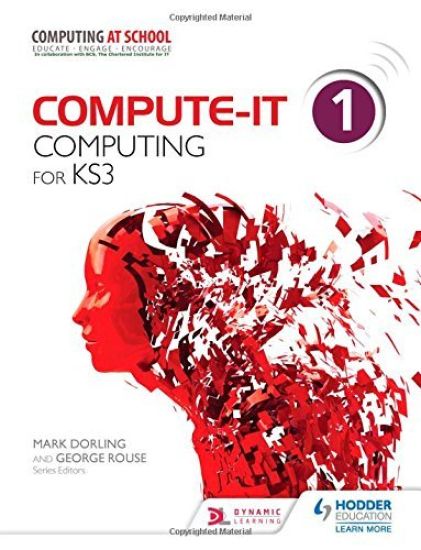
Compute-IT: Student's Book 1 - Computing for KS3

Compute-IT: Student's Book 1 - Computing for KS3

George Rouse; Graham Hastings; Zoe Ross; Carl Turland; Genevieve Smith-Nunes; Ilia Avroutine; James Abela; Mark Dorling; Phil Bagge; Sarah Lawrey

Hodder Education
2014
nidottu
Compute-IT will help you deliver innovative lessons for the new Key Stage 3 Computing curriculum with confidence, using resources and meaningful assessment produced by expert educators. With Compute-IT you will be able to assess and record students' attainment and monitor progression all the way through to Key Stage 4. Developed by members of Computing at School, the national subject association for Computer Science, and a team of Master Teachers who deliver CPD through the Network of Excellence project funded by the Department for Education, Compute-IT provides a cohesive and supportive learning package structured around the key strands of Computing. Creative and flexible in its approach, Compute-IT makes Computing for Key Stage 3 easy to teach, and fun and meaningful to learn, so you can:Follow well-structured and finely paced lessons along a variety of suggested routes through Key Stage 3Deliver engaging and interesting lessons using a range of files and tutorials provided for a range of different programming languages Ensure progression throughout Key Stage 3 with meaningful tasks underpinned by unparalleled teacher and student support Assess students' work with confidence, using ready-prepared formative and summative tasks that are mapped to meaningful learning outcomes and statements in the new Programme of StudyCreative and flexible in its approach, Compute-IT makes Computing for Key Stage 3 easy to teach, and fun and meaningful to learn. This is the first title in the Compute-IT course, which comprises three Student's Books, three Teacher Packs and a range of digital teaching and learning resources delivered through Dynamic Learning.