Kirjailija
Philip Clayton
Kirjat ja teokset yhdessä paikassa: 24 kirjaa, julkaisuja vuosilta 1989-2027, suosituimpien joukossa Science and the Sacred. Vertaile teosten hintoja ja tarkista saatavuus suomalaisista kirjakaupoista.
24 kirjaa
Kirjojen julkaisuhaarukka 1989-2027.
In this beautifully written book, an atheist and a theist explore the intersection points of science and the Sacred. Honestly acknowledging their differences, they discover unexpected common ground across every branch of science and many of the most urgent ethical and spiritual questions humanity now faces. While science may be incompatible with some ancient beliefs about God, the authors show why it is fully compatible with belief in an all-pervading divine presence. Indeed, we will only be able to steer our way safely through the complexities of the modern world when we draw on the best of scientific knowledge as well as the deepest insights of the world's spiritual traditions past and present. This unique exploration by a theologian and a well-known science journalist offers a highly accessible overview of the most complex issues arising at the intersection of science, belief, and hope. The two authors dive into debates normally deemed too sensitive to discuss, identifying common sense ways that science and human values can guide each other. Their emerging friendship and their new insights offer a pathway toward a world no longer plagued by religiously motivated violence and environmental crisis.
Do you dream of a luscious lawn that's the envy of your neighbourhood? Look no further! In this approachable and practical guide, expert gardener Philip Clayton unpacks the myths and misinformation around lawn care to give you clear, easy, practical advice on maintaining the lawn of your dreams. Including: - The ten lawn commandments - Mowing: a connoisseur's guide - how to get stripes to die for - Manicured or meadow? Achieve the look you want - Small habits, big difference - what to start (and stop) doing - Lawn myths busted Combining time-honoured know-how with smart tips and tricks, this book will take you one step closer to the perfect green lawn.
In this beautifully written book, an atheist and a theist explore the intersection points of science and the Sacred. Honestly acknowledging their differences, they discover unexpected common ground across every branch of science and many of the most urgent ethical and spiritual questions humanity now faces. While science may be incompatible with some ancient beliefs about God, the authors show why it is fully compatible with belief in an all-pervading divine presence. Indeed, we will only be able to steer our way safely through the complexities of the modern world when we draw on the best of scientific knowledge as well as the deepest insights of the world's spiritual traditions past and present. This unique exploration by a theologian and a well-known science journalist offers a highly accessible overview of the most complex issues arising at the intersection of science, belief, and hope. The two authors dive into debates normally deemed too sensitive to discuss, identifying common sense ways that science and human values can guide each other. Their emerging friendship and their new insights offer a pathway toward a world no longer plagued by religiously motivated violence and environmental crisis.
Kew: Parched is a collection of over 50 beautiful, fascinating and-most importantly-drought-proof species from around the world.We often think of the most beautiful plants as those that are lush, verdant, and need careful care and tending-but what if we could change the way we think of botanical beauty to include those that thrive with hot sun, parched earth and little to no water?Following the hottest summer on record, Kew: Parched explores the captivating variety that exists in the world of dry plants. From roadside daisies native to California and prickly pear cacti from the Mexican desert to the familiar sights of lavender, rosemary and yarrow, this incredible range of species is explored through beautiful botanical illustrations from Kew's archives in this gorgeously packaged gift book.
Discover the secret to successfully growing and nurturing beautiful roses.Ideal for first-time gardeners, Grow Roses contains everything you need to bring spectacular colours and gorgeous scents to your garden.Learn how to grow and care for a variety of roses with tips on selecting the right site, planting, and pruning. Discover the perfect roses for your own outdoor space with a handy directory of the best varieties for every situation, as well as the ideal plants to grow alongside them. With their ease of cultivation, tolerance to varied climates, and sublime beauty, roses are the perfect flower for the modern garden.Packed with practical, jargon-free know-how, this easy-to-use guide has everything you need to know to help your garden Grow.
Grow Roses: Essential Know-How and Expert Advice for Gardening Success
Philip Clayton
DK Publishing (Dorling Kindersley)
2024
nidottu
Discover the secret to successfully growing and nurturing beautiful roses. Ideal for first-time gardeners, Grow Roses contains everything you need to bring spectacular colors and gorgeous scents to your garden. Learn how to grow and care for a variety of roses with tips on selecting the right site, planting, and pruning. Discover the perfect roses for your own outdoor space with a handy directory of the best varieties for every situation, as well as the ideal plants to grow alongside them. With their ease of cultivation, tolerance to varied climates, and sublime beauty, roses are the perfect flower for the modern garden. Packed with practical, jargon-free know-how, this easy-to-use guide has everything you need to know to help your garden Grow.
Macroevolution, Contingency, and Divine Activity
Bradford McCall; Philip Clayton
Wipf Stock Publishers
2023
sidottu
What are the things that God values in the creative process? How does one define God's activity in such a world? How is God's involvement different from a contingent--what this author labels contingentist--instance? Why do we need a God-idea at all? Herein, Bradford McCall addresses how divine, amorepotent love works with and within a contingentist (i.e., radically contingent) evolutionary theory and worldview. Within the course of this project, he reaches a via media between the (somewhat) radical formalist position of Simon Conway Morris and the veritably radical contingent position of Stephen Jay Gould. But . . . how is the contingentist amorepotent and uncontrolling love of God understood as purposeful? McCall argues in detail that there in fact is some sort of purposiveness that is nevertheless working in a chastened Gouldian position, and he distinguishes between contingency and veritable divine involvement. He contends that God does not insist upon a particular outcome but merely allows propensities to work themselves out. God amorepotently loves the population of the natural world into greater forms of complexity, relationality, and beauty in varied and multifarious forms, along with the extension of diversity.
Macroevolution, Contingency, and Divine Activity
Bradford McCall; Philip Clayton
Wipf Stock Publishers
2023
pokkari
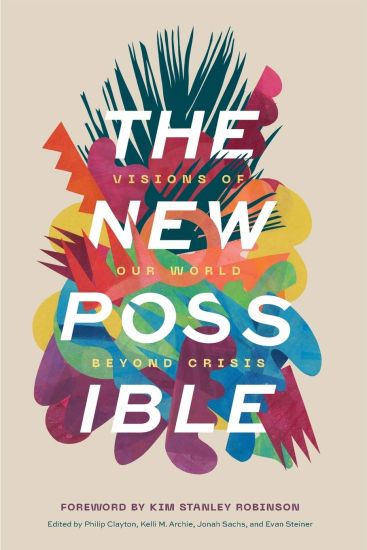
2020 upended every aspect of our lives. But where is our world heading next? Will pandemic, economic instability, and social distance lead to deeper inequalities, more nationalism, and further erosion of democracies around the world? Or are we moving toward a global re-awakening to the importance of community, mutual support, and the natural world? In our lifetimes, the future has never been so up for grabs. The New Possible offers twenty-eight unique visions of what can be, if instead of choosing to go back to normal, we choose to go forward to something far better. Assembled from global leaders on six continents, these essays are not simply speculation. They are an inspiration and a roadmap for action.With essays by: Kim Stanley Robinson, Michael Pollan, Varshini Prakash, Vandana Shiva, Jack Kornfield, Mamphela Ramphele, Justin Rosenstein, Jack Kornfield, Helena Nordberg-Hodge, David Korten, Tristan Harris, Eileen Crist, Francis Deng, Riane Eisler, Arturo Escobar, Rebecca Kiddle, Mike Joy, Natalie Foster, Jess Rimington, Jeremy Lent, Atossa Soltani, Mark Anielski, Ellen Brown, John Restakis, Zak Stein, Oren Slozberg, Anisa Nanavati, and Fr. Joshtrom Isaac Kureethadam
What is Ecological Civilization
Philip Clayton; Wm Andrew Schwartz
Process Century Press
2019
nidottu
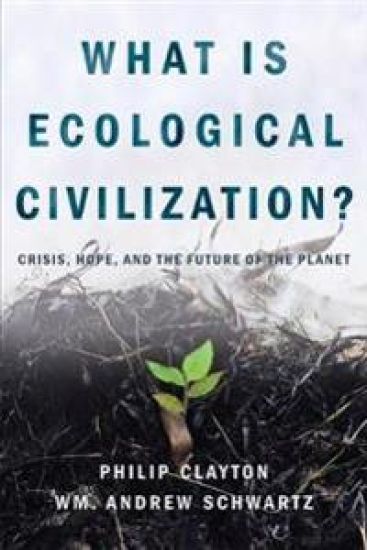
The present trajectory of life on this planet is unsustainable, and the underlying causes of our environmental crisis are inseparable from our social and economic systems. The massive inequality between the rich and the poor is not separate from our systems of unlimited growth, the depletion of natural resources, the extinction of species, or global warming. As climate predictions continue to exceed projections, it is clear that hopelessness is rapidly becoming our worst enemy. What is needed--urgently--is a new vision for the flourishing of life on this planet, a vision the authors are calling an ecological civilization. Along the way they have learned that this term brings hope unlike any other. It reminds us that humans have gone through many civilizations in the past, and the end of a particular civilization does not necessarily mean the end of humanity, much less the end of all life on the planet. It is not hard for us to conceive of a society after the fall of modernity, in which humans live in an equitable and sustainable way with one another and the planet. This book explores the idea of ecological civilization by asking eight key questions about it and drawing answers from relational philosophies, the ecological sciences, systems thinking and network theory, and the world's religious and spiritual traditions. It concludes that a genuinely ecological civilization is not a utopian ideal, but a practical way to live. To recognize this, and to begin to take steps to establish it, is the foundation for realistic hope.
Religion and science are arguably the two most powerful social forces in the world today. But where religion and science were once held to be compatible, many people now perceive them to be in conflict. This unique book provides the best available introduction to the burning debates in this controversial field. Examining the defining questions and controversies, renowned expert Philip Clayton presents the arguments from both sides, asking readers to decide for themselves where they stand: • science or religion, or science and religion?• history and philosophy of science• the role of scientific and religious ethics – modifying genes, extending life, and experimenting with human subjects• religion and the environmental crisis• the future of science vs. the future of religion.Thoroughly updated throughout, this second edition explores religious traditions from around the world and provides insights from across the sciences, making this book essential reading for all those wishing to come to their own understanding of some of the most important debates of our day.
Philip Clayton is well known as a major thinker working at the interface of science, philosophy, and Christian theology. Here, for the first time, a representative selection of his far-reaching works have been brought together into one place. After a general introduction to the breadth of Clayton's writing, the book is divided into six main sections: 1) Science & Religion; 2) Science, Faith, & God; 3) Panentheistic Reflections on Science & Theology; 4) Science & Emergence; 5) Science, Spirit, & Divine Action; and 6) Progressive Theology. This introduction and reader will become the go-to text for all inquiries regarding Philip Clayton's expansive theology. ""Bringing together a 'highlight reel' of Philip Clayton's writing is a daunting task But Bradford McCall does it well in this Reader. In addition to forty of Clayton's sophisticated writings on theology, philosophy, and science, we get a testimonial of his personal journey of faith and questioning. The Clayton synthesis of wide-ranging ideas, diverse traditions, various fields of inquiry, and experiences provides an open-ended, transformative theology-in-dialogue worth embracing "" --Thomas Jay Oord, Northwest Nazarene University, Nampa, ID ""It is indeed a matter of festive gravity that Philip Clayton's vast spectrum of writing between science and religion has been here so richly and accessibly collected. Clayton is our leading theologian of science. His panentheism, with its concept of divine action evolved so far beyond the contradictions of traditional theism, is itself a dauntless labor of emergence. So what a gift it is for thinkers in science or religion to find this treasure chest of gem-like excerpts selected from the cosmically wide spectrum of Claytonian writings."" --Catherine Keller, The Theological School at Drew University, Madison, NJ ""Philip Clayton is a philosopher and theologian to be reckoned with, and one of the most positive and creative writers on religion and science. This is a very illuminating introduction to his thinking."" --Keith Ward, Gresham College, London ""Readers fulfill at least the following roles: (1) introduce a prolific thinker to new audiences in one place; (2) cover the gamut of such a thinker's oeuvre in ways that enable comparative and analytical perspective on the parts in relationship to the whole and vice-versa; and (3) provide a vista for the evolution of an important and influential set of ideas vis-.-vis the shifting contexts being navigated. God and Gravity meets these objectives, in particular situating Philip Clayton's three-decades-plus engagement with the science-and-theology conversation against what manifests gradually as a triadic backdrop that includes the emerging church grappling with developments in the theological academy and the field of philosophy of science. Those new to the intersection of these three spheres seeking orientation will benefit from this volume even as it serves as a handy reference for seasoned scholars and theologians wishing to engage Clayton's achievements."" --Amos Yong, Fuller Theological Seminary, Pasadena, CA ""This new edited collection is without a doubt the most comprehensive and in-depth look into the fascinating work and mind of its author's endeavor to situate primal and important questions about religion and science, evolution, the human mind, ecology, and their theological treatments in search for responding and responsible visions of panentheism in the current context of the pressing issues of and for the future of humanity."" --Roland Faber, Claremont School of Theology, Claremont, CA Philip Clayton is the Ingraham Professor of Theology at Claremont School of Theology, Claremont, CA. Bradford McCall is a PhD student at Claremont School of Theology, Claremont, CA. He is the author of A Modern Relation of Theology & Science (Wipf and Stock, 2018) and many peer-reviewed journal articles.
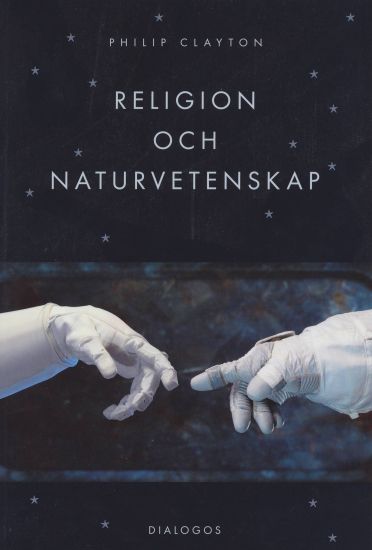
Religion och naturvetenskap är förmodligen de två starkaste tankeströmningarna i världen i dag. Men de anses ofta stå i olöslig konflikt med varandra. Denna unika bok är en introduktion till de mest brännande frågorna och åsikterna på detta kontroversiella område. Genom att analysera argumenten tema för tema ger Philip Clayton en nyanserad bild av debattens frågor, såsom: Vad går intelligent design och nyateism ut på? Vilken roll spelar vetenskaplig och religiös etik i frågor om designerdroger, artificiell intelligens och stamscellsforskning? Hur ser framtiden ut för naturvetenskap och religion? Går de att förena, eller måste ena sidan vinna till slut? Författaren presenterar de dominerande föreställningarna i en rad världsreligioner och vetenskapsgrenar och visar hur båda sidorna skulle vinna på dialog. Philip Clayton är professor och dekanus vid Claremont School of Theology och rektor vid Claremont Lincoln University i USA. Han har publicerat omkring tjugo böcker och är en internationellt erkänd auktoritet i debatten om religion och naturvetenskap.
Marxismo Orgánico: Una Alternativa al Capitalismo y a la Catástrofe Ecológica
Justin Heinzekehr; Philip Clayton
Process Century Press
2016
nidottu
Este revolucionario libro fusiona el legado perdurable del socialismo―un gobierno para el bien com n―con lo mejor del movimiento ambientalistay los m s recientes avances en los estudios de sustentabilidad. Elresultado es un manifiesto que se pone a la vanguardia partiendo de lasideas centrales de Karl Marx, de los fil sofos procesuales de China(Tao smo) y de Occidente (Alfred North Whitehead), de la ecolog a y delas pr cticas org nicas de comunidades sustentables. Sin embargo, este"marxismo postmoderno", sostienen los autores, no es ni determinista niut pico. Deja espacio para las fuerzas de mercado limitando lacorrupci n y el lucro excesivo de los ricos. A fin de cuentas, lossistemas de producci n y comercio locales inmersos en las tradicionesculturales de un pueblo dado son mucho m s sustentables y promotores dela vida que una econom a global regida por unos cuantos megabancos ytransnacionales.Este libro es una llamado a la acci n. Ya no es una opci n quedarsec modamente sentado contemplando el consumo desenfrenado de los m sricos sabiendo que con ello no quedar nada para nuestros nietos. Sin lainminencia de una crisis planetaria, los ricos seguir an sin problema enel poder, pero como nos aproximamos a los l mites que el planeta puedesoportar, la nica opci n disponible es dirigirnos hacia unacivilizaci n org nica y ecol gica. Clayton y Heinzekehr nos hacen verc mo los cient ficos, economistas, agricultores, peque os comerciantes, artistas y l deres religiosos se est n agrupando alrededor del globopara construir comunidades orientadas al bien com n.
Organic Marxism: An Alternative to Capitalism and Ecological Catastrophe
Justin Heinzekehr; Philip Clayton
RiverHouse LLC
2014
nidottu
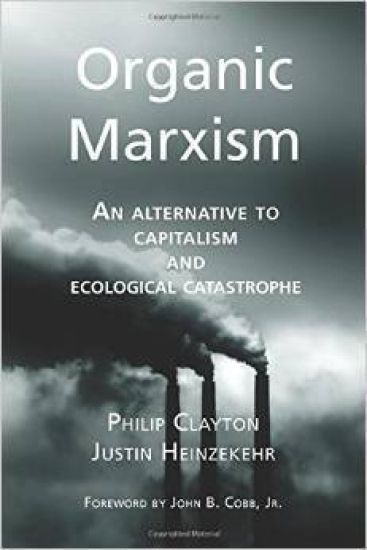
This revolutionary book fuses the enduring legacy of socialism-government for the common good-with the best of the environmental movement and the newest insights from sustainability studies. The result is a manifesto in the tradition of Bill McKibben's Eaarth-a roadmap forward in the face of the growing environmental catastrophe, which is the most complex crisis humanity has ever faced. Catherine Keller writes, "What an unexpected, discomforting and important work If Marxism seemed to be abandoned in the West to a few academic leftists and nostalgic activists, the authors bring it roaring back into relevance."American conservatives like to say that Marxism was destroyed by its opponents and by the mistakes of Marxist governments. Organic Marxism provides the definitive answer to this charge. New economic evidence reveals that Marx's predictions are coming true in ways once thought impossible. Today the wealthiest class, the richest 1%, possesses more wealth and power than ever before, whereas the 99% are slipping economically, and the majority of humans live in increasing poverty.Above all else, the global environmental crisis changes everything. Clayton and Heinzekehr show how, over the last decades, rich individuals and multinational corporations have acted selfishly to increase their own wealth-with devastating ecological consequences. The data make it clear that the planet has reached the limits of its capacity. The authors trace the unimaginable environmental and social consequences that (scientists tell us) global warming will bring: mass extinctions, food and water shortages, violent weather, rising oceans. Why then do our governments continue to favor the wealthy? Why do they take no action ... or actually worsen the situation?Organic Marxism shows why the situation is not hopeless, however. The vast majority of humans favor sustainable systems and lifestyles. With this growing support, it's possible to begin laying the foundations for a new, ecological civilization on this planet. In these pages Clayton and Heinzekehr lay out the steps toward a fair and sustainable society, one run not in the interests of the rich but for the common good. This "fresh, energetic, and revolutionary manifesto" (Santiago Slabodsky) takes its leads from the core insights of Karl Marx, from process philosophers in China (Taoism) and in the West (Alfred North Whitehead), from ecology, and from the organic practices of sustainable communities. This "postmodern Marxism," the authors argue, is not deterministic and utopian. It allows for market forces while limiting corruption and excessive profit-taking by the wealthy. In the end, localized systems of production and trade, steeped in the cultural traditions of a given people, are far more sustainable and life-affirming than a globalized economy run by the richest banks and multinational corporations.The book is a call to action. We can no longer sit by passively and allow unlimited consumption by the wealthy when it means that there will be nothing left for our grandchildren. Without a planetary crisis, the rich would remain in power. As we approach the planet's limits, however, there is no other option but to shift to an organic, ecological civilization. Clayton and Heinzekehr show how scientists and economists, farmers and small business people, artists and religious leaders are coming together around the globe, building communities for the common good.
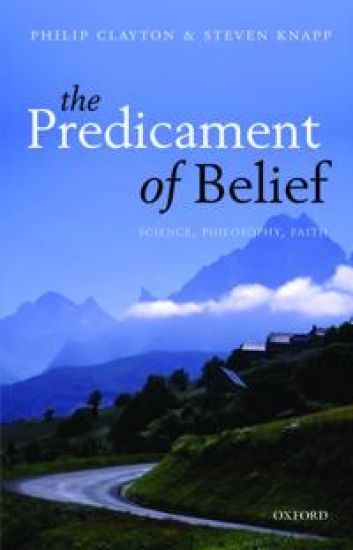
Does it make sense - can it make sense - for someone who appreciates the explanatory power of modern science to continue believing in a traditional religious account of the ultimate nature and purpose of our universe? This book is intended for those who care about that question and are dissatisfied with the rigid dichotomies that dominate the contemporary debate. The extremists won't be interested - those who assume that science answers all the questions that matter, and those so certain of their religious faith that dialogue with science, philosophy, or other faith traditions seems unnecessary. But far more people today recognize that matters of faith are complex, that doubt is endemic to belief, and that dialogue is indispensable in our day. In eight probing chapters, the authors of The Predicament of Belief consider the most urgent reasons for doubting that religious claims - in particular, those embedded in the Christian tradition - are likely to be true. They develop a version of Christian faith that preserves the tradition's core insights but also gauges the varying degrees of certainty with which those insights can still be affirmed. Along the way, they address such questions as the ultimate origin of the universe, the existence of innocent suffering, the challenge of religious plurality, and how to understand the extraordinary claim that an ancient teacher rose from the dead. They end with a discussion of what their conclusions imply about the present state and future structure of churches and other communities in which Christian affirmations are made.