Kirjojen hintavertailu. Mukana 12 595 353 kirjaa ja 12 kauppaa.

Kirjailija

Philip J. Cook

Kirjat ja teokset yhdessä paikassa: 12 kirjaa, julkaisuja vuosilta 1991-2023, suosituimpien joukossa The Gun Debate. Vertaile teosten hintoja ja tarkista saatavuus suomalaisista kirjakaupoista.

Mukana myös kirjoitusasut: Philip J Cook

12 kirjaa

Kirjojen julkaisuhaarukka 1991-2023.

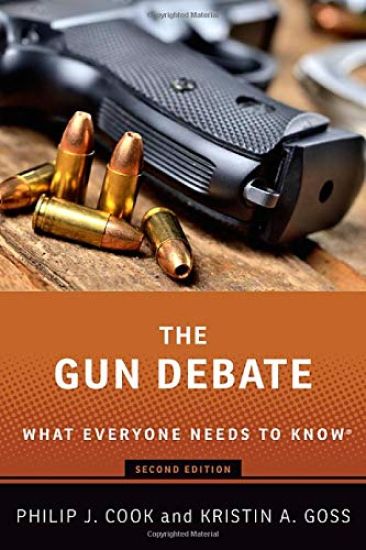
The Gun Debate

The Gun Debate

Philip J. Cook; Kristin A. Goss

Oxford University Press Inc
2020
nidottu
No topic is more polarizing than guns and gun control. From a gun culture that took root early in American history to the mass shootings that repeatedly bring the public discussion of gun control to a fever pitch, the topic has preoccupied citizens, public officials, and special interest groups for decades. In this thoroughly revised second edition of The Gun Debate: What Everyone Needs to Know® noted economist Philip J. Cook and political scientist Kristin A. Goss delve into the issues that Americans debate when they talk about guns. With a balanced and broad-ranging approach, the authors thoroughly cover the latest research, data, and developments on gun ownership, gun violence, the firearms industry, and the regulation of firearms. The authors also tackle sensitive issues such as the impact of gun violence on quality of life, the influence of exposure to gun violence on mental health, home production of guns, arming teachers, the effect of concealed weapons on crime rates, and the ability of authorities to disarm people who aren't allowed to have a gun. No discussion of guns in the U.S. would be complete without consideration of the history, culture, and politics that drive the passion behind the debate. Cook and Goss deftly explore the origins of the American gun culture and the makeup of both the gun rights and gun control movements. Written in question-and-answer format, this updated edition brings the debate up-to-date for the current political climate under Trump and will help readers make sense of the ideologically driven statistics and slogans that characterize our national conversation on firearms. This book is a must-read for anyone interested in getting a clear view of the issues surrounding guns and gun policy in America.
The Gun Debate

The Gun Debate

Philip J. Cook; Kristin A. Goss

Oxford University Press Inc
2020
sidottu
No topic is more polarizing than guns and gun control. From a gun culture that took root early in American history to the mass shootings that repeatedly bring the public discussion of gun control to a fever pitch, the topic has preoccupied citizens, public officials, and special interest groups for decades. In this thoroughly revised second edition of The Gun Debate: What Everyone Needs to Know® noted economist Philip J. Cook and political scientist Kristin A. Goss delve into the issues that Americans debate when they talk about guns. With a balanced and broad-ranging approach, the authors thoroughly cover the latest research, data, and developments on gun ownership, gun violence, the firearms industry, and the regulation of firearms. The authors also tackle sensitive issues such as the impact of gun violence on quality of life, the influence of exposure to gun violence on mental health, home production of guns, arming teachers, the effect of concealed weapons on crime rates, and the ability of authorities to disarm people who aren't allowed to have a gun. No discussion of guns in the U.S. would be complete without consideration of the history, culture, and politics that drive the passion behind the debate. Cook and Goss deftly explore the origins of the American gun culture and the makeup of both the gun rights and gun control movements. Written in question-and-answer format, this updated edition brings the debate up-to-date for the current political climate under Trump and will help readers make sense of the ideologically driven statistics and slogans that characterize our national conversation on firearms. This book is a must-read for anyone interested in getting a clear view of the issues surrounding guns and gun policy in America.
Policing Gun Violence

Policing Gun Violence

Anthony A. Braga; Philip J. Cook

OXFORD UNIVERSITY PRESS INC
2023
sidottu
In many U.S. cities, gun violence is the most urgent crime problem. High rates of deadly violence make a city less livable, dragging down quality of life, economic development, and property values. The police are the primary agency tasked with controlling gun violence, yet advocates for gun violence prevention either ignore the police or only reference them as a part of the problem. But in fact, more effective policing is key to the success of any comprehensive effort to reduce community gun violence. The stakes are high--gun violence is concentrated in low-income Black communities, and consequently these communities bear the brunt of the associated economic, social, and psychological burdens. Any successful strategy must overcome the current impasse where the residents of high-violence neighborhoods do not trust the police, having experienced both abuse and neglect in their dealings with officers. How can police departments find the right balance between over- and under-policing of high-violence areas? What are the best practices for police to preempt and deter gun violence, while engendering support and cooperation from the public? Drawing on fifty years of research and practical experience, Policing Gun Violence argues that it is possible for the police to create greater public safety while respecting the rights of individuals and communities. While gun violence can be attributed to various systemic causes that should remain on the public agenda--from widespread gun availability to poverty and racism--Anthony A. Braga and Philip J. Cook make the case that violence is itself a root cause of social disparity and future violence. Effective law enforcement is a vital component of a just society. They review and synthesize the evidence in several key areas: enforcement of gun laws, policing hot spots, controlling high-risk groups through focused deterrence, enhancing investigations to increase the arrest and conviction rate, preventing officer-involved shootings, and disrupting underground gun markets. Policing Gun Violence serves as a guide to how the police can better utilize their considerable resources to make cities safer.
Paying the Tab

Paying the Tab

Philip J. Cook

Princeton University Press
2016
pokkari
What drug provides Americans with the greatest pleasure and the greatest pain? The answer, hands down, is alcohol. The pain comes not only from drunk driving and lost lives but also addiction, family strife, crime, violence, poor health, and squandered human potential. Young and old, drinkers and abstainers alike, all are affected. Every American is paying for alcohol abuse. Paying the Tab, the first comprehensive analysis of this complex policy issue, calls for broadening our approach to curbing destructive drinking. Over the last few decades, efforts to reduce the societal costs--curbing youth drinking and cracking down on drunk driving--have been somewhat effective, but woefully incomplete. In fact, American policymakers have ignored the influence of the supply side of the equation. Beer and liquor are far cheaper and more readily available today than in the 1950s and 1960s. Philip Cook's well-researched and engaging account chronicles the history of our attempts to "legislate morality," the overlooked lessons from Prohibition, and the rise of Alcoholics Anonymous. He provides a thorough account of the scientific evidence that has accumulated over the last twenty-five years of economic and public-health research, which demonstrates that higher alcohol excise taxes and other supply restrictions are effective and underutilized policy tools that can cut abuse while preserving the pleasures of moderate consumption. Paying the Tab makes a powerful case for a policy course correction. Alcohol is too cheap, and it's costing all of us.
The Gun Debate

The Gun Debate

Philip J. Cook; Kristin A. Goss

Oxford University Press Inc
2014
sidottu
Even before the recent Newtown, CT massacre, gun violence and gun control has preoccupied public officals and legislators at all levels of government as well as powerful special interest groups for years. Guns in America: What Everyone Needs to Know tours the issues that Americans debate when they talk about guns. The volume includes information on gun control pertaining to U.S. history, jurisprudence, cultural beliefs, political agendas, epidemiologcal data, criminology, law and regulation, and policy effectivness. Throughout, economist Philip J. Cook and political scientist Kristin Goss illustrate for readers which questions and issues are contentious and on which there is something approaching consensus. They answer basic questions like: Where do people acquire guns? Is gun violence rising or falling? Who is at risk for being shot? How much does gun violence cost? And tackle tougher ones such as: Do video games and the media contribute to gun violence? Why is the gun control movement relatively weak? Is it better to enforce the laws we have or enact new ones? The answers to these questions will help the general reader to make sense of the volley of ideologically driven statistics and slogans that characterize our national conversation on firearms. This book is a must-read for anyone interested in getting a clear view of the highly polarizing topic of gun control.
The Gun Debate

The Gun Debate

Philip J. Cook; Kristin A. Goss

Oxford University Press Inc
2014
nidottu
Even before the recent Newtown, CT massacre, gun violence and gun control has preoccupied public officals and legislators at all levels of government as well as powerful special interest groups for years. The Gun Debate: What Everyone Needs to Know tours the issues that Americans debate when they talk about guns. The volume includes information on gun control pertaining to U.S. history, jurisprudence, cultural beliefs, political agendas, epidemiologcal data, criminology, law and regulation, and policy effectivness. Throughout, economist Philip J. Cook and political scientist Kristin Goss illustrate for readers which questions and issues are contentious and on which there is something approaching consensus. They answer basic questions like: Where do people acquire guns? Is gun violence rising or falling? Who is at risk for being shot? How much does gun violence cost? And tackle tougher ones such as: Do video games and the media contribute to gun violence? Why is the gun control movement relatively weak? Is it better to enforce the laws we have or enact new ones? The answers to these questions will help the general reader to make sense of the volley of ideologically driven statistics and slogans that characterize our national conversation on firearms. This book is a must-read for anyone interested in getting a clear view of the highly polarizing topic of gun control.
Winner-Take-All Society

Winner-Take-All Society

Philip J Cook; Robert H Frank

Ebury Press
2010
pokkari
Why does the top one per cent of the population capture such a disproportionate amount of the wealth? Why do top athletes win dozens of sponsorship deals, yet competitors who finish just moments behind struggle to attract a single deal? This title shows how in business, as in sport, thousands are competing for only a handful of top prizes.
Paying the Tab

Paying the Tab

Philip J. Cook

Princeton University Press
2007
sidottu
What drug provides Americans with the greatest pleasure and the greatest pain? The answer, hands down, is alcohol. The pain comes not only from drunk driving and lost lives but also addiction, family strife, crime, violence, poor health, and squandered human potential. Young and old, drinkers and abstainers alike, all are affected. Every American is paying for alcohol abuse. Paying the Tab, the first comprehensive analysis of this complex policy issue, calls for broadening our approach to curbing destructive drinking. Over the last few decades, efforts to reduce the societal costs--curbing youth drinking and cracking down on drunk driving--have been somewhat effective, but woefully incomplete. In fact, American policymakers have ignored the influence of the supply side of the equation. Beer and liquor are far cheaper and more readily available today than in the 1950s and 1960s. Philip Cook's well-researched and engaging account chronicles the history of our attempts to "legislate morality," the overlooked lessons from Prohibition, and the rise of Alcoholics Anonymous. He provides a thorough account of the scientific evidence that has accumulated over the last twenty-five years of economic and public-health research, which demonstrates that higher alcohol excise taxes and other supply restrictions are effective and underutilized policy tools that can cut abuse while preserving the pleasures of moderate consumption. Paying the Tab makes a powerful case for a policy course correction. Alcohol is too cheap, and it's costing all of us.
Gun Violence

Gun Violence

Philip J. Cook; Jens Ludwig

Oxford University Press Inc
2002
nidottu
100 billion dollars. That is the annual cost of gun violence in America according to the authors of this landmark study, a book destined to change the way Americans view the problem of gun-related violence. Until now researchers have assessed the burden imposed by gunshot injuries and deaths in terms of medical costs and lost productivity. Here, economists Philip Cook and Jens Ludwig widen the lens, developing a framework to calculate the full costs borne by Americans in a society where both gun violence and its ever-present threat mandate responses that touch every aspect of our lives. All of us, no matter where we reside or how we live, share the costs of gun violence. Whether waiting in line to pass through airport security or paying taxes for the protection of public officials; whether buying a transparent book bag for our children to meet their school's post-Columbine regulations or subsidizing an urban trauma center, the steps we take are many and the expenditures enormous. Cook and Ludwig reveal that investments in prevention, avoidance, and harm reduction, both public and private, constitute a far greater share of the gun-violence burden than previously recognized. They also employ extensive survey data to measure the subjective costs of living in a society where there is risk of being shot or losing a loved one or neighbor to gunfire. At the same time, they demonstrate that the problem of gun violence is not intractable. Their review of the available evidence suggests that there are both additional gun regulations and targeted law enforcement measures that will help. This urgently needed book documents for the first time how gun violence diminishes the quality of life for everyone in America. In doing so, it will move the debate over gun violence past symbolic politics to a direct engagement with the costs and benefits of policies that hold promise for reducing gun violence and may even pay for themselves.
Gun Violence: The Real Costs

Gun Violence: The Real Costs

Philip J. Cook; Jens Ludwig

Oxford University Press Inc
2000
sidottu
The objective of this book is to quantify the social costs of gun violence in order to help policy makers determine how many and which violence programmes to support. Drawing upon the most detailed and extensive economic study of the cost of gun violence, Cook and Ludwig provide detailed information about how the burden of gun violence is distributed in the US. Drawing upon this data, the book draws out the important implications for public policy. The burden of gun violence in America is valued at about $100 billion annually, and this heavy cost is distributed much more evenly over the population than the victimization statistics would suggest. Cook and Ludwig's examination of these costs lead them to propose a multifaceted policy agenda that includes both law enforcement and gun control measures.
The Winner-Take-All Society: Why the Few at the Top Get So Much More Than the Rest of Us
Disney chairman Michael Eisner topped the 1993 Business Week chart of America's highest-paid executives, his $203 million in earnings roughly 10,000 times that of the lowest paid Disney employee.During the last two decades, the top one percent of U.S. earners captured more than 40 percent of the country's total earnings growth, one of the largest shifts any society has endured without a revolution or military defeat. Robert H. Frank and Philip J. Cook argue that behind this shift lies the spread of "winner-take-all markets"--markets in which small differences in performance give rise to enormous differences in reward. Long familiar in sports and entertainment, this payoff pattern has increasingly permeated law, finance, fashion, publishing, and other fields. The result: in addition to the growing gap between rich and poor, we see important professions like teaching and engineering in aching need of more talent. This relentless emphasis on coming out on top--the best-selling book, the blockbuster film, the Super Bowl winner--has molded our discourse in ways that many find deeply troubling.
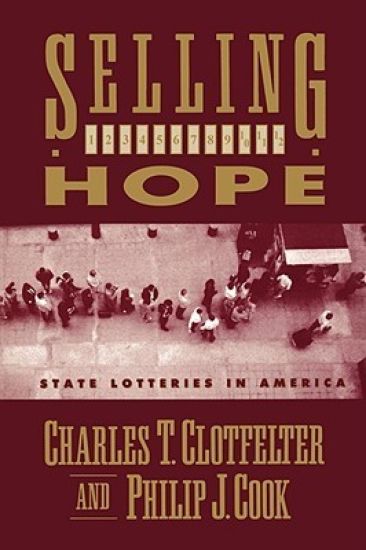
Selling Hope

Selling Hope

Charles T. Clotfelter; Philip J. Cook

Harvard University Press
1991
nidottu
With its huge jackpots and heartwarming rags-to-riches stories, the lottery has become the hope and dream of millions of Americans—and the fastest-growing source of state revenue. Despite its popularity, however, there remains much controversy over whether this is an appropriate business for state government and, if so, how this business should be conducted.