Kirjojen hintavertailu. Mukana 12 595 353 kirjaa ja 12 kauppaa.

Kirjailija

Philip K. Howard

Kirjat ja teokset yhdessä paikassa: 11 kirjaa, julkaisuja vuosilta 2002-2024, suosituimpien joukossa Failures of American Civil Justice in International Perspective. Vertaile teosten hintoja ja tarkista saatavuus suomalaisista kirjakaupoista.

11 kirjaa

Kirjojen julkaisuhaarukka 2002-2024.

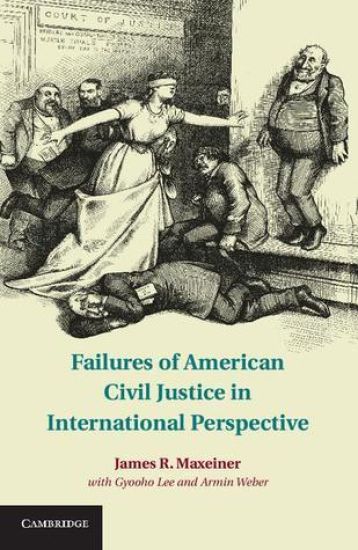
Failures of American Civil Justice in International Perspective

Failures of American Civil Justice in International Perspective

James R. Maxeiner; Philip K. Howard

Cambridge University Press
2011
sidottu
Civil justice in the United States is neither civil nor just. Instead it embodies a maxim that the American legal system is a paragon of legal process which assures its citizens a fair and equal treatment under the law. Long have critics recognized the system's failings while offering abundant criticism but few solutions. This book provides a comparative-critical introduction to civil justice systems in the United States, Germany and Korea. It shows the shortcomings of the American system and compares them with German and Korean successes in implementing the rule of law. The author argues that these shortcomings could easily be fixed if the American legal systems were open to seeing how other legal systems' civil justice processes handle cases more efficiently and fairly. Far from being a treatise for specialists, this book is an introductory text for civil justice in the three aforementioned legal systems.
Everyday Freedom: Designing the Framework for a Flourishing Society
There's a glaring vacuum in the 2024 political debate--No party or candidate offers a governing vision that deals with the root causes of alienation and failure. Something basic is missing in our culture. Americans know it. Nothing much works as it should. Simple daily choices seem impossible, or fraught with peril. In the workplace, we walk on eggshells. Big projects--say, modernizing infrastructure--get stalled in years of review. Endemic social problems such as homelessness become, well, more endemic. Everyday Freedom pinpoints the source of powerlessness that is fraying American culture and causing public failure, and offers a bold vision of simpler governing frameworks to re-empower Americans in their daily choices. "Everyday Freedom shows us how to break out of the spiral of decreasing trust, confidence, and capability," social psychologist Jonathan Haidt concludes, "and re-invigorate our institutions, our governments, and ourselves." Everyday Freedom diagnoses our collective futility as resulting from a deliberate change in governing philosophy: The assault on authority after the 1960s, aimed at enhancing freedom, instead created a plague of powerlessness. The teacher in the classroom, the principal in a school, the nurse in the hospital, the official in Washington, the parent on a field trip, the head of a local charity or church...all have their hands tied. Things don't work, and Americans have lost the freedom to be themselves. That's the main reason America is in a downward spiral of alienation and extremism. Who has a vision to revive hope and action? Not political leaders, who are picking the scab of resentment. Social media gets rich selling distrust. Stop the Steal Defund the Police Everyday Freedom, in the tradition of Thomas Paine's Common Sense, offers a radical vision for change: Re-empower Americans in their everyday choices. The massive legal structures erected since the 1960s were based on flawed notions that human judgment could be replaced by elaborate dictates. Area by area, these failed structures must be replaced with simpler frameworks activated by human responsibility and accountability. Nothing will work sensibly until Americans are free to draw on their skills, intuitions and values when confronting daily challenges. This is the only cure to alienation. This is also the only way to deliver good government. Philip Howard's understanding of the essential role of human agency has been embraced by some of America's leading economists, jurists, social psychologists and philosophers.
Not Accountable: Rethinking the Constitutionality of Public Employee Unions
"Elected leaders come and go, but public unions just say no." Hiding in plain sight is a fatal defect of modern democracy. Public employee unions have a death grip on the operating machinery of government. Schools can't work, bad cops can't be fired, and politicians sell their souls for union support. With this searing five-point indictment, Philip K. Howard argues that union controls have disempowered elected executives and should be unconstitutional. Union power in government happened almost by accident in the 1960s, ostensibly to give public unions the same bargaining rights as trade unions. But government bargaining is not about dividing profits, but making political choices about public priorities. Moreover, the political nature of decision-making allowed unions to provide campaign support to friendly officials. Public bargaining became collusive. The unions brag about it: "We elect our own bosses." Sitting on both sides of the bargaining table has allowed public unions to turn the democratic hierarchy upside down. Elected officials answer to public employees. Basic tools of good government have been eliminated. There's no accountability, detailed union entitlements make government largely unmanageable and unaffordable, and public policies are driven by what is good for public employees, not what is good for the public. Public unions keep it that way by brute political force--harnessing the huge cohort of public employees into a political force dedicated to preventing the reform of government. The solution, Howard argues, is not political but constitutional. America's republican form of government requires an executive branch that is empowered to implement public policies, not one shackled to union controls. Public employees have a fiduciary duty to serve the public and should not be allowed to organize politically to harm the public. This short book could unlock a door to fixing a broken democracy. Common Good (www.commongood.org) is a nonpartisan reform coalition to simplify government and restore common sense in daily decisions. It proposes a new governing vision: replace red tape with individual accountability. Its Founder and Chair is lawyer and author Philip K. Howard.
Try Common Sense - Replacing the Failed Ideologies of Right and Left
In this brief and powerful book, Philip K. Howard attacks the failed ideologies of both parties and proposes a radical simplification of government to re-empower Americans in their daily choices. Nothing will make sense until people are free to roll up their sleeves and make things work. The first steps are to abandon the philosophy of correctness and our devotion to mindless compliance.Americans are a practical people. They want government to be practical. Washington can't do anything practically. Worse, its bureaucracy prevents Americans from doing what's sensible. Conservative bluster won't fix this problem. Liberal hand-wringing won't work either. Frustrated voters reach for extremist leaders, but they too get bogged down in the bureaucracy that has accumulated over the past century. Howard shows how America can push the reset button and create simpler frameworks focused on public goals where officials--prepare for the shock--are actually accountable for getting the job done.
Red Tape

Red Tape

Herbert Kaufman; Philip K. Howard

Brookings Institution
2015
nidottu
"Death, taxes, and red tape. The inevitable trio no one can escape. That wry sense of reality colors Herbert Kaufman's classic study of red tape, the bureaucratic phenomenon that all of us have encountered in some form—from the confounding tax form filled out annually to the maddeningly time-consuming wait at the driver's license bureau.The complaints about red tape, Kaufman concedes, are legion. It's messy, it takes too long, it lacks local knowledge, it is out of date, it makes insane demands, it increases costs, it slows progress. It is, in short, a burden and many times there is no measurable positive outcome.Kaufman takes us on an unblinking tour of the dismal landscape of red tape. But he also shows us another side of red tape, one we often forget. Red tape is how government protects us from tainted food, shoddy products, and unfair labor practices. It guarantees a social safety net for the elderly, the disabled, children, veterans, and victims of natural disasters. One person's red tape is another person's protection.This reissue is a Brookings Classic, a series of republished books for readers to revisit or discover, notable works by the Brookings Institution Press."
The Rule of Nobody

The Rule of Nobody

Philip K. Howard

WW Norton Co
2015
nidottu
What’s wrong in Washington is deeper than you think. Yes, there’s gridlock, polarization, and self-dealing. But hidden underneath is something bigger and more destructive. It’s a broken governing system. From that comes wasteful government, rising debt, failing schools, expensive health care, and economic hardship. Rules have replaced leadership in America. Bureaucracy, regulation, and outmoded law tie our hands and confine policy choices. Nobody asks, “What’s the right thing to do here?” Instead, they wonder, “What does the rule book say?” There’s a fatal flaw in America’s governing system—trying to decree correctness through rigid laws will never work. Public paralysis is the inevitable result of the steady accretion of detailed rules. America is now run by dead people—by political leaders from the past who enacted mandatory programs that churn ahead regardless of waste, irrelevance, or new priorities. America needs to radically simplify its operating system and give people—officials and citizens alike—the freedom to be practical. Rules can’t accomplish our goals. Only humans can get things done. In The Rule of Nobody Philip K. Howard argues for a return to the framers’ vision of public law—setting goals and boundaries, not dictating daily choices. This incendiary book explains how America went wrong and offers a guide for how to liberate human ingenuity to meet the challenges of this century.
The Rule of Nobody

The Rule of Nobody

Philip K. Howard

WW Norton Co
2014
sidottu
What’s wrong in Washington is deeper than we think. There’s gridlock, polarisation and self-dealing but hidden underneath is something bigger and more destructive: a broken governing system. From that comes wasteful government, rising debt, failing schools, expensive health care and economic hardship. Rules have replaced leadership. This explosive manifesto argues that to get America moving again, Americans must be free to make sensible choices—to scrap obsolete laws and to approve new infrastructure projects in a year. Philip K. Howard explains what went wrong in the American operating system, how to mend it and how to re-engage the American spirit to make things right again.
The Death of Common Sense: How Law Is Suffocating America
NEW YORK TIMES BESTSELLER "We need a new idea of how to govern. The current system is broken. Law is supposed to be a framework for humans to make choices, not the replacement for free choice." So notes Philip K. Howard in the new Afterword to his explosive manifesto The Death of Common Sense. Here Howard offers nothing less than a fresh, lucid, practical operating system for modern democracy. America is drowning--in law, lawsuits, and nearly endless red tape. Before acting or making a decision, we often abandon our best instincts. We pause, we worry, we equivocate, and then we divert our energy into trying to protect ourselves. Filled with one too many examples of bureaucratic overreach, The Death of Common Sense demonstrates how we--and our country--can at last get back on track.
Life Without Lawyers

Life Without Lawyers

Philip K. Howard

WW Norton Co
2010
nidottu
Americans are losing the freedom to make sense of daily choices—teachers can’t maintain order in the classroom, managers are trained to avoid candor, schools ban tag, and companies plaster inane warnings on everything: “Remove Baby Before Folding Stroller.” Philip K. Howard’s urgent argument is full of examples, often darkly humorous. He describes the historical and cultural forces that led to this mess and lays out the basic shift in approach needed to fix it. Today we are flooded with legal threats that prevent us from taking responsibility. We must rebuild boundaries of law that protect an open field of freedom. The voices here will ring true to every reader. The analysis is powerful, and the solution unavoidable. What’s at stake, Howard explains in this seminal book, is the vitality of American culture.
Dinner for Architects

Dinner for Architects

Philip K. Howard

WW Norton Co
2005
nidottu
The spontaneous sketch, drawn when occasion offers on whatever comes to hand, is a trademark of the architect's creativity. On the occasion of the opening of the museum of architecture in the Gallery of Modern Art in Munich, the museum director asked architects of international standing to sketch their personal greetings and congratulations on a paper napkin. These napkins are now part of a colorful, imaginative, and often droll collection, reproduced here interspersed with pithy quotes from an array of famous architects.
The Collapse of the Common Good: How America's Lawsuit Culture Undermines Our Freedom
In pursuit of fairness at any cost, we have created a society paralyzed by legal fear: Doctors are paranoid and principals powerless. Little league coaches, scared of liability, stop volunteering. Schools and hospitals start to crumble. The common good fades, replaced by a cacophony of people claiming their "individual rights." By turns funny and infuriating, this startling book dissects the dogmas of fairness that allow self-interested individuals to bully the rest of society. Philip K. Howard explains how, trying to honor individual rights, we removed the authority needed to maintain a free society. Teachers don't even have authority to maintain order in the classroom. With no one in charge, the safe course is to avoid any possible risk. Seesaws and diving boards are removed. Ridiculous warning labels litter the American landscape: "Caution: Contents Are Hot." Striving to protect "individual rights," we ended up losing much of our freedom. When almost any decision that someone disagrees with is a possible lawsuit, no one knows where he stands. A huge monument to the unknown plaintiff looms high above America, casting a dark shadow across our daily choices. Today, in the land of free speech, you'd have to be a fool to say what you really think. This provocative book not only attacks the sacred cows of political correctness, but takes a breathtakingly bold stand on how to reinvigorate our common good. Only by restoring personal authority can schools begin to work again. Only by judges and legislatures taking back the authority to decide who can sue for what can doctors feel comfortable using their best judgment and American be liberated to say and do what they know is right. Lucid, honest, and hard hitting, The Collapse of the Common Good shows how Americans can bring back freedom and common sense to a society disabled by lawyers and legal fear.