Kirjojen hintavertailu. Mukana 12 595 353 kirjaa ja 12 kauppaa.

Kirjailija

Philip Selznick

Kirjat ja teokset yhdessä paikassa: 16 kirjaa, julkaisuja vuosilta 1984-2022, suosituimpien joukossa TVA and the Grass Roots: A Study of Politics and Organization. Vertaile teosten hintoja ja tarkista saatavuus suomalaisista kirjakaupoista.

16 kirjaa

Kirjojen julkaisuhaarukka 1984-2022.

Old Age and Political Behavior

Old Age and Political Behavior

Frank A. Pinner; Paul Jacobs; Philip Selznick

University of California Press
2022
pokkari
This title is part of UC Press's Voices Revived program, which commemorates University of California Press’s mission to seek out and cultivate the brightest minds and give them voice, reach, and impact. Drawing on a backlist dating to 1893, Voices Revived makes high-quality, peer-reviewed scholarship accessible once again using print-on-demand technology. This title was originally published in 1959.
Old Age and Political Behavior

Old Age and Political Behavior

Frank A. Pinner; Paul Jacobs; Philip Selznick

University of California Press
2022
sidottu
This title is part of UC Press's Voices Revived program, which commemorates University of California Press’s mission to seek out and cultivate the brightest minds and give them voice, reach, and impact. Drawing on a backlist dating to 1893, Voices Revived makes high-quality, peer-reviewed scholarship accessible once again using print-on-demand technology. This title was originally published in 1959.
Law, Society, and Industrial Justice

Law, Society, and Industrial Justice

Philip Selznick; Lauren B Edelman

Quid Pro, LLC
2020
sidottu
Law, Society, and Industrial Justice is a foundational study of workplace justice, still engaging and referenced a half-century after its original publication. The 50th Anniversary Edition adds an extensive, substantive Foreword by Berkeley's Lauren Edelman. She writes that the book "remains important for how it conceptualizes law, for how it conceptualizes organizations, and for the theory Selznick offers regarding the moral evolution of organizations as they become 'institutions, ' or living entities infused with values." It is "a profound book for many reasons," as she critically examines. Norms and values still matter in organizational governance - even in what amounts to "private government" - as this classic work reminds us. - "Selznick's classic text invites the reader to understand the interplay of formal and informal structures that produce new organizational norms, which, at their best, would replace workplace arbitrariness with due process protections like those embodied in the Rule of Law. It is not just an extraordinary contribution to the fields of sociology and jurisprudence, it is the theoretically foundational precursor to entire subfields in sociology and law." -- Laura Beth Nielsen, Chair, Department of Sociology, Northwestern University; Research Professor, ABF -"Philip Selznick laid the foundation for one of law and society's most vibrant areas of inquiry: law and organizations. Although this book has often been underappreciated, its 50th anniversary is a good opportunity to reassess its significance. Indeed, the current #MeToo movement lends more urgency to Selznick's highly relevant ideas about conceptualizing organizations as legal orders, the importance of changing norms and values, the role of law within organizations, and organizations' influence on the law." -- Ashley T. Rubin, Sociology, University of Hawai'i at Manoa -"A contribution, brilliant and substantial, to the literature on private government." -- Winston M. Fisk, American Political Science Review
Law and Society in Transition

Law and Society in Transition

Philippe Nonet; Philip Selznick; Robert A. Kagan

Routledge
2017
sidottu
Year by year, law seems to penetrate ever larger realms of social, political, and economic life, generating both praise and blame. Nonet and Selznick's Law and Society in Transition explains in accessible language the primary forms of law as a social, political, and normative phenomenon. They illustrate with great clarity the fundamental difference between repressive law, riddled with raw conflict and the accommodation of special interests, and responsive law, the reasoned effort to realize an ideal of polity. To make jurisprudence relevant, legal, political, and social theory must be reintegrated. As a step in this direction, Nonet and Selznick attempt to recast jurisprudential issues in a social science perspective. They construct a valuable framework for analyzing and assessing the worth of alternative modes of legal ordering. The volume's most enduring contribution is the authors' typology-repressive, autonomous, and responsive law. This typology of law is original and especially useful because it incorporates both political and jurisprudential aspects of law and speaks directly to contemporary struggles over the proper place of law in democratic governance. In his new introduction, Robert A. Kagan recasts this classic text for the contemporary world. He sees a world of responsive law in which legal institutions-courts, regulatory agencies, alternative dispute resolution bodies, police departments-are periodically studied and redesigned to improve their ability to fulfill public expectations. Schools, business corporations, and governmental bureaucracies are more fully pervaded by legal values. Law and Society in Transition describes ways in which law changes and develops. It is an inspiring vision of a politically responsive form of governance, of special interest to those in sociology, law, philosophy, and politics.
The Anatomy of Nazism

The Anatomy of Nazism

Earl Raab; Philip Selznick

Literary Licensing, LLC
2011
sidottu
The Anatomy of Nazism by Earl Raab is a comprehensive study of the Nazi movement and its rise to power in Germany. The book provides a detailed analysis of the historical, social, and economic factors that led to the emergence of Nazism, as well as the ideology and propaganda that fueled its growth. Raab examines the role of key figures such as Adolf Hitler, Heinrich Himmler, and Joseph Goebbels in shaping the movement, and explores the impact of Nazi policies on German society and the world at large. The book also delves into the psychology of Nazism, examining the roots of its appeal to certain segments of the population and the mechanisms by which it maintained its grip on power. Drawing on a wealth of primary sources and scholarly research, The Anatomy of Nazism provides a nuanced and insightful understanding of one of the most destructive and influential political movements in modern history.This scarce antiquarian book is a facsimile reprint of the old original and may contain some imperfections such as library marks and notations. Because we believe this work is culturally important, we have made it available as part of our commitment for protecting, preserving, and promoting the world's literature in affordable, high quality, modern editions, that are true to their original work.
A Humanist Science

A Humanist Science

Philip Selznick

STANFORD UNIVERSITY PRESS
2008
sidottu
Providing a capstone to Philip Selznick's influential body of scholarly work, A Humanist Science insightfully brings to light the value-centered nature of the social sciences. The work clearly challenges the supposed separation of fact and value, and argues that human values belong to the world of fact and are the source of the ideals that govern social and political institutions. By demonstrating the close connection between the social sciences and the humanities, Selznick reveals how the methods of the social sciences highlight and enrich the study of such values as well-being, prosperity, rationality, and self-government. The book moves from the animating principles that make up the humanist tradition to the values that are central to the social sciences, analyzing the core teachings of these disciplines with respect to the moral issues at stake. Throughout the work, Selznick calls attention to the conditions that affect the emergence, realization, and decline of human values, offering a valuable resource for scholars and students of law, sociology, political science, and philosophy.
The Communitarian Persuasion

The Communitarian Persuasion

Philip Selznick

Woodrow Wilson Center Press
2002
sidottu
The communitarian movement aims to balance the individual liberties prized by modernity with the health of the community in which those liberties are exercised. The movement arose in 1980s America-a society asserting, on the left, personal self-realization and, on the right, unrestrained capitalism and distrust of government, both sides assailing social institutions. In The Communitarian Persuasion esteemed thinker Philip Selznick shows how the communitarian response to such pressures is not opposition but integration. "Communities have this remarkable feature: they build upon and are nourished by other unities, which are persons, groups, practices, and institutions. What we prize in community is not unity of any sort at any price, but unity that preserves the integrity of the parts." Selznick situates communitarianism as a public philosophy and relates the communitarian project to key social and political questions raised by the recent transformations of modern life. He also reflects on the appropriate demands of the common good and on religious faith's contributions to community.Readers new to communitarian ideas and readers long acquainted with them will find The Communitarian Persuasion well worth their attention.
Law and Society in Transition

Law and Society in Transition

Philippe Nonet; Philip Selznick; Robert A. Kagan

Transaction Publishers
2001
nidottu
Year by year, law seems to penetrate ever larger realms of social, political, and economic life, generating both praise and blame. Nonet and Selznick's Law and Society in Transition explains in accessible language the primary forms of law as a social, political, and normative phenomenon. They illustrate with great clarity the fundamental difference between repressive law, riddled with raw conflict and the accommodation of special interests, and responsive law, the reasoned effort to realize an ideal of polity. To make jurisprudence relevant, legal, political, and social theory must be reintegrated. As a step in this direction, Nonet and Selznick attempt to recast jurisprudential issues in a social science perspective. They construct a valuable framework for analyzing and assessing the worth of alternative modes of legal ordering. The volume's most enduring contribution is the authors' typology-repressive, autonomous, and responsive law. This typology of law is original and especially useful because it incorporates both political and jurisprudential aspects of law and speaks directly to contemporary struggles over the proper place of law in democratic governance. In his new introduction, Robert A. Kagan recasts this classic text for the contemporary world. He sees a world of responsive law in which legal institutions-courts, regulatory agencies, alternative dispute resolution bodies, police departments-are periodically studied and redesigned to improve their ability to fulfill public expectations. Schools, business corporations, and governmental bureaucracies are more fully pervaded by legal values. Law and Society in Transition describes ways in which law changes and develops. It is an inspiring vision of a politically responsive form of governance, of special interest to those in sociology, law, philosophy, and politics.
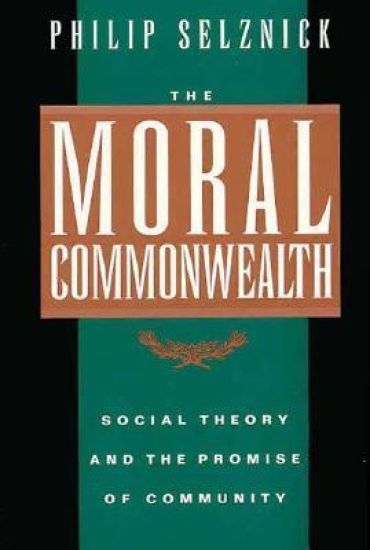
The Moral Commonwealth

The Moral Commonwealth

Philip Selznick

University of California Press
1994
pokkari
Philip Selznick's study of moral and social theory establishes the intellectual foundations of an important new movement in American thought: communitarianism. Emerging in part as a response to the excesses of American individualism - particularly rampant during the 1980s - communitarianism seeks to restore the balance between individual rights and social responsibilities. The Moral Commonwealth attempts to explain and justify this communitarian turn and give it a liberal interpretation.
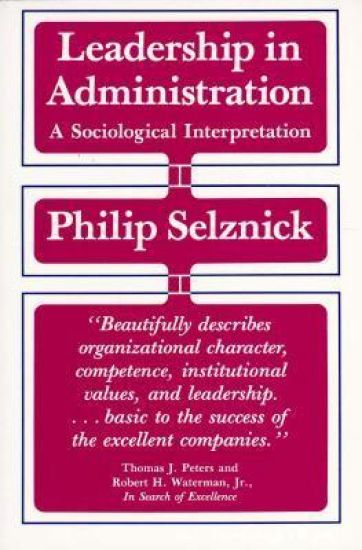
Leadership in Administration

Leadership in Administration

Philip Selznick

University of California Press
1984
pokkari
From the Preface:This essay outlines a perspective for the study of leadership in administrative organizations. It was written in the conviction that more reflective, theoretical discussion is needed to guide the gathering of facts that the diagnosis of troubles. This subject, like the larger study of government and society, requires our profoundest intellectual concern. We shall not find any simple prescriptions for sound organizational leadership; nor will it be purchased with a bag of tricks and gadgets. It requires nothing less than the proper ordering of human affairs, including the establishment of social order, the determination of public interest, and the defense of critical values. Thus conceived, our inquiry has ancient roots. The main problems and issues have been known for a long time, although they need to be restated for the purposes of administrative theory.