Kirjojen hintavertailu. Mukana 12 595 353 kirjaa ja 12 kauppaa.

Kirjailija

Philip T. Hoffman

Kirjat ja teokset yhdessä paikassa: 7 kirjaa, julkaisuja vuosilta 2000-2026, suosituimpien joukossa Why Europe?. Vertaile teosten hintoja ja tarkista saatavuus suomalaisista kirjakaupoista.

7 kirjaa

Kirjojen julkaisuhaarukka 2000-2026.

Why Europe?

Why Europe?

Philip T. Hoffman

Cambridge University Press
2026
nidottu
Economic growth transformed the world. It freed us from a world where nearly everyone was mired in poverty and half of all children died before reaching adulthood. However, these benefits have not been felt everywhere, nor by everyone. In this groundbreaking new account of the divergence between east and west, Philip T. Hoffman uncovers the ultimate causes of economic growth and the reasons why it originated in seventeenth-century western Europe. He examines the relative impacts of a wide range of economic, political, and social factors, from high wages, cheap capital, and financial institutions to political fragmentation, porous borders, and interstate warfare. Through accessible economic principles and fascinating case studies, he demonstrates why growth began in Britain, why it spread so unevenly elsewhere, and why inequality inhibits growth.
Why Europe?

Why Europe?

Philip T. Hoffman

Cambridge University Press
2026
sidottu
Economic growth transformed the world. It freed us from a world where nearly everyone was mired in poverty and half of all children died before reaching adulthood. However, these benefits have not been felt everywhere, nor by everyone. In this groundbreaking new account of the divergence between east and west, Philip T. Hoffman uncovers the ultimate causes of economic growth and the reasons why it originated in seventeenth-century western Europe. He examines the relative impacts of a wide range of economic, political, and social factors, from high wages, cheap capital, and financial institutions to political fragmentation, porous borders, and interstate warfare. Through accessible economic principles and fascinating case studies, he demonstrates why growth began in Britain, why it spread so unevenly elsewhere, and why inequality inhibits growth.
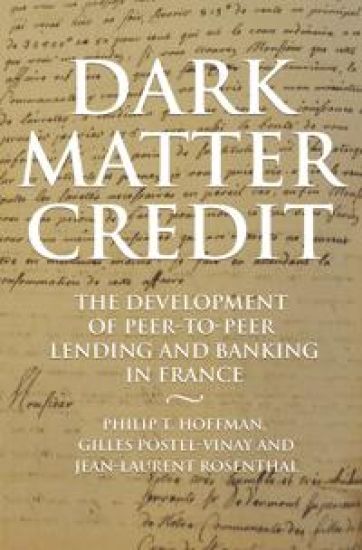
Dark Matter Credit

Dark Matter Credit

Philip T. Hoffman; Gilles Postel-Vinay; Jean-Laurent Rosenthal

Princeton University Press
2019
sidottu
How a vast network of shadow credit financed European growth long before the advent of bankingPrevailing wisdom dictates that, without banks, countries would be mired in poverty. Yet somehow much of Europe managed to grow rich long before the diffusion of banks. Dark Matter Credit draws on centuries of cleverly collected loan data from France to reveal how credit abounded well before banks opened their doors. This incisive book shows how a vast system of shadow credit enabled nearly a third of French families to borrow in 1740, and by 1840 funded as much mortgage debt as the American banking system of the 1950s.Dark Matter Credit traces how this extensive private network outcompeted banks and thrived prior to World War I—not just in France but in Britain, Germany, and the United States—until killed off by government intervention after 1918. Overturning common assumptions about banks and economic growth, the book paints a revealing picture of an until-now hidden market of thousands of peer-to-peer loans made possible by a network of brokers who matched lenders with borrowers and certified the borrowers’ creditworthiness.A major work of scholarship, Dark Matter Credit challenges widespread misperceptions about French economic history, such as the notion that banks proliferated slowly, and the idea that financial innovation was hobbled by French law. By documenting how intermediaries in the shadow credit market devised effective financial instruments, this compelling book provides new insights into how countries can develop and thrive today.
Why Did Europe Conquer the World?

Why Did Europe Conquer the World?

Philip T. Hoffman

Princeton University Press
2017
pokkari
Between 1492 and 1914, Europeans conquered 84 percent of the globe. But why did Europe establish global dominance, when for centuries the Chinese, Japanese, Ottomans, and South Asians were far more advanced? In Why Did Europe Conquer the World?, Philip Hoffman demonstrates that conventional explanations--such as geography, epidemic disease, and the Industrial Revolution--fail to provide answers. Arguing instead for the pivotal role of economic and political history, Hoffman shows that if certain variables had been different, Europe would have been eclipsed, and another power could have become master of the world. Hoffman sheds light on the two millennia of economic, political, and historical changes that set European states on a distinctive path of development, military rivalry, and war. This resulted in astonishingly rapid growth in Europe's military sector, and produced an insurmountable lead in gunpowder technology. The consequences determined which states established colonial empires or ran the slave trade, and even which economies were the first to industrialize. Debunking traditional arguments, Why Did Europe Conquer the World? reveals the startling reasons behind Europe's historic global supremacy.
Why Did Europe Conquer the World?

Why Did Europe Conquer the World?

Philip T. Hoffman

Princeton University Press
2015
sidottu
Between 1492 and 1914, Europeans conquered 84 percent of the globe. But why did Europe establish global dominance, when for centuries the Chinese, Japanese, Ottomans, and South Asians were far more advanced? In Why Did Europe Conquer the World?, Philip Hoffman demonstrates that conventional explanations--such as geography, epidemic disease, and the Industrial Revolution--fail to provide answers. Arguing instead for the pivotal role of economic and political history, Hoffman shows that if certain variables had been different, Europe would have been eclipsed, and another power could have become master of the world. Hoffman sheds light on the two millennia of economic, political, and historical changes that set European states on a distinctive path of development, military rivalry, and war. This resulted in astonishingly rapid growth in Europe's military sector, and produced an insurmountable lead in gunpowder technology. The consequences determined which states established colonial empires or ran the slave trade, and even which economies were the first to industrialize. Debunking traditional arguments, Why Did Europe Conquer the World? reveals the startling reasons behind Europe's historic global supremacy.
Surviving Large Losses

Surviving Large Losses

Philip T. Hoffman; Gilles Postel-Vinay; Jean-Laurent Rosenthal

The Belknap Press
2009
nidottu
Listen to a short interview with Philip T. HoffmanHost: Chris Gondek | Producer: Heron & CraneFinancial disasters often have long-range institutional consequences. When financial institutions--banks, insurance companies, brokerage firms, stock exchanges--collapse, new ones take their place, and these changes shape markets for decades or even generations. Surviving Large Losses explains why such financial crises occur, why their effects last so long, and what political and economic conditions can help countries both rich and poor survive--and even prosper--in the aftermath.Looking at past and more recent financial disasters through the lens of political economy, the authors identify three factors critical to the development of financial institutions: the level of government debt, the size of the middle class, and the quality of information that is available to participants in financial transactions. They seek to find out when these factors promote financial development and mitigate the effects of financial crises and when they exacerbate them.Although there is no panacea for crises--no one set of institutions that will resolve them--it is possible, the authors argue, to strengthen existing financial institutions, to encourage economic growth, and to limit the harm that future catastrophes can do.
Growth in a Traditional Society

Growth in a Traditional Society

Philip T. Hoffman

Princeton University Press
2000
pokkari
Philip Hoffman shatters the widespread myth that traditional agricultural societies in early modern Europe were socially and economically stagnant and ultimately dependent on wide-scale political revolution for their growth. Through a richly detailed historical investigation of the peasant agriculture of ancien-regime France, the author uncovers evidence that requires a new understanding of what constituted economic growth in such societies. His arguments rest on a measurement of long-term growth that enables him to analyze the economic, institutional, and political factors that explain its forms and rhythms. In comparing France with England and Germany, Hoffman arrives at fresh answers to some classic questions: Did French agriculture lag behind farming in other countries? If so, did the obstacles in French agriculture lurk within peasant society itself, in the peasants' culture, in their communal property rights, or in the small scale of their farms? Or did the obstacles hide elsewhere, in politics, in the tax system, or in meager opportunities for trade? The author discovers that growth cannot be explained by culture, property rights, or farm size, and argues that the real causes of growth derived from politics and gains from trade. By challenging other widely held beliefs, such as the nature of the commons and the workings of the rural economy, Hoffman offers a new analysis of peasant society and culture, one based on microeconomics and game theory and intended for a wide range of social scientists.