Kirjojen hintavertailu. Mukana 12 595 353 kirjaa ja 12 kauppaa.

Kirjailija

Philipp Frank

Kirjat ja teokset yhdessä paikassa: 13 kirjaa, julkaisuja vuosilta 1934-2022, suosituimpien joukossa Einstein. Vertaile teosten hintoja ja tarkista saatavuus suomalaisista kirjakaupoista.

13 kirjaa

Kirjojen julkaisuhaarukka 1934-2022.

The Humanistic Background of Science

The Humanistic Background of Science

Philipp Frank

STATE UNIVERSITY OF NEW YORK PRESS
2022
pokkari
The once-lost introduction to the philosophy of science by Philipp Frank (1884-1966), a leading member of the Vienna circle of philosophers and biographer of Albert Einstein.Philipp Frank (1884–1966) was an influential philosopher of science, public intellectual, and Harvard educator whose last book, The Humanistic Background of Science, is finally available. Never published in his lifetime, this original manuscript has been edited and introduced to highlight Frank's remarkable but little-known insights about the nature of modern science-insights that rival those of Karl Popper and Frank's colleagues Thomas Kuhn and James Bryant Conant. As a leading exponent of logical empiricism and a member of the famous Vienna Circle, Frank intended his book to provide an accessible, engaging introduction to the philosophy of science and its cultural significance. The book is steadfastly true to science; to aspirations of peace, unity, and human flourishing after World War II; and to the pragmatic philosophies of Charles S. Peirce, William James, and John Dewey that Frank embraced in his new American home. Amidst the many recent surveys and retrospective analyses of midcentury philosophy of science, The Humanistic Background of Science offers an original, first-hand view of Frank's post-European life and of intellectual dramas then unfolding in Chicago, New York City, and Boston.

The Humanistic Background of Science

The Humanistic Background of Science

Philipp Frank

State University of New York Press
2021
sidottu
The once-lost introduction to the philosophy of science by Philipp Frank (1884-1966), a leading member of the Vienna circle of philosophers and biographer of Albert Einstein.Philipp Frank (1884–1966) was an influential philosopher of science, public intellectual, and Harvard educator whose last book, The Humanistic Background of Science, is finally available. Never published in his lifetime, this original manuscript has been edited and introduced to highlight Frank's remarkable but little-known insights about the nature of modern science-insights that rival those of Karl Popper and Frank's colleagues Thomas Kuhn and James Bryant Conant. As a leading exponent of logical empiricism and a member of the famous Vienna Circle, Frank intended his book to provide an accessible, engaging introduction to the philosophy of science and its cultural significance. The book is steadfastly true to science; to aspirations of peace, unity, and human flourishing after World War II; and to the pragmatic philosophies of Charles S. Peirce, William James, and John Dewey that Frank embraced in his new American home. Amidst the many recent surveys and retrospective analyses of midcentury philosophy of science, The Humanistic Background of Science offers an original, first-hand view of Frank's post-European life and of intellectual dramas then unfolding in Chicago, New York City, and Boston.

The Law of Causality and Its Limits
The Law of Causality and its Limits was the principal philosophical work of the physicist turned philosopher, Philipp Frank. Born in Vienna on March 20, 1884, Frank died in Cambridge, Massachusetts on July 21, 1966. He received his doctorate in 1907 at the University of Vienna in theoretical physics, having studied under Ludwig Boltzmann; his sub­ sequent research in physics and mathematics was represented by more than 60 scientific papers. Moreover his great success as teacher and expositor was recognized throughout the scientific world with publication of his collaborative Die Differentialgleichungen der Mechanik und Physik, with Richard von Mises, in 1925-27. Frank was responsible for the second volume, on physics, and especially noted for his authoritative article on classical Hamiltonian mechanics and optics. Among his earliest papers were those, beginning in 1908, devoted to special relativity, which together with general relativity and physical cosmology occupied him throughout his life. Already in 1907, Frank published his seminal paper 'Kausalgesetz und Erfahrung' ('Experience and the Law of Causality'), much later collected with a splendid selection of his essays on philosophy of science, in English (1941c and 1949g, in our Bibliography). Joining the first 'Vienna Circle' in the first decade of the 20th century, with Hans Hahn, mathematician, and Otto Neurath, sociologist and economist, and deeply influenced by studies of Ernst Mach's critical conceptual histories of science and by the striking challenge of Poincare and Duhem, Frank continued his epistemological investigations.
Einstein

Einstein

Philipp Frank

Vieweg+teubner Verlag
2012
nidottu
Das Manuskript zu diesem Buch ist unter merkwürdigen Um­ ständen entstanden. Ich begann die Niederschrift 1939 in New York, setzte sie 1940 in Chicago fort und beendete den größten Teil 1941 in Boston. Das Manuskript war in deutscher Sprache geschrieben, aber begreiflicherweise unter der damaligen Reichs­ regierung nicht für eine Veröffentlichung in deutscher Sprache bestimmt; 'es sollte ins Englische übersetzt und in Amerika ver­ öffentlicht werden. Bevor die übersetzung beendet war, wurde die Einsteinsche Relativitätstheorie, die oft als eine spekulative Hypothese an­ gesehen und unterschätzt wurde, die Grundlage einer ganz neuen Wendung in der technischen Entwicklung der Menschheit: Die Kernenergie des Atoms wurde die Energiequelle der Zukunft, und all die trüben Prophezeiungen über ein Versagen der Energie­ quellen konnten zum alten Gerümpel geworfen werden. Jm Jahre 1945 fügte ich eine Darstellung dieser Wendung in englischer Sprache hinzu, und dieser Teil ist der einzige im Buch, der aus dem Englischen übersetzt ist. Die amerikanische Ausgabe erschien 1947; große Teile der deutschen Fassung wurden nicht aufgenom­ men. Daher ist das vorliegende Buch die erste vollständige Wieder­ gabe meines Manuskriptes.
Relativity: A Richer Truth

Relativity: A Richer Truth

Philipp Frank; Albert Einstein

Literary Licensing, LLC
2012
sidottu
Relativity: A Richer Truth is a book written by Philipp Frank that explores the fundamental principles of Albert Einstein's theory of relativity. The book is a comprehensive guide that delves into the history and development of the theory, explaining the complex concepts and ideas in a clear and concise manner.The book is divided into two parts, with the first part focusing on the historical background of relativity and the second part delving into the mathematical and physical principles that underlie the theory. The author provides a detailed account of Einstein's life and work, tracing the evolution of his ideas and the scientific and philosophical debates that surrounded them.The second part of the book explores the mathematical and physical principles that form the foundation of relativity. The author explains the concepts of space-time, the equivalence principle, and the nature of gravity, among others, in a way that is accessible to readers with no prior knowledge of physics.In addition to providing a clear and comprehensive introduction to relativity, the book also highlights the broader implications of the theory for our understanding of the universe and our place within it. The author discusses the philosophical and cultural implications of relativity, exploring its impact on our concepts of time, space, and reality.Overall, Relativity: A Richer Truth is an engaging and informative book that offers readers a deeper understanding of one of the most important scientific theories of the modern era. It is a must-read for anyone interested in the history of science, physics, or the philosophical implications of relativity.This scarce antiquarian book is a facsimile reprint of the old original and may contain some imperfections such as library marks and notations. Because we believe this work is culturally important, we have made it available as part of our commitment for protecting, preserving, and promoting the world's literature in affordable, high quality, modern editions, that are true to their original work.
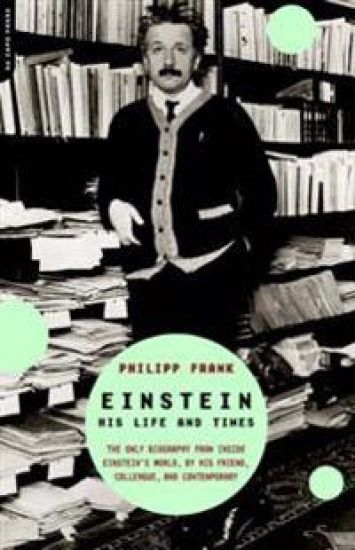
Einstein - His Life And Times

Einstein - His Life And Times

Philipp Frank

READ BOOKS
2008
sidottu
Einstein His Life and Times By PHILIPP FRANK. Contents include: I. EINSTEIN'S YOUTH AND TRAINING 1 Family Background 3 2 Childhood 6 3 Gymnasium in Munich 10 4 Intellectual Interests 12 5 Departure from Munich 15 6 Student at Zurich 18 7 Official of a Patent Office 21 II. CONCEPTIONS OF THE PHYSICAL WORLD BEFORE EINSTEIN 1 Philosophical Conception of Nature 25 2 Organismic Physics of the Middle Ages 27 3 Mechanistic Physics and Philosophy 28 4 Relativity Principle in Newtonian Mechanics 30 5 Ether as a Mechanical Hypothesis 32 6 Remnants of Medieval Concepts in Mechanistic Physics 34 7 Critics of the Mechanistic Philosophy 36 8 Ernst Mach: The General Laws of Physics Are Summaries of Observations Organized in Simple Forms 38 9 Henri Polncarl: The General Laws of Physics Are Free Creations of the Human Mind 40 10 Positivistic and Pragmatic Movements 42 11 Science at the End of the Nineteenth Century 45 HI. BEGINNING OF A NEW ERA IN PHYSICS 1 Life in Bern 49 2 Interest in Philosophy 50 3 The Fundamental Hypotheses of the Theory of Relativity 53 vli Contents 4 Consequences of Einstein's Two Hypotheses 55 5 Relativity of Time 57 6 Relativity of Other Physical Concepts 63 7 Equivalence of Mass and Energy 65 8 Theory of Brownian Motion 67 9 Origin of the Quantum Theory 69 10 Theory of the Photon 71 IV. EINSTEIN AT PRAGUE 1 Professor at the University of Zurich 74 2 Appointment to Prague 77 3 Colleagues at Prague 80 4 TA? Jews in Prague 83 5 Einstein's Personality Portrayed in a Novel 85 6 Einstein as a Professor 89 7 Generalization of the Special Theory of Relativity 91 8 Influence of Gravity on the Propagation of Light 94 9 Departure from Prague 98 V. EINSTEIN AT BERLIN 1 The Solvay Congress 101 2 Trip to Vienna 103 3 Invitation to Berlin 106 4 Einstein's Position in the Academic Life of Berlin 109 5 Relationship with Colleagues 112 6 Relationship with Students 116 7 Outbrea of the World War 119 8 German Science in the War 121 9 Lz'jfe iVz Wartime 123 VI. THE GENERAL THEORY OF RELATIVITY 1 New Theory of Gravitation 127 2 . R0/
Einstein

Einstein

Philipp Frank

Da Capo Press Inc
2002
pokkari
Much has been written about Albert Einstein, technical and biographical, but very little remains as valuable as this unique hybrid of a book written by Einstein's colleague and contemporary. Both rich in personal insights and grounded in a deep knowledge of twentieth-century science, Phillip Frank's biography anchors the reader with a lucid overview of physics and draws an intimate portrait of the Nobel Prize-winner.
The Law of Causality and Its Limits
The Law of Causality and its Limits was the principal philosophical work of the physicist turned philosopher, Philipp Frank. Born in Vienna on March 20, 1884, Frank died in Cambridge, Massachusetts on July 21, 1966. He received his doctorate in 1907 at the University of Vienna in theoretical physics, having studied under Ludwig Boltzmann; his sub­ sequent research in physics and mathematics was represented by more than 60 scientific papers. Moreover his great success as teacher and expositor was recognized throughout the scientific world with publication of his collaborative Die Differentialgleichungen der Mechanik und Physik, with Richard von Mises, in 1925-27. Frank was responsible for the second volume, on physics, and especially noted for his authoritative article on classical Hamiltonian mechanics and optics. Among his earliest papers were those, beginning in 1908, devoted to special relativity, which together with general relativity and physical cosmology occupied him throughout his life. Already in 1907, Frank published his seminal paper 'Kausalgesetz und Erfahrung' ('Experience and the Law of Causality'), much later collected with a splendid selection of his essays on philosophy of science, in English (1941c and 1949g, in our Bibliography). Joining the first 'Vienna Circle' in the first decade of the 20th century, with Hans Hahn, mathematician, and Otto Neurath, sociologist and economist, and deeply influenced by studies of Ernst Mach's critical conceptual histories of science and by the striking challenge of Poincare and Duhem, Frank continued his epistemological investigations.
Logische Syntax der Sprache

Logische Syntax der Sprache

Rudolf Carnap; Philipp Frank; Moritz Schlick

Springer-Verlag Berlin and Heidelberg GmbH Co. K
1934
nidottu
Dieser Buchtitel ist Teil des Digitalisierungsprojekts Springer Book Archives mit Publikationen, die seit den Anfängen des Verlags von 1842 erschienen sind. Der Verlag stellt mit diesem Archiv Quellen für die historische wie auch die disziplingeschichtliche Forschung zur Verfügung, die jeweils im historischen Kontext betrachtet werden müssen. Dieser Titel erschien in der Zeit vor 1945 und wird daher in seiner zeittypischen politisch-ideologischen Ausrichtung vom Verlag nicht beworben.