Kirjojen hintavertailu. Mukana 12 595 353 kirjaa ja 12 kauppaa.

Kirjailija

Piero Mella

Kirjat ja teokset yhdessä paikassa: 8 kirjaa, julkaisuja vuosilta 2012-2025, suosituimpien joukossa The Combinatory Systems Theory. Vertaile teosten hintoja ja tarkista saatavuus suomalaisista kirjakaupoista.

8 kirjaa

Kirjojen julkaisuhaarukka 2012-2025.

The Combinatory Systems Theory

The Combinatory Systems Theory

Piero Mella

Springer International Publishing AG
2025
sidottu
This book adopts the logic of Systems Thinking and Control Systems, presenting a simple but complete theory called the Theory of Combinatory Systems. This new theory describes, interprets, explains, and simulates collective phenomena and their observable effects. Such collective phenomena – many of which are “one way", non-repeatable or reproducible – can all be described and understood using the model, as simple as it is general, of combinatory systems; that is, systems formed by collectivities, or populations of non-connected and unorganized individuals of some species, which appear to be directed by an invisible hand that guides the analogous actions of similar individuals in order to produce an emerging collective phenomenon. This edition includes enhanced theories such as an analysis of potential interactions between combinatory systems and their dynamics, highlighting the role of the environment in which such systems operate. It also includes new examples and enhanced figures that illustrate how combinatory systems are observed in social, biological and physical contexts.
The Magic Ring

The Magic Ring

Piero Mella

Springer Nature Switzerland AG
2022
nidottu
This book presents a new understanding on how control systems truly operate, and explains how to recognize, simulate, and improve control systems in all fields of activity. It also reveals the pervasive, ubiquitous and indispensable role of control processes in our life and the need to develop a “control-oriented thinking”—based on uncomplicated but effective models derived from systems thinking—that is, a true “discipline of control.” Over the book’s thirteen chapters, Piero Mella shows that there are simple control systems (rather than complex ones) that can easily help us to manage complexity without drawing upon more sophisticated control systems. It begins by reviewing the basic language of systems thinking and the models it allows users to create. It then introduces the control process, presenting the theoretical structure of three simple control systems we all can observe in order to gain fundamental knowledge from them about the basic structure of a control system. Then, it presents the anatomy of the simplest “magic ring” and the general theoretical model of any control system. This is followed by an introduction to a general typology of control systems and a broader view of control systems by investigating multi-lever control systems and multi-objective systems. The book undertakes the concepts through various environments, increasingly broader in scope to suggest to readers how to recognize therein control systems manifestations in everyday life and in natural phenomena. Updated for the 2nd edition, new chapters explore control systems regulating the biological environment and the organizations, with an in-depth study of the control of quality, productivity, production, stocks and costs. Finally, it concludes by dealing with the learning process, problem-solving, and designing the logical structure of control systems.
The Magic Ring

The Magic Ring

Piero Mella

Springer Nature Switzerland AG
2021
sidottu
This book presents a new understanding on how control systems truly operate, and explains how to recognize, simulate, and improve control systems in all fields of activity. It also reveals the pervasive, ubiquitous and indispensable role of control processes in our life and the need to develop a “control-oriented thinking”—based on uncomplicated but effective models derived from systems thinking—that is, a true “discipline of control.” Over the book’s thirteen chapters, Piero Mella shows that there are simple control systems (rather than complex ones) that can easily help us to manage complexity without drawing upon more sophisticated control systems. It begins by reviewing the basic language of systems thinking and the models it allows users to create. It then introduces the control process, presenting the theoretical structure of three simple control systems we all can observe in order to gain fundamental knowledge from them about the basic structure of a control system. Then, it presents the anatomy of the simplest “magic ring” and the general theoretical model of any control system. This is followed by an introduction to a general typology of control systems and a broader view of control systems by investigating multi-lever control systems and multi-objective systems. The book undertakes the concepts through various environments, increasingly broader in scope to suggest to readers how to recognize therein control systems manifestations in everyday life and in natural phenomena. Updated for the 2nd edition, new chapters explore control systems regulating the biological environment and the organizations, with an in-depth study of the control of quality, productivity, production, stocks and costs. Finally, it concludes by dealing with the learning process, problem-solving, and designing the logical structure of control systems.
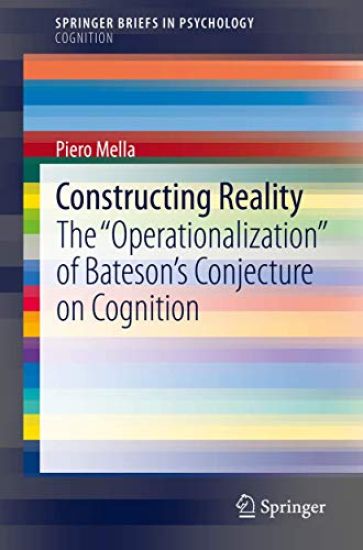
Constructing Reality

Constructing Reality

Piero Mella

Springer Nature Switzerland AG
2020
nidottu
This brief presents an overview of Gregory Bateson’s Constructivist method of Cognition. Bateson proposes a theory of cognition that is based on the abstract notion of difference that the mind distinguishes and perceives and represents information that constitutes and separates how different states are ordered, grouped, and classified. Bateson, however, does not clearly indicate how a cognitive system can develop a knowledge of reality from the perception of these differences. This book seeks to offer a scientific approach to Constructivism. Using Bateson’s hypothesis, chapters discuss how our mind distinguishes and elaborates differences, allowing us to form perceptions of objects, and how these objects can be described and compared. Chapters also discuss how from differences, it is possible to construct concepts or ideas of how these can be defined and how to derive from these differences the meanings of the signs used for the structuring of languages. The brief offers a coherent structure of propositions that form an interpretative theory of the modus operandi of the human mind, which will be useful not only in shedding light on our cognitive processes, but also in laying the formal groundwork for artificial intelligence. Constructing Reality is a must-have resource for researchers and students of the cognitive sciences, as well as education sciences, and researchers and scholars of artificial intelligence, learning theory, and intelligent automata programming.
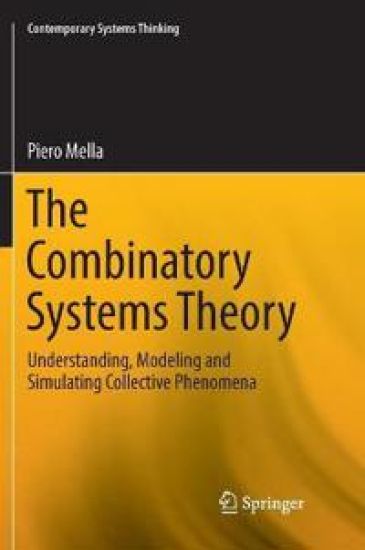
The Combinatory Systems Theory

The Combinatory Systems Theory

Piero Mella

Springer International Publishing AG
2018
nidottu
This study adopts the logic of Systems Thinking and Control Systems, presenting a simple but complete theory called the Theory of Combinatory Systems. This new theory is able to describe, interpret, explain, simulate and control collective phenomena and their observable effects. Despite specific differences among these phenomena – many of which are “one way", non-repeatable or reproducible – they can all be described or explained, and thus understood, using the model, as simple as it is general, of combinatory systems; that is, systems formed by collectivities, or populations of non-connected and unorganized individuals of some species, which appear to be directed by an invisible hand that guides the analogous actions of similar individuals in order to produce an emerging collective phenomenon. Combinatory Systems function due to the presence of micro control systems which, operating at the individual level, lead to uniform micro behavior by individuals in order to eliminate the (gap)with respect to the objective that is represented – or revealed – by the global information (macro behavior or effect). The book also examines Combinatory Automata, which represent a powerful tool for simulating the most relevant combinatory systems. In stochastic combinatory automata, when both probabilities and periods of transition of state are agent/time/state sensitive, the probabilistic micro behaviors are conditioned by the macro behavior of the entire system, which makes the micro-macro feedback more evident.The Combinatory Systems Theory: Understanding, Modeling and Simulating Collective Phenomena is composed of four main chapters. Chapter 1 presents the basic ideas behind the theory, which are analysed in some detail. Chapter 2 describes the heuristic models of several relevant combinatory systems observable in different environments. Chapter 3, while not making particular use of sophisticated mathematical and statistical tools, presents the Theory of Combinatory Automata and builds models for simulating the operative logic of combinatory systems. Chapter 4 tries to answer three questions: are combinatory systems “systems” in the true sense of the term? Why is this theory able to explain so many and so varied a number of phenomena, even though it is based on a very simple modus operandi? Are combinatory systems different than complex systems? The book has been written with no prerequisite required to read and understand it, in particular math, statistics and computer knowledge.
The Magic Ring

The Magic Ring

Piero Mella

Springer International Publishing AG
2016
nidottu
This book presents a gradual path toward “educating” readers in understanding how Control Systems truly operate and in recognizing, simulating and improving them in all fields of activity. Starting from the hypothesis that knowledge of Control Systems is not only a technical fact but also represents a discipline – that is, “A discipline is a developmental path for acquiring certain skills or competencies. (…) To practice a discipline is to be a lifelong learner. You “never arrive”; you spend your life mastering disciplines.” (Senge, 2006, p. 10) – Piero Mella has set the objective of making Control Systems a topic that is, in a certain sense, simple and attractive by turning to the effective symbolism typical of Systems Thinking models and avoiding too technical and formal a treatment of the subject. Thus readers should know that this is not an engineering, physics, biology or economics text, nor a mathematics one either. Technical or mathematical tools are not necessary to construct Control Systems; instead the book adopts a highly simple and universal logic behind the notion itself of control process and the simple and universal action of the Control Systems that produce this process.The Magic Ring: Systems Thinking Approach to Control Systems is divided into 10 chapters. Chapter 1 seeks to review the basic language of Systems Thinking and the models it allows us to create, while Chapter 2 introduces the control process, presenting the theoretical structure of four simple Control Systems we all can observe and manage. In Chapter 3 a general typology of Control Systems is proposed with examples taken from observations of reality. The view of Control Systems is broadened in Chapter 4 by introducing two important generalizations: 1. multi lever Control Systems, with levers that are independent or dependent of each other; 2. multi-objective systems, with independent or interdependent objectives. Chapter 5 outlines the guidelines for recognizing, observing or designing Control Systems and presents the problems that arise regarding their logical realization, introducing the fundamental distinction between symptomatic and structural control. Chapters 6-9 undertake a “mental journey” through various “environments”, increasingly broader in scope, suggesting to the reader how to recognize therein Control Systems that, by their ubiquitous presence, make the world possible in all its manifestations. Finally Chapter 10 covers ideas about a Discipline of Control Systems and the human aspects of control.
Systems Thinking

Systems Thinking

Piero Mella

Springer Verlag
2014
nidottu
The core belief underlying this book is that the most useful and effective models to strengthen our intelligence are system ones, developed following the logic of Systems Thinking. Such models can explore complexity, dynamics, and change, and it is the author’s view that intelligence depends on the ability to construct models of this nature. The book is designed to allow the reader not only to acquire simple information on Systems Thinking but above all to gradually learn the logic and techniques that make this way of thinking an instrument for the improvement of intelligence. In order to aid the learning and practice of the Systems Thinking discipline, the author has abandoned a rigid formal language for a more discursive style. He writes in the first person, with an ample number of citations and critical analyses, and without ever giving in to the temptation to use formal mathematics.
Systems Thinking

Systems Thinking

Piero Mella

Springer Verlag
2012
sidottu
The core belief underlying this book is that the most useful and effective models to strengthen our intelligence are system ones, developed following the logic of Systems Thinking. Such models can explore complexity, dynamics, and change, and it is the author’s view that intelligence depends on the ability to construct models of this nature. The book is designed to allow the reader not only to acquire simple information on Systems Thinking but above all to gradually learn the logic and techniques that make this way of thinking an instrument for the improvement of intelligence. In order to aid the learning and practice of the Systems Thinking discipline, the author has abandoned a rigid formal language for a more discursive style. He writes in the first person, with an ample number of citations and critical analyses, and without ever giving in to the temptation to use formal mathematics.