Kirjojen hintavertailu. Mukana 12 595 353 kirjaa ja 12 kauppaa.

Kirjailija

Pieter Harpe

Kirjat ja teokset yhdessä paikassa: 2 kirjaa, julkaisuja vuosilta 2010-2012, suosituimpien joukossa Smart AD and DA Conversion. Vertaile teosten hintoja ja tarkista saatavuus suomalaisista kirjakaupoista.

2 kirjaa

Kirjojen julkaisuhaarukka 2010-2012.

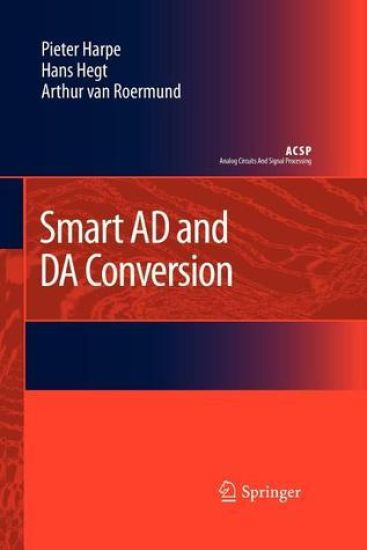
Smart AD and DA Conversion

Smart AD and DA Conversion

Pieter Harpe; Hans Hegt; Arthur H.M. van Roermund

Springer
2012
nidottu
The history of the application of semiconductors for controlling currents goes back all the way to 1926, in which Julius Lilienfeld led a patent for a “Method and apparatus for controlling electric currents” [1], which is considered the rst work on metal/semiconductor eld-effect transistors. More well-known is the work of William Shockley, John Bardeen and Walter Brattain in the 1940s [2, 3], after which the development of semiconductor devices commenced. In 1958, independent work from Jack Kilby and Robert Noyce ledto the invention of integrated circuits. A few milestones in IC design are the rst monolithic operational ampli er in 1963 (Fairchild?A702, Bob Widlar) and the rst o- chip 4-bit microprocessor in 1971 (Intel 4004). Ever since the start of the semiconductor history, integration plays an imp- tant role: starting from single devices, ICs with basic functions were developed (e. g. opamps, logic gates), followed by ICs that integrate larger parts of a s- tem (e. g. microprocessors, radio tuners, audio ampli ers). Following this trend of system integration, this eventually leads to the integration of analog and d- ital components in one chip, resulting in mixed-signal ICs: digital components are required because signal processing is preferably done in the digital - main; analog components are required because physical signals are analog by nature. Mixed-signal ICs are already widespread in many applications (e. g. - dio, video); for the future, it is expected that this trend will continue, leading to a larger scale of integration.
Smart AD and DA Conversion

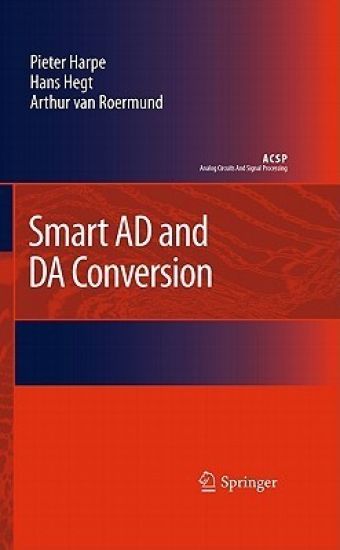
Smart AD and DA Conversion

Pieter Harpe; Hans Hegt; Arthur H.M. van Roermund

Springer
2010
sidottu
The history of the application of semiconductors for controlling currents goes back all the way to 1926, in which Julius Lilienfeld led a patent for a “Method and apparatus for controlling electric currents” [1], which is considered the rst work on metal/semiconductor eld-effect transistors. More well-known is the work of William Shockley, John Bardeen and Walter Brattain in the 1940s [2, 3], after which the development of semiconductor devices commenced. In 1958, independent work from Jack Kilby and Robert Noyce ledto the invention of integrated circuits. A few milestones in IC design are the rst monolithic operational ampli er in 1963 (Fairchild?A702, Bob Widlar) and the rst o- chip 4-bit microprocessor in 1971 (Intel 4004). Ever since the start of the semiconductor history, integration plays an imp- tant role: starting from single devices, ICs with basic functions were developed (e. g. opamps, logic gates), followed by ICs that integrate larger parts of a s- tem (e. g. microprocessors, radio tuners, audio ampli ers). Following this trend of system integration, this eventually leads to the integration of analog and d- ital components in one chip, resulting in mixed-signal ICs: digital components are required because signal processing is preferably done in the digital - main; analog components are required because physical signals are analog by nature. Mixed-signal ICs are already widespread in many applications (e. g. - dio, video); for the future, it is expected that this trend will continue, leading to a larger scale of integration.