Kirjojen hintavertailu. Mukana 12 390 323 kirjaa ja 12 kauppaa.

Kirjailija

Pim Martens

Kirjat ja teokset yhdessä paikassa: 4 kirjaa, julkaisuja vuosilta 2008-2014, suosituimpien joukossa Health and Climate Change. Vertaile teosten hintoja ja tarkista saatavuus suomalaisista kirjakaupoista.

4 kirjaa

Kirjojen julkaisuhaarukka 2008-2014.

Health and Climate Change

Health and Climate Change

Pim Martens

Routledge
2014
nidottu
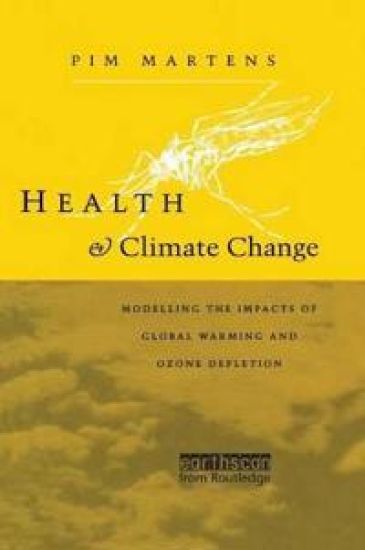
'Understanding how complex ecological and climatic change can influence human health is the new challenge before us. The book confronts these multidimensional risk assessments head-on and will catalyse the important interdisciplinary and integrated approach that is the new paradigm now required for environmental and public health research.' Dr JONATHAN PATZ Johns Hopkins School of Hygiene and Public Health 'This book provides a sturdy foundation for thinking about how best to tackle a varied spectrum of population health hazards posed by different aspects and combinations of global change processes it alsogoes that extra mile by estimating the attributable population burdens of disease or mortality that are likely to result from these aspects of global change. It is heartening to see the results of this mathematical modeling being presented in policy-relevant terms.' From the Foreword by TONY McMICHAEL Health and Climate Change is the first major study of the potentially devastating health impacts of the global atmospheric changes which are under way. Using the best available data, the author presents models of the most plausible future courses of vector-borne diseases such as malaria, dengue fever and schistosomiasis; skin cancer caused by nozone depletion; and cardiovascular and respiratory disorders caused by higher temperatures. Current epidemiological research methods are not well adapted to analysing complex systems influenced by human intervention, or more simple processes calculated to take place within the distant future. Health and Climate Change proposes a new paradigm of integrated eco-epidemiological models for these areas of study. It will be essential reading for those concerned with public health and epidemiology, environmental studies, climate change and development studies. Originally published in 1998
Measuring Globalisation

Measuring Globalisation

Axel Dreher; Noel Gaston; Pim Martens

Springer-Verlag New York Inc.
2010
nidottu
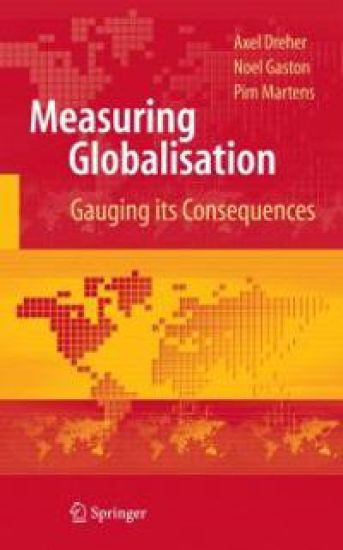
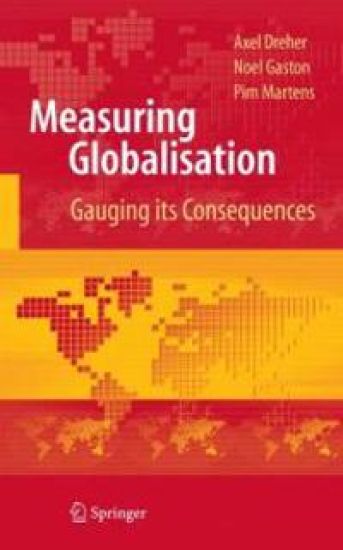
During the last few decades, human dynamics, institutional change, political relations, and the natural environment have become successively more intertwined. While the increased global economic integration, global forms of governance, globally inter-linked social and environmental developments are often referred to as “globalisation,” there is no unanimously-agreed upon definition of the term. Depending on the researcher or commentator, it can mean, among other things, the growing integration of markets and nation-states, receding geographical constraints on social and cultural arrangements, the increased dissemination of ideas and technologies, the threat to national sovereignty by trans-national actors; or the transformation of the economic, political and cultural foundations of societies. Regardless of perspective, globalisation permeates our economic, political, and social institutions to a profound degree. Recently, the issue of “sustainability” has reached the mainstream: are the forces of globalisation ultimately contributing to growth and opportunity—or to destruction and chaos? Against the chorus of globalisation’s proponents and detractors, the authors propose an approach for measuring globalisation and its consequences. Undertaking a comprehensive review of the literature on globalisation and using data from the MGI and KOF indices, the authors build a framework for defining globalisation and analyzing the relationships among economic, political, and social variables. In particular, they apply the methodology to analyze the effects of globalisation on tax policy, government spending, economic growth, inequality, union power, and the natural environment and consider additional avenues for research, analysis, and decision making. In the process, they hope that by introducing objective measures to enhance our insight into the functioning of the complex global system. Dreher, Gaston and Martens have produced the most systematicand comprehensive research I have seen on both measuring globalisation and analyzing its impact on the most important social and economic issues of our time. Globalisation research is a dense thicket. This books stands out among its many thorns. Geoffrey Garrett, President of the Pacific Council on International Policy This is an important contribution to the growing literature on measuring globalization. The analysis is comprehensive and insightful, making it a work that the students of globalization cannot ignore. Jagdish Bhagwati, University Professor, Economics and Law, Columbia University and Author of In Defense of Globalization
Health and Climate Change

Health and Climate Change

Pim Martens

Earthscan Ltd
2009
sidottu
'Understanding how complex ecological and climatic change can influence human health is the new challenge before us. The book confronts these multidimensional risk assessments head-on and will catalyse the important interdisciplinary and integrated approach that is the new paradigm now required for environmental and public health research.' Dr JONATHAN PATZ Johns Hopkins School of Hygiene and Public Health 'This book provides a sturdy foundation for thinking about how best to tackle a varied spectrum of population health hazards posed by different aspects and combinations of global change processes it alsogoes that extra mile by estimating the attributable population burdens of disease or mortality that are likely to result from these aspects of global change. It is heartening to see the results of this mathematical modeling being presented in policy-relevant terms.' From the Foreword by TONY McMICHAEL Health and Climate Change is the first major study of the potentially devastating health impacts of the global atmospheric changes which are under way. Using the best available data, the author presents models of the most plausible future courses of vector-borne diseases such as malaria, dengue fever and schistosomiasis; skin cancer caused by nozone depletion; and cardiovascular and respiratory disorders caused by higher temperatures. Current epidemiological research methods are not well adapted to analysing complex systems influenced by human intervention, or more simple processes calculated to take place within the distant future. Health and Climate Change proposes a new paradigm of integrated eco-epidemiological models for these areas of study. It will be essential reading for those concerned with public health and epidemiology, environmental studies, climate change and development studies. Originally published in 1998
Measuring Globalisation

Measuring Globalisation

Axel Dreher; Noel Gaston; Pim Martens

Springer-Verlag New York Inc.
2008
sidottu
During the last few decades, human dynamics, institutional change, political relations, and the natural environment have become successively more intertwined. While the increased global economic integration, global forms of governance, globally inter-linked social and environmental developments are often referred to as “globalisation,” there is no unanimously-agreed upon definition of the term. Depending on the researcher or commentator, it can mean, among other things, the growing integration of markets and nation-states, receding geographical constraints on social and cultural arrangements, the increased dissemination of ideas and technologies, the threat to national sovereignty by trans-national actors; or the transformation of the economic, political and cultural foundations of societies. Regardless of perspective, globalisation permeates our economic, political, and social institutions to a profound degree. Recently, the issue of “sustainability” has reached the mainstream: are the forces of globalisation ultimately contributing to growth and opportunity—or to destruction and chaos? Against the chorus of globalisation’s proponents and detractors, the authors propose an approach for measuring globalisation and its consequences. Undertaking a comprehensive review of the literature on globalisation and using data from the MGI and KOF indices, the authors build a framework for defining globalisation and analyzing the relationships among economic, political, and social variables. In particular, they apply the methodology to analyze the effects of globalisation on tax policy, government spending, economic growth, inequality, union power, and the natural environment and consider additional avenues for research, analysis, and decision making. In the process, they hope that by introducing objective measures to enhance our insight into the functioning of the complex global system. Dreher, Gaston and Martens have produced the most systematicand comprehensive research I have seen on both measuring globalisation and analyzing its impact on the most important social and economic issues of our time. Globalisation research is a dense thicket. This books stands out among its many thorns. Geoffrey Garrett, President of the Pacific Council on International Policy This is an important contribution to the growing literature on measuring globalization. The analysis is comprehensive and insightful, making it a work that the students of globalization cannot ignore. Jagdish Bhagwati, University Professor, Economics and Law, Columbia University and Author of In Defense of Globalization