Kirjailija
Pindar
Kirjat ja teokset yhdessä paikassa: 46 kirjaa, julkaisuja vuosilta 1986-2025, suosituimpien joukossa Pindar´s Olympische Siegesgesänge. Vertaile teosten hintoja ja tarkista saatavuus suomalaisista kirjakaupoista.
46 kirjaa
Kirjojen julkaisuhaarukka 1986-2025.

Pindar's Siegesgesaenge, mit Prolegomenis ueber Pindarische Kolometrie und Textkritik
Pindar
Antigonos Verlag
2025
nidottu
One of the most celebrated poets of the classical world, Pindar wrote odes for athletes that provide a unique perspective on the social and political life of ancient Greece. Commissioned in honor of successful contestants at the Olympic games and other Panhellenic contests, these odes were performed in the victors’ hometowns and conferred enduring recognition on their achievements. Andrew M. Miller’s superb new translation captures the beauty of Pindar’s forty-five surviving victory odes, preserving the rhythm, elegance, and imagery for which they have been admired since antiquity while adhering closely to the meaning of the original Greek. This edition provides a comprehensive introduction and interpretive notes to guide readers through the intricacies of the poems and the worldview that they embody.

One of the most celebrated poets of the classical world, Pindar wrote odes for athletes that provide a unique perspective on the social and political life of ancient Greece. Commissioned in honor of successful contestants at the Olympic games and other Panhellenic contests, these odes were performed in the victors’ hometowns and conferred enduring recognition on their achievements. Andrew M. Miller’s superb new translation captures the beauty of Pindar’s forty-five surviving victory odes, preserving the rhythm, elegance, and imagery for which they have been admired since antiquity while adhering closely to the meaning of the original Greek. This edition provides a comprehensive introduction and interpretive notes to guide readers through the intricacies of the poems and the worldview that they embody.


A Translation of all the Pythian, Nemean, and Isthmian Odes of Pindar, Except the Fourth and Fifth Pythian Odes, and Those Odes Which Have Been Translated by the Late Gilbert West, Esq. By the Rev. James Banister
Pindar
Gale Ecco, Print Editions
2018
sidottu
The 18th century was a wealth of knowledge, exploration and rapidly growing technology and expanding record-keeping made possible by advances in the printing press. In its determination to preserve the century of revolution, Gale initiated a revolution of its own: digitization of epic proportions to preserve these invaluable works in the largest archive of its kind. Now for the first time these high-quality digital copies of original 18th century manuscripts are available in print, making them highly accessible to libraries, undergraduate students, and independent scholars.Western literary study flows out of eighteenth-century works by Alexander Pope, Daniel Defoe, Henry Fielding, Frances Burney, Denis Diderot, Johann Gottfried Herder, Johann Wolfgang von Goethe, and others. Experience the birth of the modern novel, or compare the development of language using dictionaries and grammar discourses. ++++The below data was compiled from various identification fields in the bibliographic record of this title. This data is provided as an additional tool in helping to insure edition identification: ++++British LibraryT134722Half-title: 'A translation of the odes of Pindar.' - With a final errata leaf.Salisbury: printed by E. and J. Easton; for G. and T. Wilkie, London, 1791. 4], xv, 1],244, 2]





Seit 1923 erscheinen in der Sammlung Tusculum magebende Editionen griechischer und lateinischer Werke mit deutscher Ubersetzung. Die Originaltexte werden zudem eingeleitet und umfassend kommentiert; nach der neuen Konzeption bieten schlielich thematische Essays tiefere Einblicke in das Werk, seinen historischen Kontext und sein Nachleben. Die hohe wissenschaftliche Qualitat der Ausgaben, gepaart mit dem leserfreundlichen Sprachstil der Einfuhrungs- und Kommentarteile, macht jeden Tusculum-Band zu einer fundamentalen Lekture nicht nur fur Studierende, die sich zum ersten Mal einem antiken Autor nahern, und fur Wissenschaftler, die spezifische Aspekte eines Werkes vertiefen mochten, sondern fur alle, die sich durch vertrauenswurdige Ubersetzungen einen Zugang zur Antiken Welt verschaffen wollen. In der Reihe wurden bisher uber 270 Titel publiziert, alle erhaltlich als Buch und eBook. Dadruch werden bislang vergriffene Titel und Raritaten wieder vollstandig verfugbar gemacht. Zusatzlich zu der Buchreihe erscheint bei De Gruyter zum 90-jahrigen Jubilaum das eBook-PaketTusculum Online, eine digitale Sammlung aller von 1923 bis 2013 erschienenen Titel -eine gebuhrende Wurdigung eines wichtigen Stucks deutscher Verlagsgeschichte. Mehr Informationen rund um Tusculum erhalten Sie unter: www.degruyter.com/tusculum

Pindar, geboren 522/518 v. Chr. bei Theben, hat Chorlyrik berwiegend religi sen Inhalts geschrieben: Hymnen, Paiane und Dithyramben, aber auch M dchenlieder, Tanzlieder und Trauerges nge. Vollst ndig erhalten geblieben sind die vier B cher Siegeslieder (Epinikien), die den strengen Stil mythischer Dichtung mit der Sprache der sportlichen Wettk mpfe verbinden. Mit dieser Verschr nkung von aktuellem Anlass, mythischem Hintergrund, berlieferter Lebensweisheit und poetologischer Reflexion werden Spannungsb gen entworfen, die in der antiken wie in der modernen Lyrik einzigartig sind. Bereits in hellenistischer Zeit galt Pindar als der Lyriker schlechthin. Nicht anders sahen ihn die R mer, wobei Horaz in seiner Ode 4,2 warnt, der Versuch, Pindar nachzuahmen, k nne leicht wie der Flug des Ikaros mit einer Bruchlandung enden. In Deutschland beginnt die Wirkungsgeschichte mit Klopstock, reicht ber H lderlin und die Dichter des Sturm und Drang, wie den jungen Goethe, hin zu Nietzsche und den George-Kreis. Auch in der Lyrik Ezra Pounds sind Nachkl nge der Oden Pindars unverkennbar. Die vorliegende Ausgabe der Siegeslieder bietet neben dem griechischen Text eine bersetzung, deren Pr zision es dem Kenner des Griechischen erm glicht, sich in den Urtext einzulesen. Pindars Bildwelt wird exakt reproduziert, gewisserma en "dokumentiert," in einer rhythmisierten Prosa, die eigenst ndig neben fr heren Pindar-Verdeutschungen steht. Die sprachliche Struktur des Originals wird in ihrer harten F gung bewahrt und nicht einer Umsetzung in das Gewohnte geopfert. Zugleich wird eine Ann herung an eine unserer Zeit gem e Sprachform erreicht, die dem literarisch Interessierten den Zugang zu Pindar entschlie t. Eingehende Analyse zur Deutung und zur Wirkungsgeschichte k nnen zu einem vertieften Verst ndnis f hren.
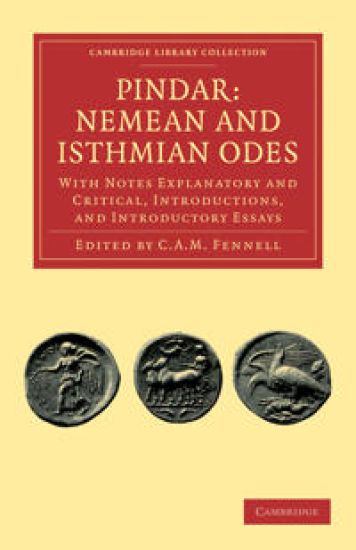
One of the nine canonical Greek lyric poets, Pindar (c. 522–443 BCE) has enjoyed a brilliant reputation since antiquity. Notoriously challenging but widely respected, Pindar's poetry has been increasingly studied in modern times. In the late nineteenth century, C. A. M. Fennell (1843–1916), a classicist and Fellow of Jesus College, Cambridge, turned his attention to Pindar's Nemean and Isthmian odes. First published in 1883 but released in a new edition in 1899, this book features an introduction focusing on the practical aspects of the pentathlon, which sets a good grounding for the comprehension of the odes themselves. Touching on metrical structure, this edition then presents each ode in its original Greek, accompanied by an individual, detailed introduction and full commentary. This fascinating work will be of value to advanced students of Greek grappling with the intricacies of Pindar's complex poetry.

You've just won the gold medal, what are you going to do? In Ancient Greece, your patron could throw a feast in your honor and have a poet write a hymn of praise to you. The great poet Pindar composed many such odes for victorious athletes. Esteemed classicist Anne Pippin Burnett presents a fresh and exuberant translation of Pindar's victory songs. The typical Pindaric ode reflects three separate moments: the instant of success in contest, the victory night with its disorderly revels, and the actual banquet of family and friends where the commissioned poem is being offered as entertainment. In their essential effect, these songs transform a physical triumph, as experienced by one man, into a sense of elation shared by his peers-men who have gathered to dine and to drink. Athletic odes were presented by small bands of dancing singers, influencing the audience with music and dance as well as by words. These translations respect the form of the originals, keeping the stanzas that shaped repeating melodies and danced figures and using rhythms meant to suggest performers in motion. Pindar's songs were meant to entertain and exalt groups of drinking men. These translations revive the confident excitement of their original performances.
Odes of Pindar. Translated from the Greek. by Gilbert West, ...
Pindar
Gale Ecco, Print Editions
2010
pokkari

A Translation of All the Pythian, Nemean, and Isthmian Odes of Pindar, Except the Fourth and Fifth Pythian Odes, and Those Odes Which Have Been Transl
Pindar
Gale Ecco, Print Editions
2010
nidottu