Kirjojen hintavertailu. Mukana 12 595 353 kirjaa ja 12 kauppaa.

Kirjailija

Ping Yan

Kirjat ja teokset yhdessä paikassa: 5 kirjaa, julkaisuja vuosilta 2008-2020, suosituimpien joukossa Quantitative Methods for Investigating Infectious Disease Outbreaks. Vertaile teosten hintoja ja tarkista saatavuus suomalaisista kirjakaupoista.

5 kirjaa

Kirjojen julkaisuhaarukka 2008-2020.

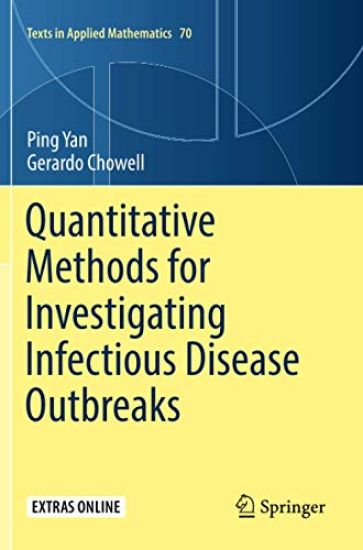
Quantitative Methods for Investigating Infectious Disease Outbreaks

Quantitative Methods for Investigating Infectious Disease Outbreaks

Ping Yan; Gerardo Chowell

Springer Nature Switzerland AG
2020
nidottu
This book provides a systematic treatment of the mathematical underpinnings of work in the theory of outbreak dynamics and their control, covering balanced perspectives between theory and practice including new material on contemporary topics in the field of infectious disease modelling. Specifically, it presents a unified mathematical framework linked to the distribution theory of non-negative random variables; the many examples used in the text, are introduced and discussed in light of theoretical perspectives. The book is organized into 9 chapters: The first motivates the presentation of the material on subsequent chapters; Chapter 2-3 provides a review of basic concepts of probability and statistical models for the distributions of continuous lifetime data and the distributions of random counts and counting processes, which are linked to phenomenological models. Chapters 4 focuses on dynamic behaviors of a disease outbreak during the initial phase while Chapters 5-6 broadly cover compartment models to investigate the consequences of epidemics as the outbreak moves beyond the initial phase. Chapter 7 provides a transition between mostly theoretical topics in earlier chapters and Chapters 8 and 9 where the focus is on the data generating processes and statistical issues of fitting models to data as well as specific mathematical epidemic modeling applications, respectively. This book is aimed at a wide audience ranging from graduate students to established scientists from quantitatively-oriented fields of epidemiology, mathematics and statistics. The numerous examples and illustrations make understanding of the mathematics of disease transmission and control accessible. Furthermore, the examples and exercises, make the book suitable for motivated students in applied mathematics, either through a lecture course, or through self-study. This text could be used in graduate schools or special summer schools covering research problems in mathematical biology.
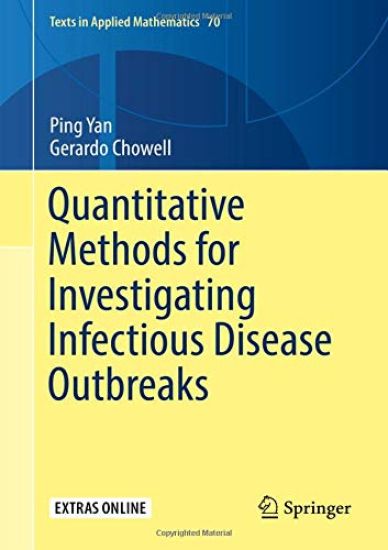
Quantitative Methods for Investigating Infectious Disease Outbreaks

Quantitative Methods for Investigating Infectious Disease Outbreaks

Ping Yan; Gerardo Chowell

Springer Nature Switzerland AG
2019
sidottu
This book provides a systematic treatment of the mathematical underpinnings of work in the theory of outbreak dynamics and their control, covering balanced perspectives between theory and practice including new material on contemporary topics in the field of infectious disease modelling. Specifically, it presents a unified mathematical framework linked to the distribution theory of non-negative random variables; the many examples used in the text, are introduced and discussed in light of theoretical perspectives. The book is organized into 9 chapters: The first motivates the presentation of the material on subsequent chapters; Chapter 2-3 provides a review of basic concepts of probability and statistical models for the distributions of continuous lifetime data and the distributions of random counts and counting processes, which are linked to phenomenological models. Chapters 4 focuses on dynamic behaviors of a disease outbreak during the initial phase while Chapters 5-6 broadly cover compartment models to investigate the consequences of epidemics as the outbreak moves beyond the initial phase. Chapter 7 provides a transition between mostly theoretical topics in earlier chapters and Chapters 8 and 9 where the focus is on the data generating processes and statistical issues of fitting models to data as well as specific mathematical epidemic modeling applications, respectively. This book is aimed at a wide audience ranging from graduate students to established scientists from quantitatively-oriented fields of epidemiology, mathematics and statistics. The numerous examples and illustrations make understanding of the mathematics of disease transmission and control accessible. Furthermore, the examples and exercises, make the book suitable for motivated students in applied mathematics, either through a lecture course, or through self-study. This text could be used in graduate schools or special summer schools covering research problems in mathematical biology.
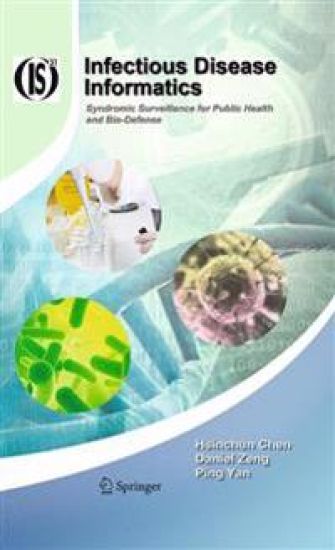
Infectious Disease Informatics

Infectious Disease Informatics

Hsinchun Chen; Daniel Zeng; Ping Yan

Springer-Verlag New York Inc.
2012
nidottu
Computer-based infectious disease surveillance systems are capable of real-time or near real-time detection of serious illnesses and potential bioterrorism agent exposures and represent a major step forward in disease surveillance. Infectious Disease Informatics: Syndromic Surveillance for Public Health and Bio-Defense is an in-depth monograph that analyzes and evaluates the outbreak modeling and detection capabilities of existing surveillance systems under a unified framework, and presents the first book-length coverage of the subject from an informatics-driven perspective. Individual chapters consider the state of the art, including the facilitation of data collection, sharing and transmission; a focus on various outbreak detection methods; data visualization and information dissemination issues; and system assessment and other policy issues. Eight chapters then report on several real-world case studies, summarizing and comparing eight syndromic surveillance systems, including those that have been adopted by many public health agencies (e.g., RODS and BioSense). The book concludes with a discussion of critical issues and challenges, with a look to future directions. This book is an excellent source of current information for researchers in public health and IT. Government public health officials and private-sector practitioners in both public health and IT will find the most up-to-date information available, and students from a variety of disciplines, including public health, biostatistics, information systems, computer science, and public administration and policy will get a comprehensive look at the concepts, techniques, and practices of syndromic surveillance.
Infectious Disease Informatics

Infectious Disease Informatics

Hsinchun Chen; Daniel Zeng; Ping Yan

Springer-Verlag New York Inc.
2009
sidottu
Computer-based infectious disease surveillance systems are capable of real-time or near real-time detection of serious illnesses and potential bioterrorism agent exposures and represent a major step forward in disease surveillance. Infectious Disease Informatics: Syndromic Surveillance for Public Health and Bio-Defense is an in-depth monograph that analyzes and evaluates the outbreak modeling and detection capabilities of existing surveillance systems under a unified framework, and presents the first book-length coverage of the subject from an informatics-driven perspective. Individual chapters consider the state of the art, including the facilitation of data collection, sharing and transmission; a focus on various outbreak detection methods; data visualization and information dissemination issues; and system assessment and other policy issues. Eight chapters then report on several real-world case studies, summarizing and comparing eight syndromic surveillance systems, including those that have been adopted by many public health agencies (e.g., RODS and BioSense). The book concludes with a discussion of critical issues and challenges, with a look to future directions. This book is an excellent source of current information for researchers in public health and IT. Government public health officials and private-sector practitioners in both public health and IT will find the most up-to-date information available, and students from a variety of disciplines, including public health, biostatistics, information systems, computer science, and public administration and policy will get a comprehensive look at the concepts, techniques, and practices of syndromic surveillance.