Kirjojen hintavertailu. Mukana 12 390 323 kirjaa ja 12 kauppaa.

Kirjailija

Pippa Norris

Kirjat ja teokset yhdessä paikassa: 42 kirjaa, julkaisuja vuosilta 1990-2022, suosituimpien joukossa Comparing Democracies. Vertaile teosten hintoja ja tarkista saatavuus suomalaisista kirjakaupoista.

42 kirjaa

Kirjojen julkaisuhaarukka 1990-2022.

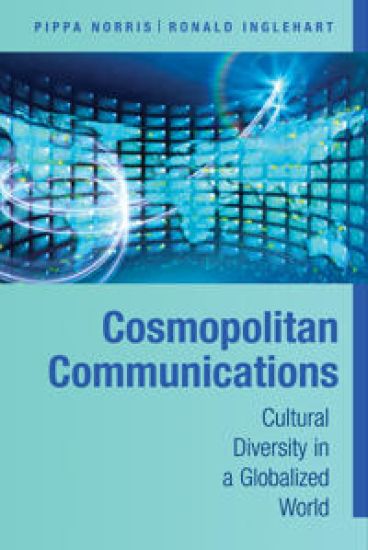
Cosmopolitan Communications

Cosmopolitan Communications

Pippa Norris; Ronald Inglehart

Cambridge University Press
2009
sidottu
Societies around the world have experienced a flood of information from diverse channels originating beyond local communities and even national borders, transmitted through the rapid expansion of cosmopolitan communications. For more than half a century, conventional interpretations, Norris and Inglehart argue, have commonly exaggerated the potential threats arising from this process. A series of firewalls protect national cultures. This book develops a new theoretical framework for understanding cosmopolitan communications and uses it to identify the conditions under which global communications are most likely to endanger cultural diversity. The authors analyze empirical evidence from both the societal level and the individual level, examining the outlook and beliefs of people in a wide range of societies. The study draws on evidence from the World Values Survey, covering 90 societies in all major regions worldwide from 1981 to 2007. The conclusion considers the implications of their findings for cultural policies.

Cosmopolitan Communications

Cosmopolitan Communications

Pippa Norris; Ronald Inglehart

Cambridge University Press
2009
pokkari
Societies around the world have experienced a flood of information from diverse channels originating beyond local communities and even national borders, transmitted through the rapid expansion of cosmopolitan communications. For more than half a century, conventional interpretations, Norris and Inglehart argue, have commonly exaggerated the potential threats arising from this process. A series of firewalls protect national cultures. This book develops a new theoretical framework for understanding cosmopolitan communications and uses it to identify the conditions under which global communications are most likely to endanger cultural diversity. The authors analyze empirical evidence from both the societal level and the individual level, examining the outlook and beliefs of people in a wide range of societies. The study draws on evidence from the World Values Survey, covering 90 societies in all major regions worldwide from 1981 to 2007. The conclusion considers the implications of their findings for cultural policies.

Driving Democracy

Driving Democracy

Pippa Norris

Cambridge University Press
2008
pokkari
Proposals for power-sharing constitutions remain controversial, as highlighted by current debates in Iraq, Afghanistan, Nepal, and Sudan. This book updates and refines the theory of consociationalism, taking account of the flood of contemporary innovations in power-sharing institutions that have occurred worldwide. The book classifies and compares four types of political institutions: the electoral system, parliamentary or presidential executives, unitary or federal states, and the structure and independence of the mass media. The study tests the potential advantages and disadvantages of each of these institutions for democratic governance. Cross-national time-series data concerning trends in democracy are analyzed for all countries worldwide since the early 1970s. Chapters are enriched by comparing detailed case studies. The mixed-method research design illuminates the underlying causal mechanisms by examining historical developments and processes of institutional change within particular nations and regions.
Driving Democracy

Driving Democracy

Pippa Norris

Cambridge University Press
2008
sidottu
Proposals for power-sharing constitutions remain controversial, as highlighted by current debates in Iraq, Afghanistan, Nepal, and Sudan. This book updates and refines the theory of consociationalism, taking account of the flood of contemporary innovations in power-sharing institutions that have occurred worldwide. The book classifies and compares four types of political institutions: the electoral system, parliamentary or presidential executives, unitary or federal states, and the structure and independence of the mass media. The study tests the potential advantages and disadvantages of each of these institutions for democratic governance. Cross-national time-series data concerning trends in democracy are analyzed for all countries worldwide since the early 1970s. Chapters are enriched by comparing detailed case studies. The mixed-method research design illuminates the underlying causal mechanisms by examining historical developments and processes of institutional change within particular nations and regions.
Radical Right

Radical Right

Pippa Norris

Cambridge University Press
2005
pokkari
During recent decades, radical right parties have been surging in popularity in many nations, gaining legislative seats, enjoying the legitimacy endowed by ministerial office, and striding the corridors of government power. The popularity of leaders such as Le Pen, Haider, and Fortuyn has aroused widespread popular concern and a burgeoning scholarly literature. Despite the interest, little consensus has emerged about the primary factors driving this phenomenon. The puzzle is to explain why radical right parties have advanced in a diverse array of democracies - including in Austria, Canada, Norway, France, Italy, New Zealand, Switzerland, Israel, Romania, Russia, and Chile - while failing to make comparable gains in similar societies elsewhere, such as in Sweden, Britain, and the United States. This book, first published in 2005, expands our understanding of support for radical right parties through presenting an integrated new theory which is then tested systematically using a wealth of cross-national survey evidence covering almost forty countries.
Radical Right

Radical Right

Pippa Norris

Cambridge University Press
2005
sidottu
During recent decades, radical right parties have been surging in popularity in many nations, gaining legislative seats, enjoying the legitimacy endowed by ministerial office, and striding the corridors of government power. The popularity of leaders such as Le Pen, Haider, and Fortuyn has aroused widespread popular concern and a burgeoning scholarly literature. Despite the interest, little consensus has emerged about the primary factors driving this phenomenon. The puzzle is to explain why radical right parties have advanced in a diverse array of democracies - including in Austria, Canada, Norway, France, Italy, New Zealand, Switzerland, Israel, Romania, Russia, and Chile - while failing to make comparable gains in similar societies elsewhere, such as in Sweden, Britain, and the United States. This book, first published in 2005, expands our understanding of support for radical right parties through presenting an integrated new theory which is then tested systematically using a wealth of cross-national survey evidence covering almost forty countries.
Electoral Engineering

Electoral Engineering

Pippa Norris

Cambridge University Press
2004
sidottu
From Kosovo to Kabul, the last decade witnessed growing interest in ?electoral engineering?. Reformers have sought to achieve either greater government accountability through majoritarian arrangements or wider parliamentary diversity through proportional formula. Underlying the normative debates are important claims about the impact and consequences of electoral reform for political representation and voting behavior. The study compares and evaluates two broad schools of thought, each offering contracting expectations. One popular approach claims that formal rules define electoral incentives facing parties, politicians and citizens. By changing these rules, rational choice institutionalism claims that we have the capacity to shape political behavior. Alternative cultural modernization theories differ in their emphasis on the primary motors driving human behavior, their expectations about the pace of change, and also their assumptions about the ability of formal institutional rules to alter, rather than adapt to, deeply embedded and habitual social norms and patterns of human behavior.
Electoral Engineering

Electoral Engineering

Pippa Norris

Cambridge University Press
2004
pokkari
From Kosovo to Kabul, the last decade witnessed growing interest in ?electoral engineering?. Reformers have sought to achieve either greater government accountability through majoritarian arrangements or wider parliamentary diversity through proportional formula. Underlying the normative debates are important claims about the impact and consequences of electoral reform for political representation and voting behavior. The study compares and evaluates two broad schools of thought, each offering contracting expectations. One popular approach claims that formal rules define electoral incentives facing parties, politicians and citizens. By changing these rules, rational choice institutionalism claims that we have the capacity to shape political behavior. Alternative cultural modernization theories differ in their emphasis on the primary motors driving human behavior, their expectations about the pace of change, and also their assumptions about the ability of formal institutional rules to alter, rather than adapt to, deeply embedded and habitual social norms and patterns of human behavior.
Rising Tide

Rising Tide

Ronald Inglehart; Pippa Norris

Cambridge University Press
2003
pokkari
The twentieth century gave rise to profound changes in traditional sex roles. However, the force of this ‘rising tide’ has varied among rich and poor societies around the globe, as well as among younger and older generations. Rising Tide sets out to understand how modernization has changed cultural attitudes towards gender equality and to analyze the political consequences of this process. The core argument suggests that women and men’s lives have been altered in a two-stage modernization process consisting of (i) the shift from agrarian to industrialized societies and (ii) the move from industrial towards post industrial societies. This book is the first to systematically compare attitudes towards gender equality worldwide, comparing almost 70 nations that run the gamut from rich to poor, agrarian to postindustrial. Rising Tide is essential reading for those interested in understanding issues of comparative politics, public opinion, political behavior, political development, and political sociology.
Rising Tide

Rising Tide

Ronald Inglehart; Pippa Norris

Cambridge University Press
2003
sidottu
The twentieth century gave rise to profound changes in traditional sex roles. However, the force of this ‘rising tide’ has varied among rich and poor societies around the globe, as well as among younger and older generations. Rising Tide sets out to understand how modernization has changed cultural attitudes towards gender equality and to analyze the political consequences of this process. The core argument suggests that women and men’s lives have been altered in a two-stage modernization process consisting of (i) the shift from agrarian to industrialized societies and (ii) the move from industrial towards post industrial societies. This book is the first to systematically compare attitudes towards gender equality worldwide, comparing almost 70 nations that run the gamut from rich to poor, agrarian to postindustrial. Rising Tide is essential reading for those interested in understanding issues of comparative politics, public opinion, political behavior, political development, and political sociology.
Democratic Phoenix

Democratic Phoenix

Pippa Norris

Cambridge University Press
2002
pokkari
Conventional wisdom suggests that citizens in many countries have become disengaged from the traditional channels of political participation. Commentators highlight warning signs including sagging electoral turnout, rising anti-party sentiment, and the decay of civic organizations. But are these concerns justified? This book, first published in 2002, compares systematic evidence for electoral turnout, party membership, and civic activism in countries around the world and suggests good reasons to question assumptions of decline. Not only is the obituary for older forms of political activism premature, but new forms of civic engagement may have emerged in modern societies to supplement traditional modes. The process of societal modernization and rising levels of human capital are primarily responsible, although participation is also explained by the structure of the state, the role of agencies, and social inequalities.
Democratic Phoenix

Democratic Phoenix

Pippa Norris

Cambridge University Press
2002
sidottu
Conventional wisdom suggests that citizens in many countries have become disengaged from the traditional channels of political participation. Commentators highlight warning signs including sagging electoral turnout, rising anti-party sentiment, and the decay of civic organizations. But are these concerns justified? This book, first published in 2002, compares systematic evidence for electoral turnout, party membership, and civic activism in countries around the world and suggests good reasons to question assumptions of decline. Not only is the obituary for older forms of political activism premature, but new forms of civic engagement may have emerged in modern societies to supplement traditional modes. The process of societal modernization and rising levels of human capital are primarily responsible, although participation is also explained by the structure of the state, the role of agencies, and social inequalities.
Digital Divide

Digital Divide

Pippa Norris

Cambridge University Press
2001
pokkari
There is widespread concern that the growth of the Internet is exacerbating inequalities between the information rich and poor. Digital Divide examines access and use of the Internet in 179 nations world-wide. A global divide is evident between industrialized and developing societies. A social divide is apparent between rich and poor within each nation. Within the online community, evidence for a democratic divide is emerging between those who do and do not use Internet resources to engage and participate in public life. Part I outlines the theoretical debate between cyber-optimists who see the Internet as the great leveler. Part II examines the virtual political system and the way that representative institutions have responded to new opportunities on the Internet. Part III analyzes how the public has responded to these opportunities in Europe and the United States and develops the civic engagement model to explain patterns of participation via the Internet.
Digital Divide

Digital Divide

Pippa Norris

Cambridge University Press
2001
sidottu
There is widespread concern that the growth of the Internet is exacerbating inequalities between the information rich and poor. Digital Divide examines access and use of the Internet in 179 nations world-wide. A global divide is evident between industrialized and developing societies. A social divide is apparent between rich and poor within each nation. Within the online community, evidence for a democratic divide is emerging between those who do and do not use Internet resources to engage and participate in public life. Part I outlines the theoretical debate between cyber-optimists who see the Internet as the great leveler. Part II examines the virtual political system and the way that representative institutions have responded to new opportunities on the Internet. Part III analyzes how the public has responded to these opportunities in Europe and the United States and develops the civic engagement model to explain patterns of participation via the Internet.
A Virtuous Circle

A Virtuous Circle

Pippa Norris

Cambridge University Press
2000
sidottu
Is the process of political communications by the news media and by parties responsible for civic malaise? A Virtuous Circle sets out to challenge the conventional wisdom that it is. Based on a comparative examination of the role of the news media and parties in 29 postindustrial societies, focusing in particular on Western Europe and the United States, this study argues that rather than mistakenly ‘blaming the messenger’ we need to understand and confront more deep-rooted flaws in systems of representative democracy. The book outlines appropriate standards for evaluating the performance of the news media and the methods available to study this issue. It also compares changes in the news media including the rise of the Internet and the development of post-modern election campaigns. Norris shows that although negative news can erode public support for specific policy issues, in general there is a consistently positive relationship between attention to the news media and political knowledge, trust and participation. For more information on the book, please visit the author’s website at www.pippanorris.com.
A Virtuous Circle

A Virtuous Circle

Pippa Norris

Cambridge University Press
2000
pokkari
Is the process of political communications by the news media and by parties responsible for civic malaise? A Virtuous Circle sets out to challenge the conventional wisdom that it is. Based on a comparative examination of the role of the news media and parties in 29 postindustrial societies, focusing in particular on Western Europe and the United States, this study argues that rather than mistakenly ‘blaming the messenger’ we need to understand and confront more deep-rooted flaws in systems of representative democracy. The book outlines appropriate standards for evaluating the performance of the news media and the methods available to study this issue. It also compares changes in the news media including the rise of the Internet and the development of post-modern election campaigns. Norris shows that although negative news can erode public support for specific policy issues, in general there is a consistently positive relationship between attention to the news media and political knowledge, trust and participation. For more information on the book, please visit the author’s website at www.pippanorris.com.
On Message

On Message

Pippa Norris; John Curtice; David Sanders; Margaret Scammell; Holli A Semetko

SAGE Publications Inc
1999
nidottu
To what extent are the techniques of campaigning and media management critical to the outcome of modern elections? This book brings together a group of leading scholars to provide a comprehensive analysis of the role and impact of political communications during election campaigns. They set the context of election campaigning in Britain, and the methodology used to undertand media effects, review party strategies and resulting media coverage, and draw together evidence of the impact of the 1997 British General Election campaign, analyzing how far television and the press media influenced the public's civic engagement, agenda priorities, and party preferences.
On Message

On Message

Pippa Norris; John Curtice; David Sanders; Margaret Scammell; Holli A Semetko

SAGE Publications Inc
1999
sidottu
To what extent are the techniques of campaigning and media management critical to the outcome of modern elections? This book brings together a group of leading scholars to provide a comprehensive analysis of the role and impact of political communications during election campaigns. They set the context of election campaigning in Britain, and the methodology used to undertand media effects, review party strategies and resulting media coverage, and draw together evidence of the impact of the 1997 British General Election campaign, analyzing how far television and the press media influenced the public's civic engagement, agenda priorities, and party preferences.
Electoral Change Since 1945

Electoral Change Since 1945

Pippa Norris

Blackwell Publishers
1996
sidottu
This book explores the nature of electoral change in Britain during the last half century. The period from 1945-70 was the classic era of two-party dominance at every level of British politics: at Westminster, county hall, and in the electorate. Since the early seventies Conservative and Labour hegemony has remained virtually unaltered in Parliament, but their grip has been loosened in local government, and the popular foundations of the two-party system have been eroded among voters. Why has Britain evolved from a dominant to a declining two-party system during the last fifty years? This study considers alternative explanations for these developments, focusing on changes in voters, parties, and political communications. The book provides students with a fresh and accessible perspective on theories of electoral change, placing developments in Britain within their broader comparative context, and challenging many conventional assumptions about trends in voting behaviour.
Electoral Change Since 1945

Electoral Change Since 1945

Pippa Norris

Blackwell Publishers
1996
nidottu
This book explores the nature of electoral change in Britain during the last half century. The period from 1945-70 was the classic era of two-party dominance at every level of British politics: at Westminster, county hall, and in the electorate. Since the early seventies Conservative and Labour hegemony has remained virtually unaltered in Parliament, but their grip has been loosened in local government, and the popular foundations of the two-party system have been eroded among voters. Why has Britain evolved from a dominant to a declining two-party system during the last fifty years? This study considers alternative explanations for these developments, focusing on changes in voters, parties, and political communications. The book provides students with a fresh and accessible perspective on theories of electoral change, placing developments in Britain within their broader comparative context, and challenging many conventional assumptions about trends in voting behaviour.