Kirjojen hintavertailu. Mukana 12 595 353 kirjaa ja 12 kauppaa.

Kirjailija

Pratyusha Rakshit

Kirjat ja teokset yhdessä paikassa: 2 kirjaa, julkaisuja vuosilta 2018-2020, suosituimpien joukossa Principles in Noisy Optimization. Vertaile teosten hintoja ja tarkista saatavuus suomalaisista kirjakaupoista.

2 kirjaa

Kirjojen julkaisuhaarukka 2018-2020.

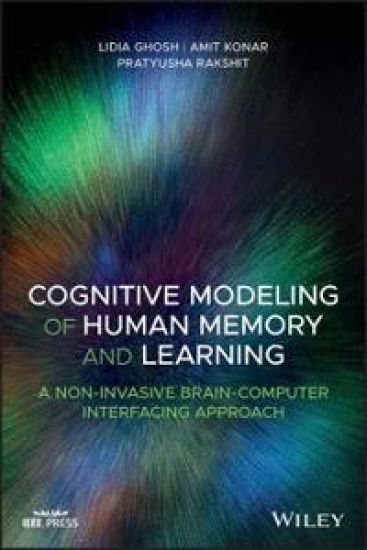
Cognitive Modeling of Human Memory and Learning

Cognitive Modeling of Human Memory and Learning

Lidia Ghosh; Amit Konar; Pratyusha Rakshit

Wiley-Blackwell
2020
sidottu
Proposes computational models of human memory and learning using a brain-computer interfacing (BCI) approach Human memory modeling is important from two perspectives. First, the precise fitting of the model to an individual's short-term or working memory may help in predicting memory performance of the subject in future. Second, memory models provide a biological insight to the encoding and recall mechanisms undertaken by the neurons present in active brain lobes, participating in the memorization process. This book models human memory from a cognitive standpoint by utilizing brain activations acquired from the cortex by electroencephalographic (EEG) and functional near-infrared-spectroscopic (f-NIRs) means. Cognitive Modeling of Human Memory and Learning A Non-invasive Brain-Computer Interfacing Approach begins with an overview of the early models of memory. The authors then propose a simplistic model of Working Memory (WM) built with fuzzy Hebbian learning. A second perspective of memory models is concerned with Short-Term Memory (STM)-modeling in the context of 2-dimensional object-shape reconstruction from visually examined memorized instances. A third model assesses the subjective motor learning skill in driving from erroneous motor actions. Other models introduce a novel strategy of designing a two-layered deep Long Short-Term Memory (LSTM) classifier network and also deal with cognitive load assessment in motor learning tasks associated with driving. The book ends with concluding remarks based on principles and experimental results acquired in previous chapters. Examines the scope of computational models of memory and learning with special emphasis on classification of memory tasks by deep learning-based modelsProposes two algorithms of type-2 fuzzy reasoning: Interval Type-2 fuzzy reasoning (IT2FR) and General Type-2 Fuzzy Sets (GT2FS)Considers three classes of cognitive loads in the motor learning tasks for driving learners Cognitive Modeling of Human Memory and Learning A Non-invasive Brain-Computer Interfacing Approach will appeal to researchers in cognitive neuro-science and human/brain-computer interfaces. It is also beneficial to graduate students of computer science/electrical/electronic engineering.
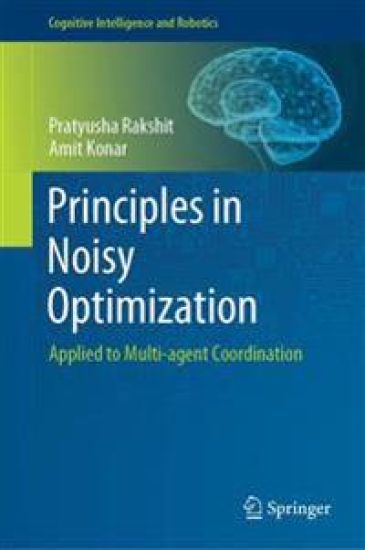
Principles in Noisy Optimization

Principles in Noisy Optimization

Pratyusha Rakshit; Amit Konar

Springer Verlag, Singapore
2018
sidottu
Noisy optimization is a topic of growing interest for researchers working on mainstream optimization problems. Although several techniques for dealing with stochastic noise in optimization problems are covered in journals and conference proceedings, today there are virtually no books that approach noisy optimization from a layman’s perspective; this book remedies that gap. Beginning with the foundations of evolutionary optimization, the book subsequently explores the principles of noisy optimization in single and multi-objective settings, and presents detailed illustrations of the principles developed for application in real-world multi-agent coordination problems. Special emphasis is given to the design of intelligent algorithms for noisy optimization in real-time applications. The book is unique in terms of its content, writing style and above all its simplicity, which will appeal to readers with a broad range of backgrounds.The book is divided into 7 chapters, the first of which provides an introduction to Swarm and Evolutionary Optimization algorithms. Chapter 2 includes a thorough review of agent architectures for multi-agent coordination. In turn, Chapter 3 provides an extensive review of noisy optimization, while Chapter 4 addresses issues of noise handling in the context of single-objective optimization problems. An illustrative case study on multi-robot path-planning in the presence of measurement noise is also highlighted in this chapter. Chapter 5 deals with noisy multi-objective optimization and includes a case study on noisy multi-robot box-pushing. In Chapter 6, the authors examine the scope of various algorithms in noisy optimization problems. Lastly, Chapter 7 summarizes the main results obtained in the previous chapters and elaborates on the book’s potential with regard to real-world noisy optimization problems.