
Kirjojen hintavertailu. Mukana 12 390 323 kirjaa ja 12 kauppaa.

Kirjailija

Praveen Raghavan

Kirjat ja teokset yhdessä paikassa: 4 kirjaa, julkaisuja vuosilta 2010-2015, suosituimpien joukossa Ultra-Low Energy Domain-Specific Instruction-Set Processors. Vertaile teosten hintoja ja tarkista saatavuus suomalaisista kirjakaupoista.

4 kirjaa

Kirjojen julkaisuhaarukka 2010-2015.

Energy-Efficient Communication Processors

Energy-Efficient Communication Processors

Robert Fasthuber; Francky Catthoor; Praveen Raghavan; Frederik Naessens

Springer-Verlag New York Inc.
2015
nidottu
This book describes a new design approach for energy-efficient, Domain-Specific Instruction set Processor (DSIP) architectures for the wireless baseband domain. The innovative techniques presented enable co-design of algorithms, architectures and technology, for efficient implementation of the most advanced technologies. To demonstrate the feasibility of the author’s design approach, case studies are included for crucial functionality of advanced wireless systems with increased computational performance, flexibility and reusability. Designers using this approach will benefit from reduced development/product costs and greater scalability to future process technology nodes.

Energy-Efficient Communication Processors

Energy-Efficient Communication Processors

Robert Fasthuber; Francky Catthoor; Praveen Raghavan; Frederik Naessens

Springer-Verlag New York Inc.
2013
sidottu
This book describes a new design approach for energy-efficient, Domain-Specific Instruction set Processor (DSIP) architectures for the wireless baseband domain. The innovative techniques presented enable co-design of algorithms, architectures and technology, for efficient implementation of the most advanced technologies. To demonstrate the feasibility of the author’s design approach, case studies are included for crucial functionality of advanced wireless systems with increased computational performance, flexibility and reusability. Designers using this approach will benefit from reduced development/product costs and greater scalability to future process technology nodes.
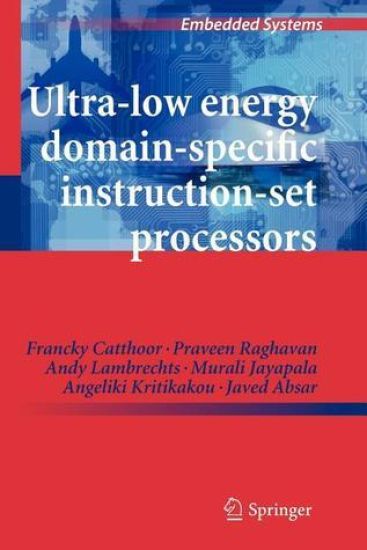
Ultra-Low Energy Domain-Specific Instruction-Set Processors

Ultra-Low Energy Domain-Specific Instruction-Set Processors

Francky Catthoor; Praveen Raghavan; Andy Lambrechts; Murali Jayapala; Angeliki Kritikakou; Javed Absar

Springer
2012
nidottu
Modern consumers carry many electronic devices, like a mobile phone, digital camera, GPS, PDA and an MP3 player. The functionality of each of these devices has gone through an important evolution over recent years, with a steep increase in both the number of features as in the quality of the services that they provide. However, providing the required compute power to support (an uncompromised combination of) all this functionality is highly non-trivial. Designing processors that meet the demanding requirements of future mobile devices requires the optimization of the embedded system in general and of the embedded processors in particular, as they should strike the correct balance between flexibility, energy efficiency and performance. In general, a designer will try to minimize the energy consumption (as far as needed) for a given performance, with a sufficient flexibility. However, achieving this goal is already complex when looking at the processor in isolation, but, in reality, the processor is a single component in a more complex system. In order to design such complex system successfully, critical decisions during the design of each individual component should take into account effect on the other parts, with a clear goal to move to a global Pareto optimum in the complete multi-dimensional exploration space. In the complex, global design of battery-operated embedded systems, the focus of Ultra-Low Energy Domain-Specific Instruction-Set Processors is on the energy-aware architecture exploration of domain-specific instruction-set processors and the co-optimization of the datapath architecture, foreground memory, and instruction memory organisation with a link to the required mapping techniques or compiler steps at the early stages of the design. By performing an extensive energy breakdown experiment for a complete embedded platform, both energy and performance bottlenecks have been identified, together with the important relations between thedifferent components. Based on this knowledge, architecture extensions are proposed for all the bottlenecks.
Ultra-Low Energy Domain-Specific Instruction-Set Processors

Ultra-Low Energy Domain-Specific Instruction-Set Processors

Francky Catthoor; Praveen Raghavan; Andy Lambrechts; Murali Jayapala; Angeliki Kritikakou; Javed Absar

Springer
2010
sidottu
Modern consumers carry many electronic devices, like a mobile phone, digital camera, GPS, PDA and an MP3 player. The functionality of each of these devices has gone through an important evolution over recent years, with a steep increase in both the number of features as in the quality of the services that they provide. However, providing the required compute power to support (an uncompromised combination of) all this functionality is highly non-trivial. Designing processors that meet the demanding requirements of future mobile devices requires the optimization of the embedded system in general and of the embedded processors in particular, as they should strike the correct balance between flexibility, energy efficiency and performance. In general, a designer will try to minimize the energy consumption (as far as needed) for a given performance, with a sufficient flexibility. However, achieving this goal is already complex when looking at the processor in isolation, but, in reality, the processor is a single component in a more complex system. In order to design such complex system successfully, critical decisions during the design of each individual component should take into account effect on the other parts, with a clear goal to move to a global Pareto optimum in the complete multi-dimensional exploration space. In the complex, global design of battery-operated embedded systems, the focus of Ultra-Low Energy Domain-Specific Instruction-Set Processors is on the energy-aware architecture exploration of domain-specific instruction-set processors and the co-optimization of the datapath architecture, foreground memory, and instruction memory organisation with a link to the required mapping techniques or compiler steps at the early stages of the design. By performing an extensive energy breakdown experiment for a complete embedded platform, both energy and performance bottlenecks have been identified, together with the important relations between thedifferent components. Based on this knowledge, architecture extensions are proposed for all the bottlenecks.