Kirjojen hintavertailu. Mukana 12 363 376 kirjaa ja 12 kauppaa.

Kirjailija

Pumla Dineo Gqola

Kirjat ja teokset yhdessä paikassa: 5 kirjaa, julkaisuja vuosilta 2008-2023, suosituimpien joukossa Reading from the South. Vertaile teosten hintoja ja tarkista saatavuus suomalaisista kirjakaupoista.

5 kirjaa

Kirjojen julkaisuhaarukka 2008-2023.

Reading from the South

Reading from the South

Charne Lavery; Sarah Nuttall; Sunil Amrith; Gabeba Baderoon; Karin Barber; Rimli Bhattacharya; Antoinette Burton; Pumla Dineo Gqola; Carolyn Hamilton; Khwezi Mkhize; Danai S Mupotsa; James Ogude; Christopher Ew Ouma; Ranka Primorac; Madhumita Lahiri; Meg Samuelson; Lakshmi Subramanian

WITS UNIVERSITY PRESS
2023
sidottu
This set of essays analyses the work of Isabel Hofmeyr, globally recognised as one of South Africa's foremost literary and Indian Ocean scholars. The essays elucidate Hofmeyr's path-breaking studies of transnational histories of the book, African print cultures, and cultural circulations in the Indian Ocean world. This book draws together reflective and analytical essays by renowned intellectuals from around the world who critically engage with the work of one of the global South's leading scholars of African print cultures and the oceanic humanities. Isabel Hofmeyr's scholarship spans more than four decades, and its sustained and long-term influence on her discipline and beyond is formidable. While much of the history of print cultures has been written primarily from the North, Isabel Hofmeyr is one of the leading thinkers producing new knowledge in this area from Africa, the Indian Ocean world and the global South. Her major contribution encompasses the history of the book as well as shorter textual forms and abridged iterations of canonical works such as John Bunyan's The Pilgrim's Progress. She has done pioneering research on the ways in which such printed matter moves across the globe, focusing on intra-African trajectories and circulations as well as movements across land and sea, port and shore. The essays gathered here are written in a blend of intellectual and personal modes, and mostly by scholars of Indian and African descent. Via their engagement with Hofmeyr's path-breaking work, the essays in turn elaborate and contribute to studies of print culture as well as critical oceanic studies, consolidating their findings from the point of view of global South historical contexts and textual practices.
Reading from the South

Reading from the South

Charne Lavery; Sarah Nuttall; Sunil Amrith; Gabeba Baderoon; Karin Barber; Rimli Bhattacharya; Antoinette Burton; Pumla Dineo Gqola; Carolyn Hamilton; Khwezi Mkhize; Danai S Mupotsa; James Ogude; Christopher EW Ouma; Ranka Primorac; Madhumita Lahiri; Meg Samuelson; Lakshmi Subramanian

WITS UNIVERSITY PRESS
2023
pokkari
This book covers concepts and methods from the work of Isabel Hofmeyr, a leading South African scholar of print cultures and intellectual trajectories in the Atlantic and Indian oceans.
Go Home or Die Here

Go Home or Die Here

Shireen Hassim; Tawana Kupe; Eric Worby; Paul Verryn; Alex Eliseev; Rolf Maruping; Daryl Glaser; Noor Nieftagodien; Stephen Gelb; Devan Pillay; Loren Landau; David Coplan; Julia Hornberger; Melinda Silverman; Tanya Zack; Anton Harber; Cathi Albertyn; Andile Mngxitama; Pumla Dineo Gqola; Véronique Tadjo

Wits University Press
2008
pokkari
The xenophobic attacks that started in Alexandra, Johannesburg in May 2008 before quickly spreading around the country caused an outcry across the world and raised many fundamental questions: Of what profound social malaise is xenophobia – and the violence that it inspires – a symptom? Have our economic and political choices created new forms of exclusion that fuel anger and distrust? What consequences does the emergence of xenophobia hold for the idea of an equal, non-racial society as symbolised by a democratic South Africa? On 28 May 2008 the Faculty of Humanities in the University of the Witwatersrand, Johannesburg convened an urgent colloquium that focused on searching for short and long-term solutions. Nearly twenty individuals – mostly Wits academics from a variety of disciplines, but also two student leaders, a journalist and a bishop – addressed the unfolding violence in ways that were conversant with the moment, yet rooted in scholarship and ongoing research. Go Home or Die Here emanates directly from the colloquium. It hopes to make sense of the nuances and trajectories of building a democratic society out of a deeply divided and conflictual past, in the conditions of global recession, heightening inequalities and future uncertainty. The authors hoped to pose questions that would lead both to research and to more informed, reflective forms of public action. With extensive photographs by award-winning photographer Alon Skuy, who covered the violence for The Times newspaper, the volume is passionate and engaged, and aims to stimulate reflection, debate and activism among concerned members of a broad public.
Female Fear Factory

Female Fear Factory

Pumla Dineo Gqola

Cassava Republic Press
2022
nidottu
"Patriarchy does not respect national boundaries. It is unabashedly promiscuous in its influences and tethers. Yet, it does use nationalism very productively." Drawing on examples from around the world - from Uganda, Nigeria, South Africa to Saudi Arabia, the Americas and Europe, Gqola traces the construction and machinations of the female fear factory by exposing its lies, myths, and seductions. She shows how seemingly disparate effects like driving bans, higher education rape sexual harassment and femicide are all premised on the construction of people, mostly women, as female, and thereafter the use fear as a tool of patriarchal subjugation and punishment.
What is Slavery to Me?

What is Slavery to Me?

Pumla Dineo Gqola

Wits University Press
2010
nidottu
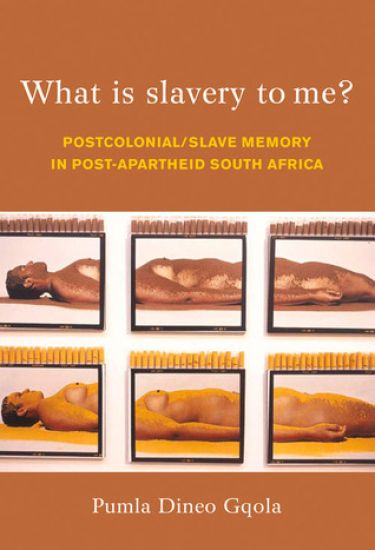
Much has been made about South Africa's transition from histories of colonialism, slavery and apartheid. ""Memory"" features prominently in the country's reckoning with its pasts. While there has been an outpouring of academic essays, anthologies and other full-length texts which study this transition, most have focused on the Truth and Reconciliation Commission (TRC). Pumla Dineo Gqola's What is slavery to me? links with that research in its concern with South Africa's past and the meaning-making processes attendant to it, but reads specifically memory activity which pertains to colonial slavery as practiced predominantly in the Western Cape for three centuries by the British and Dutch. What is slavery to me? is the first full-length study of slave memory in the South African context, and examines the relevance and effects of slave memory for contemporary negotiations of South African gendered and radicalised identities. It draws from feminist, postcolonial and memory studies and is therefore interdisciplinary in approach. It reads memory as one way of processing this past, and interprets a variety of cultural, literary and filmic texts to ascertain the particular experiences in relation to slave pasts being fashioned, processed and disseminated. Much of the material surveyed across disciplines attributes to memory, or ""popular history making"", a dialogue between past and present whilst ascribing sense to both the eras and their relationship. In this sense then, memory is active, entailing a personal relationship with the past which acts as mediator of reality on a day to day basis. The projects studies various negotiations of raced and gendered identities in creative and other public spaces in contemporary South Africa, by being particularly attentive to the encoding of consciousness about the country's slave past. This book extends memory studies in South Africa, provokes new lines of inquiry, and develops new frameworks through which to think about slavery and memory in South Africa.