Kirjojen hintavertailu. Mukana 12 595 353 kirjaa ja 12 kauppaa.
Kirjailija
Qi-Man Shao
Kirjat ja teokset yhdessä paikassa: 7 kirjaa, julkaisuja vuosilta 2000-2021, suosituimpien joukossa Monte Carlo Methods in Bayesian Computation. Vertaile teosten hintoja ja tarkista saatavuus suomalaisista kirjakaupoista.
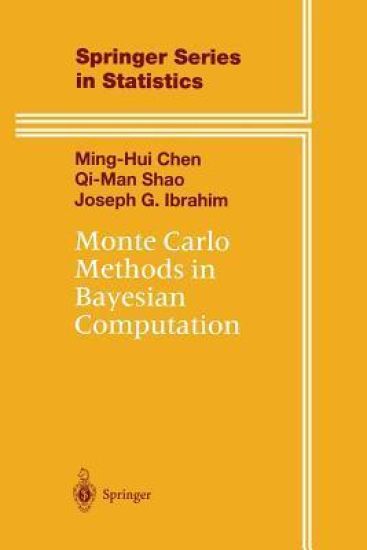
Sampling from the posterior distribution and computing posterior quanti ties of interest using Markov chain Monte Carlo (MCMC) samples are two major challenges involved in advanced Bayesian computation. This book examines each of these issues in detail and focuses heavily on comput ing various posterior quantities of interest from a given MCMC sample. Several topics are addressed, including techniques for MCMC sampling, Monte Carlo (MC) methods for estimation of posterior summaries, improv ing simulation accuracy, marginal posterior density estimation, estimation of normalizing constants, constrained parameter problems, Highest Poste rior Density (HPD) interval calculations, computation of posterior modes, and posterior computations for proportional hazards models and Dirichlet process models. Also extensive discussion is given for computations in volving model comparisons, including both nested and nonnested models. Marginal likelihood methods, ratios of normalizing constants, Bayes fac tors, the Savage-Dickey density ratio, Stochastic Search Variable Selection (SSVS), Bayesian Model Averaging (BMA), the reverse jump algorithm, and model adequacy using predictive and latent residual approaches are also discussed. The book presents an equal mixture of theory and real applications.
Sampling from the posterior distribution and computing posterior quanti ties of interest using Markov chain Monte Carlo (MCMC) samples are two major challenges involved in advanced Bayesian computation. This book examines each of these issues in detail and focuses heavily on comput ing various posterior quantities of interest from a given MCMC sample. Several topics are addressed, including techniques for MCMC sampling, Monte Carlo (MC) methods for estimation of posterior summaries, improv ing simulation accuracy, marginal posterior density estimation, estimation of normalizing constants, constrained parameter problems, Highest Poste rior Density (HPD) interval calculations, computation of posterior modes, and posterior computations for proportional hazards models and Dirichlet process models. Also extensive discussion is given for computations in volving model comparisons, including both nested and nonnested models. Marginal likelihood methods, ratios of normalizing constants, Bayes fac tors, the Savage-Dickey density ratio, Stochastic Search Variable Selection (SSVS), Bayesian Model Averaging (BMA), the reverse jump algorithm, and model adequacy using predictive and latent residual approaches are also discussed. The book presents an equal mixture of theory and real applications.
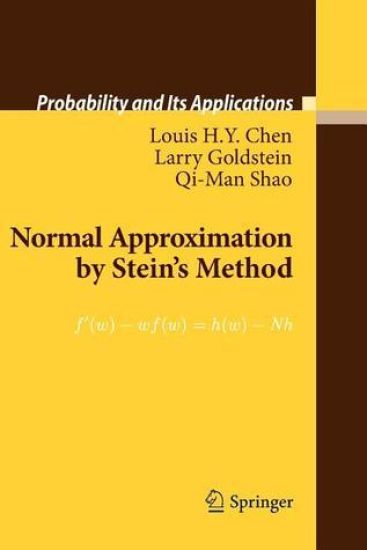
Since its introduction in 1972, Stein’s method has offered a completely novel way of evaluating the quality of normal approximations. Through its characterizing equation approach, it is able to provide approximation error bounds in a wide variety of situations, even in the presence of complicated dependence. Use of the method thus opens the door to the analysis of random phenomena arising in areas including statistics, physics, and molecular biology. Though Stein's method for normal approximation is now mature, the literature has so far lacked a complete self contained treatment. This volume contains thorough coverage of the method’s fundamentals, includes a large number of recent developments in both theory and applications, and will help accelerate the appreciation, understanding, and use of Stein's method by providing the reader with the tools needed to apply it in new situations. It addresses researchers as well as graduate students in Probability, Statistics and Combinatorics.
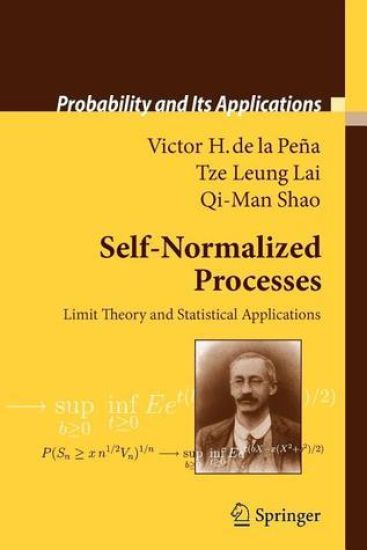
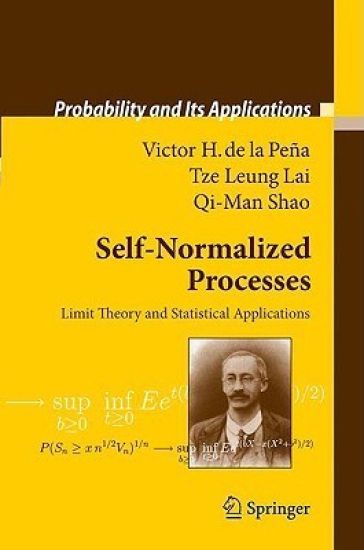
Self-normalized processes are of common occurrence in probabilistic and statistical studies. A prototypical example is Student's t-statistic introduced in 1908 by Gosset, whose portrait is on the front cover. Due to the highly non-linear nature of these processes, the theory experienced a long period of slow development. In recent years there have been a number of important advances in the theory and applications of self-normalized processes. Some of these developments are closely linked to the study of central limit theorems, which imply that self-normalized processes are approximate pivots for statistical inference. The present volume covers recent developments in the area, including self-normalized large and moderate deviations, and laws of the iterated logarithms for self-normalized martingales. This is the first book that systematically treats the theory and applications of self-normalization.
Since its introduction in 1972, Stein’s method has offered a completely novel way of evaluating the quality of normal approximations. Through its characterizing equation approach, it is able to provide approximation error bounds in a wide variety of situations, even in the presence of complicated dependence. Use of the method thus opens the door to the analysis of random phenomena arising in areas including statistics, physics, and molecular biology. Though Stein's method for normal approximation is now mature, the literature has so far lacked a complete self contained treatment. This volume contains thorough coverage of the method’s fundamentals, includes a large number of recent developments in both theory and applications, and will help accelerate the appreciation, understanding, and use of Stein's method by providing the reader with the tools needed to apply it in new situations. It addresses researchers as well as graduate students in Probability, Statistics and Combinatorics.
Self-normalized processes are of common occurrence in probabilistic and statistical studies. A prototypical example is Student's t-statistic introduced in 1908 by Gosset, whose portrait is on the front cover. Due to the highly non-linear nature of these processes, the theory experienced a long period of slow development. In recent years there have been a number of important advances in the theory and applications of self-normalized processes. Some of these developments are closely linked to the study of central limit theorems, which imply that self-normalized processes are approximate pivots for statistical inference. The present volume covers recent developments in the area, including self-normalized large and moderate deviations, and laws of the iterated logarithms for self-normalized martingales. This is the first book that systematically treats the theory and applications of self-normalization.