Kirjojen hintavertailu. Mukana 12 595 353 kirjaa ja 12 kauppaa.

Kirjailija

Qiang Yang

Kirjat ja teokset yhdessä paikassa: 7 kirjaa, julkaisuja vuosilta 2011-2026, suosituimpien joukossa Crafting Your Research Future. Vertaile teosten hintoja ja tarkista saatavuus suomalaisista kirjakaupoista.

7 kirjaa

Kirjojen julkaisuhaarukka 2011-2026.

Artificial Intelligence Empowered Smart Energy Systems

Artificial Intelligence Empowered Smart Energy Systems

Qiang Yang; Gang Huang

JOHN WILEY SONS INC
2025
sidottu
An illuminating and up-to-date exploration of the latest advances in AI-empowered smart energy systems In Artificial Intelligence Empowered Smart Energy Systems, the editors along with a team of distinguished researchers deliver an original and comprehensive discussion of artificial intelligence enabled smart energy systems. The book offers a deep dive into AI's integration with energy, examining critical topics like renewable energy forecasting, load monitoring, fault diagnosis, resilience-oriented optimization, and efficiency-driven control. The contributors discuss the real-world applications of AI in smart energy systems, showing you AI's transformative effects on energy landscapes. It provides practical solutions and strategies to address complicated problems in energy systems. The book also includes: A thorough introduction to cybersecurity, privacy, and virtual power plantsComprehensive demonstrations of the effective leveraging of AI technologies in energy systemsPractical discussions of the potential of AI to create sustainable, efficient, and resilient energy systemsDetailed case studies and real-world examples of AI's implementation in smart energy systems Perfect for researchers, data scientists, and policymakers, Artificial Intelligence Empowered Smart Energy Systems will also benefit graduate and senior undergraduate students in both the tech and energy industries.
Privacy-preserving Computing

Privacy-preserving Computing

Kai Chen; Qiang Yang

Cambridge University Press
2023
sidottu
Privacy-preserving computing aims to protect the personal information of users while capitalizing on the possibilities unlocked by big data. This practical introduction for students, researchers, and industry practitioners is the first cohesive and systematic presentation of the field's advances over four decades. The book shows how to use privacy-preserving computing in real-world problems in data analytics and AI, and includes applications in statistics, database queries, and machine learning. The book begins by introducing cryptographic techniques such as secret sharing, homomorphic encryption, and oblivious transfer, and then broadens its focus to more widely applicable techniques such as differential privacy, trusted execution environment, and federated learning. The book ends with privacy-preserving computing in practice in areas like finance, online advertising, and healthcare, and finally offers a vision for the future of the field.
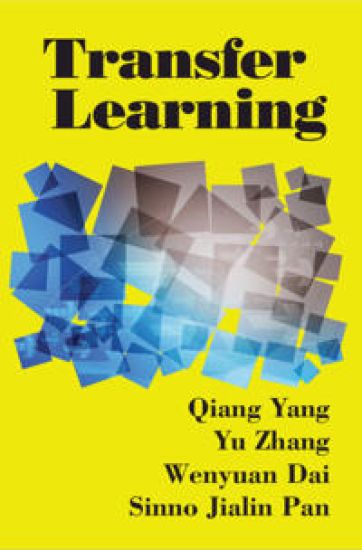
Transfer Learning

Transfer Learning

Qiang Yang; Yu Zhang; Wenyuan Dai; Sinno Jialin Pan

Cambridge University Press
2020
sidottu
Transfer learning deals with how systems can quickly adapt themselves to new situations, tasks and environments. It gives machine learning systems the ability to leverage auxiliary data and models to help solve target problems when there is only a small amount of data available. This makes such systems more reliable and robust, keeping the machine learning model faced with unforeseeable changes from deviating too much from expected performance. At an enterprise level, transfer learning allows knowledge to be reused so experience gained once can be repeatedly applied to the real world. For example, a pre-trained model that takes account of user privacy can be downloaded and adapted at the edge of a computer network. This self-contained, comprehensive reference text describes the standard algorithms and demonstrates how these are used in different transfer learning paradigms. It offers a solid grounding for newcomers as well as new insights for seasoned researchers and developers.
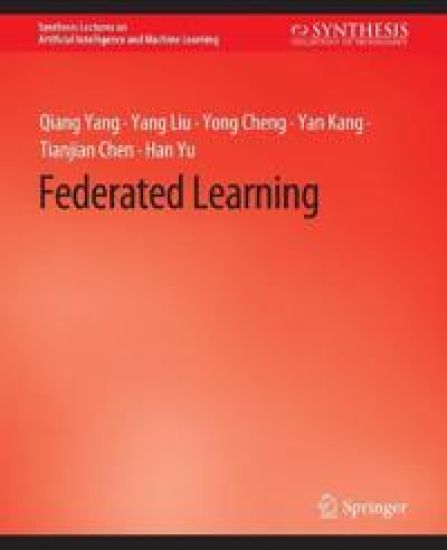
Federated Learning

Federated Learning

Qiang Yang; Yang Liu; Yong Cheng; Yan Kang; Tianjian Chen; Han Yu

Springer International Publishing AG
2019
nidottu
How is it possible to allow multiple data owners to collaboratively train and use a shared prediction model while keeping all the local training data private? Traditional machine learning approaches need to combine all data at one location, typically a data center, which may very well violate the laws on user privacy and data confidentiality. Today, many parts of the world demand that technology companies treat user data carefully according to user-privacy laws. The European Union's General Data Protection Regulation (GDPR) is a prime example. In this book, we describe how federated machine learning addresses this problem with novel solutions combining distributed machine learning, cryptography and security, and incentive mechanism design based on economic principles and game theory. We explain different types of privacy-preserving machine learning solutions and their technological backgrounds, and highlight some representative practical use cases. We show how federated learning can become the foundation of next-generation machine learning that caters to technological and societal needs for responsible AI development and application.
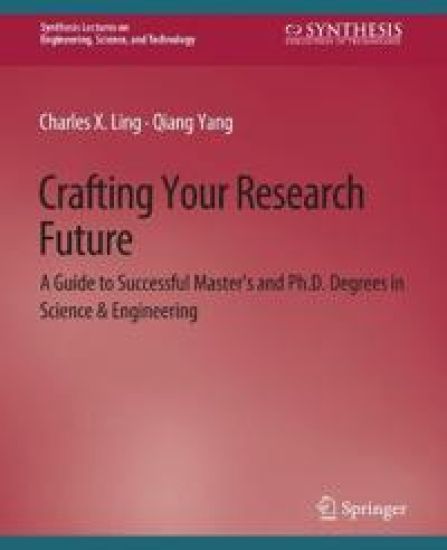
Crafting Your Research Future

Crafting Your Research Future

Charles Ling; Qiang Yang

Springer International Publishing AG
2012
nidottu
What is it like to be a researcher or a scientist? For young people, including graduate students and junior faculty members in universities, how can they identify good ideas for research? How do they conduct solid research to verify and realize their new ideas? How can they formulate their ideas and research results into high-quality articles, and publish them in highly competitive journals and conferences? What are effective ways to supervise graduate students so that they can establish themselves quickly in their research careers? In this book, Ling and Yang answer these questions in a step-by-step manner with specific and concrete examples from their first-hand research experience. Table of Contents: Acknowledgments / Preface / Basics of Research / Goals of Ph.D. Research / Getting Started: Finding New Ideas and Organizing Your Plans / Conducting Solid Research / Writing and Publishing Papers / Misconceptions and Tips for Paper Writing / Writing and Defending a Ph.D. Thesis / Life After Ph.D. / Summary / References / Author Biographies
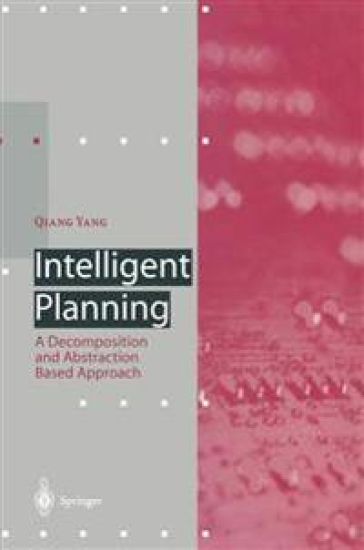
Intelligent Planning

Intelligent Planning

Qiang Yang; M. Pollack

Springer-Verlag Berlin and Heidelberg GmbH Co. K
2011
nidottu
"The central fact is that we are planning agents." (M. Bratman, Intentions, Plans, and Practical Reasoning, 1987, p. 2) Recent arguments to the contrary notwithstanding, it seems to be the case that people-the best exemplars of general intelligence that we have to date­ do a lot of planning. It is therefore not surprising that modeling the planning process has always been a central part of the Artificial Intelligence enterprise. Reasonable behavior in complex environments requires the ability to consider what actions one should take, in order to achieve (some of) what one wants­ and that, in a nutshell, is what AI planning systems attempt to do. Indeed, the basic description of a plan generation algorithm has remained constant for nearly three decades: given a desciption of an initial state I, a goal state G, and a set of action types, find a sequence S of instantiated actions such that when S is executed instate I, G is guaranteed as a result. Working out the details of this class of algorithms, and making the elabora­ tions necessary for them to be effective in real environments, have proven to be bigger tasks than one might have imagined.