Kirjojen hintavertailu. Mukana 12 595 353 kirjaa ja 12 kauppaa.

Kirjailija

Qijun Zhao

Kirjat ja teokset yhdessä paikassa: 3 kirjaa, julkaisuja vuosilta 2019-2021, suosituimpien joukossa Advanced Fingerprint Recognition: From 3D Shape to Ridge Detail. Vertaile teosten hintoja ja tarkista saatavuus suomalaisista kirjakaupoista.

3 kirjaa

Kirjojen julkaisuhaarukka 2019-2021.

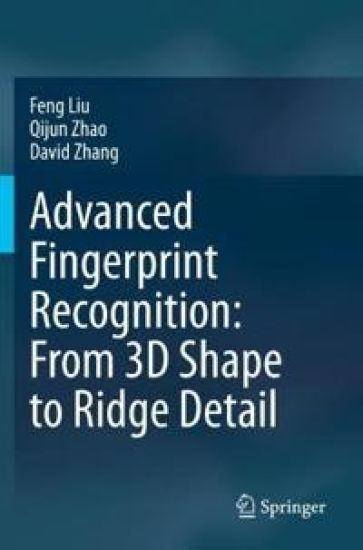
Advanced Fingerprint Recognition: From 3D Shape to Ridge Detail

Advanced Fingerprint Recognition: From 3D Shape to Ridge Detail

Feng Liu; Qijun Zhao; David Zhang

Springer Verlag, Singapore
2021
nidottu
Fingerprints are among the most widely used biometric modalities and have been successfully applied in various scenarios. For example, in forensics, fingerprints serve as important legal evidence; and in civilian applications, fingerprints are used for access and attendance control as well as other identity services. Thanks to advances in three-dimensional (3D) and high-resolution imaging technology, it is now feasible to capture 3D or high-resolution fingerprints to provide extra information and go beyond the traditional features such as global ridge patterns and local ridge singularities used in conventional fingerprint recognition tasks. This book presents the state of the art in the acquisition and analysis of 3D and high-resolution fingerprints. Based on the authors’ research, this book focuses on advanced fingerprint recognition using 3D fingerprint features (i.e., finger shape, level 0 features) or high-resolution fingerprint features (i.e., ridge detail, level 3 features). It is a valuable resource for researchers, professionals and graduate students working in the field of computer vision, pattern recognition, security/biometrics practice, as well as interdisciplinary researchers.
Advanced Fingerprint Recognition: From 3D Shape to Ridge Detail

Advanced Fingerprint Recognition: From 3D Shape to Ridge Detail

Feng Liu; Qijun Zhao; David Zhang

Springer Verlag, Singapore
2020
sidottu
Fingerprints are among the most widely used biometric modalities and have been successfully applied in various scenarios. For example, in forensics, fingerprints serve as important legal evidence; and in civilian applications, fingerprints are used for access and attendance control as well as other identity services. Thanks to advances in three-dimensional (3D) and high-resolution imaging technology, it is now feasible to capture 3D or high-resolution fingerprints to provide extra information and go beyond the traditional features such as global ridge patterns and local ridge singularities used in conventional fingerprint recognition tasks. This book presents the state of the art in the acquisition and analysis of 3D and high-resolution fingerprints. Based on the authors’ research, this book focuses on advanced fingerprint recognition using 3D fingerprint features (i.e., finger shape, level 0 features) or high-resolution fingerprint features (i.e., ridge detail, level 3 features). It is a valuable resource for researchers, professionals and graduate students working in the field of computer vision, pattern recognition, security/biometrics practice, as well as interdisciplinary researchers.

Facial Multi-characteristics And Applications

Facial Multi-characteristics And Applications

Bob Zhang; Qijun Zhao; David Zhang

World Scientific Publishing Co Pte Ltd
2019
sidottu
What features or information can we observe from a face, and how can these information help us to understand the person concerned, in terms of their well-being and what can we learn about and from each given feature? This book answers these questions by first dividing a face's multiple characteristics into two main categories: original (or physiological) features and features that change over a lifetime. The first category, original features, may be further divided into two sub-classes: features special (or unique) to an individual, and features common to a particular group. The second, changed features, can also be subdivided into two groups: features altered due to disease or features altered by other external factors. From these four sub-categories, four different applications — facial identification using original and special features; beauty analysis using original common features; facial diagnosis by disease changed features; and expression recognition through affect-changed features — are identified.The book will benefit researchers, professionals, and graduate students working in the field of computer vision, pattern recognition, security/clinical practice, and beauty analysis, and will also be useful for interdisciplinary research.