Kirjojen hintavertailu. Mukana 12 152 606 kirjaa ja 12 kauppaa.

Kirjailija

Qing Wang

Kirjat ja teokset yhdessä paikassa: 12 kirjaa, julkaisuja vuosilta 2009-2025, suosituimpien joukossa Intelligent Crowdsourced Testing. Vertaile teosten hintoja ja tarkista saatavuus suomalaisista kirjakaupoista.

12 kirjaa

Kirjojen julkaisuhaarukka 2009-2025.

Distributed Cooperative Control and Optimization for Multi-Agent Systems

Distributed Cooperative Control and Optimization for Multi-Agent Systems

Qing Wang; Bin Xin; Jie Chen

Springer Nature Switzerland AG
2025
sidottu
This book provides a concise and in-depth exposition of distributed control and optimization problems of multi-agent systems. The book integrates various ideas and tools from dynamic systems, control theory, graph theory, and optimization to address the special challenges posed by such complexities in the environment as communication delay, topological dynamics, and environmental uncertainties. In order to deal with the mismatched uncertainties and time delay, observer-based controller and sliding mode control are developed to achieve consensus control. When there is a leader or multiple leaders in the communication topologies, containment control is required. The book studies both state and output containment for nonlinear multi-agent systems with undirected or directed networks. Furthermore, event-triggered schemes are proposed to reduce communication and computation costs. Distributed optimization for multi-agent systems is an interesting topic that has attracted more and more attention due to its wide range of applications such as smart grids, sensor networks, and mobile manipulators. In distributed optimization, the goal is to optimize the global cost function, which is the sum of all local cost functions, each of which is known only by its own local agent. Distributed nonsmooth convex optimization for multi-agent systems based on proximal operators is developed to achieve distributed optimal consensus.
Intelligent Crowdsourced Testing

Intelligent Crowdsourced Testing

Qing Wang; Zhenyu Chen; Junjie Wang; Yang Feng

SPRINGER VERLAG, SINGAPORE
2023
nidottu
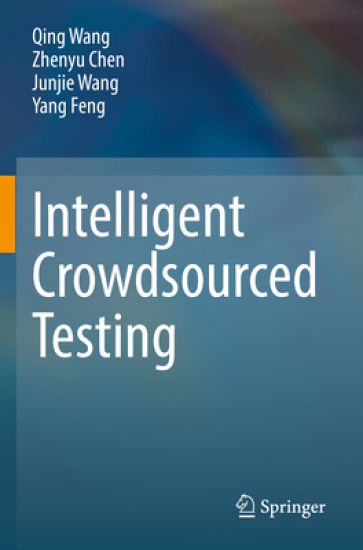
In an article for Wired Magazine in 2006, Jeff Howe defined crowdsourcing as an idea for outsourcing a task that is traditionally performed by a single employee to a large group of people in the form of an open call. Since then, by modifying crowdsourcing into different forms, some of the most successful new companies on the market have used this idea to make people’s lives easier and better. On the other hand, software testing has long been recognized as a time-consuming and expensive activity. Mobile application testing is especially difficult, largely due to compatibility issues: a mobile application must work on devices with different operating systems (e.g. iOS, Android), manufacturers (e.g. Huawei, Samsung) and keypad types (e.g. virtual keypad, hard keypad). One cannot be 100% sure that, just because a tested application works well on one device, it will run smoothly on all others.Crowdsourced testing is an emerging paradigm that can improve the cost-effectiveness of softwaretesting and accelerate the process, especially for mobile applications. It entrusts testing tasks to online crowdworkers whose diverse testing devices/contexts, experience, and skill sets can significantly contribute to more reliable, cost-effective and efficient testing results. It has already been adopted by many software organizations, including Google, Facebook, Amazon and Microsoft. This book provides an intelligent overview of crowdsourced testing research and practice. It employs machine learning, data mining, and deep learning techniques to process the data generated during the crowdsourced testing process, to facilitate the management of crowdsourced testing, and to improve the quality of crowdsourced testing.
Intelligent Crowdsourced Testing

Intelligent Crowdsourced Testing

Qing Wang; Zhenyu Chen; Junjie Wang; Yang Feng

SPRINGER VERLAG, SINGAPORE
2022
sidottu
In an article for Wired Magazine in 2006, Jeff Howe defined crowdsourcing as an idea for outsourcing a task that is traditionally performed by a single employee to a large group of people in the form of an open call. Since then, by modifying crowdsourcing into different forms, some of the most successful new companies on the market have used this idea to make people’s lives easier and better. On the other hand, software testing has long been recognized as a time-consuming and expensive activity. Mobile application testing is especially difficult, largely due to compatibility issues: a mobile application must work on devices with different operating systems (e.g. iOS, Android), manufacturers (e.g. Huawei, Samsung) and keypad types (e.g. virtual keypad, hard keypad). One cannot be 100% sure that, just because a tested application works well on one device, it will run smoothly on all others.Crowdsourced testing is an emerging paradigm that can improve the cost-effectiveness of softwaretesting and accelerate the process, especially for mobile applications. It entrusts testing tasks to online crowdworkers whose diverse testing devices/contexts, experience, and skill sets can significantly contribute to more reliable, cost-effective and efficient testing results. It has already been adopted by many software organizations, including Google, Facebook, Amazon and Microsoft. This book provides an intelligent overview of crowdsourced testing research and practice. It employs machine learning, data mining, and deep learning techniques to process the data generated during the crowdsourced testing process, to facilitate the management of crowdsourced testing, and to improve the quality of crowdsourced testing.
21st Century Maritime Silk Road: Wave Energy Resource Evaluation

21st Century Maritime Silk Road: Wave Energy Resource Evaluation

Chongwei Zheng; Jianjun Xu; Chao Zhan; Qing Wang

Springer Verlag, Singapore
2020
nidottu
This book focuses on the evaluation of wave energy in the Maritime Silk Road. Firstly, it compares wave energy and other main energy sources, and then discusses the various disadvantages. It also presents the current research and the difficulties of wave energy evaluation, and systematically analyzes the climatic characteristics of the wave energy, including the temporal–spatial distribution and climatic trend of a series of key factors (e.g. wave power density, availability, richness, stability, energy direction, energy storage). It then describes the design of a short-term forecasting scheme and a long-term projection scheme of wave energy suitable for the Maritime Silk Road, to serve as a plan for the daily operation and long-term development of wave energy. Further, it highlights the wave energy analysis and decision-making in the context of the remote islands and reefs, using Sri Lanka is taken as a case study. Lastly, it presents the first wave energy resource dataset for theMaritime Silk Road.This book is one of a series of publications on the 21st century Maritime Silk Road (shortened as “Maritime Silk Road”) that covers the characteristics of the marine environment and marine new energy, remote islands and reef construction, climate change, early warning of wave disasters, legal escort, marine environment and energy big data construction, contributing to the safe and efficient construction of the Maritime Silk Road. It aims to improve our knowledge of the ocean, and so improve the capacity for marine construction, enhance the viability of remote islands and reefs, ease the energy crisis and protect the ecological environment and improve the quality of life of residents along the Maritime Silk Road, as well as to protect the rights, and interests of the countries and regions participating in the construction of the Maritime Silk Road. This book is a valuable reference resource for decision-makers, researchers, and marine engineers working in the related fields.
21st Century Maritime Silk Road: Wave Energy Resource Evaluation

21st Century Maritime Silk Road: Wave Energy Resource Evaluation

Chongwei Zheng; Jianjun Xu; Chao Zhan; Qing Wang

Springer Verlag, Singapore
2019
sidottu
This book focuses on the evaluation of wave energy in the Maritime Silk Road. Firstly, it compares wave energy and other main energy sources, and then discusses the various disadvantages. It also presents the current research and the difficulties of wave energy evaluation, and systematically analyzes the climatic characteristics of the wave energy, including the temporal–spatial distribution and climatic trend of a series of key factors (e.g. wave power density, availability, richness, stability, energy direction, energy storage). It then describes the design of a short-term forecasting scheme and a long-term projection scheme of wave energy suitable for the Maritime Silk Road, to serve as a plan for the daily operation and long-term development of wave energy. Further, it highlights the wave energy analysis and decision-making in the context of the remote islands and reefs, using Sri Lanka is taken as a case study. Lastly, it presents the first wave energy resource dataset for theMaritime Silk Road.This book is one of a series of publications on the 21st century Maritime Silk Road (shortened as “Maritime Silk Road”) that covers the characteristics of the marine environment and marine new energy, remote islands and reef construction, climate change, early warning of wave disasters, legal escort, marine environment and energy big data construction, contributing to the safe and efficient construction of the Maritime Silk Road. It aims to improve our knowledge of the ocean, and so improve the capacity for marine construction, enhance the viability of remote islands and reefs, ease the energy crisis and protect the ecological environment and improve the quality of life of residents along the Maritime Silk Road, as well as to protect the rights, and interests of the countries and regions participating in the construction of the Maritime Silk Road. This book is a valuable reference resource for decision-makers, researchers, and marine engineers working in the related fields.
Electromagnetic Ultrasonic Guided Waves

Electromagnetic Ultrasonic Guided Waves

Songling Huang; Shen Wang; Weibin Li; Qing Wang

Springer Verlag, Singapore
2018
nidottu
This book introduces the fundamental theory of electromagnetic ultrasonic guided waves, together with its applications. It includes the dispersion characteristics and matching theory of guided waves; the mechanism of production and theoretical model of electromagnetic ultrasonic guided waves; the effect mechanism between guided waves and defects; the simulation method for the entire process of electromagnetic ultrasonic guided wave propagation; electromagnetic ultrasonic thickness measurement; pipeline axial guided wave defect detection; and electromagnetic ultrasonic guided wave detection of gas pipeline cracks. This theory and findings on applications draw on the author’s intensive research over the past eight years. The book can be used for nondestructive testing technology and as an engineering reference work. The specific implementation of the electromagnetic ultrasonic guided wave system presented here will also be of value for other nondestructive test developers.
Coaching Psychology for Learning
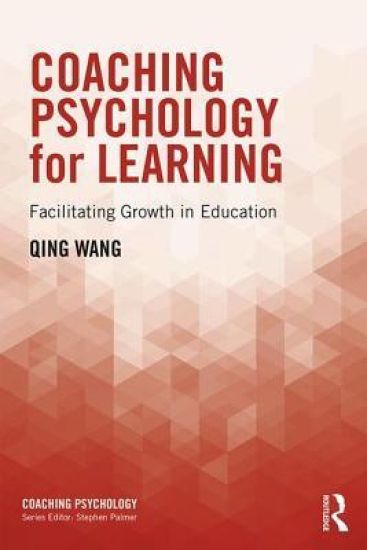
The contribution of coaching psychology to educational fields is increasingly recognised. This timely book introduces coaching psychology as a facilitative method to support learning in different educational contexts.Coaching Psychology for Learning: Facilitating Growth in Education is conveniently organised into three parts: Part One begins with a detailed account of educational paradigms, learning theories, and coaching psychology theories; it then reviews important studies of coaching applied to the educational field and identifies a number of gaps to which coaching psychology for learning can contribute; Part Two presents two empirical participatory studies of coaching psychology for learning, which draw from both doctoral research conducted in the UK and educational work in Mainland China; two original and evidence-based coaching models are also illustrated; Part Three consolidates the empirical evidence and original coaching models by exploring the nature of educational coaching, including the context, purpose, processes, and people and their interrelations. The review of learning theories and coaching psychology theories in Part One enables the reader to gain a quick understanding of coaching psychology and its role in education, while the empirical studies in Part Two are particularly useful for undergraduate and postgraduate students, providing practical examples of how to conduct coaching psychology research in the field of education, in both the West and the East. The book also offers advice on design and implementation issues, which will benefit educational psychologists and coaching psychologists who wish to focus their professional practice in education.Coaching Psychology for Learning is essential reading for any teacher, student or practitioner who wishes to become an educational coach to facilitate learning. It will appeal to coaches and coaching psychologists, including those in training and at postgraduate level, as well as professionals in educational settings, such as school leaders, counsellors and coaches, and educational psychologists.
Coaching Psychology for Learning
The contribution of coaching psychology to educational fields is increasingly recognised. This timely book introduces coaching psychology as a facilitative method to support learning in different educational contexts.Coaching Psychology for Learning: Facilitating Growth in Education is conveniently organised into three parts: Part One begins with a detailed account of educational paradigms, learning theories, and coaching psychology theories; it then reviews important studies of coaching applied to the educational field and identifies a number of gaps to which coaching psychology for learning can contribute; Part Two presents two empirical participatory studies of coaching psychology for learning, which draw from both doctoral research conducted in the UK and educational work in Mainland China; two original and evidence-based coaching models are also illustrated; Part Three consolidates the empirical evidence and original coaching models by exploring the nature of educational coaching, including the context, purpose, processes, and people and their interrelations. The review of learning theories and coaching psychology theories in Part One enables the reader to gain a quick understanding of coaching psychology and its role in education, while the empirical studies in Part Two are particularly useful for undergraduate and postgraduate students, providing practical examples of how to conduct coaching psychology research in the field of education, in both the West and the East. The book also offers advice on design and implementation issues, which will benefit educational psychologists and coaching psychologists who wish to focus their professional practice in education.Coaching Psychology for Learning is essential reading for any teacher, student or practitioner who wishes to become an educational coach to facilitate learning. It will appeal to coaches and coaching psychologists, including those in training and at postgraduate level, as well as professionals in educational settings, such as school leaders, counsellors and coaches, and educational psychologists.
Electromagnetic Ultrasonic Guided Waves

Electromagnetic Ultrasonic Guided Waves

Songling Huang; Shen Wang; Weibin Li; Qing Wang

Springer Verlag, Singapore
2016
sidottu
This book introduces the fundamental theory of electromagnetic ultrasonic guided waves, together with its applications. It includes the dispersion characteristics and matching theory of guided waves; the mechanism of production and theoretical model of electromagnetic ultrasonic guided waves; the effect mechanism between guided waves and defects; the simulation method for the entire process of electromagnetic ultrasonic guided wave propagation; electromagnetic ultrasonic thickness measurement; pipeline axial guided wave defect detection; and electromagnetic ultrasonic guided wave detection of gas pipeline cracks. This theory and findings on applications draw on the author’s intensive research over the past eight years. The book can be used for nondestructive testing technology and as an engineering reference work. The specific implementation of the electromagnetic ultrasonic guided wave system presented here will also be of value for other nondestructive test developers.
Universal Estimation of Information Measures for Analog Sources

Universal Estimation of Information Measures for Analog Sources

Qing Wang; Sanjeev Kulkarni; Sergio Verdú

now publishers Inc
2009
nidottu
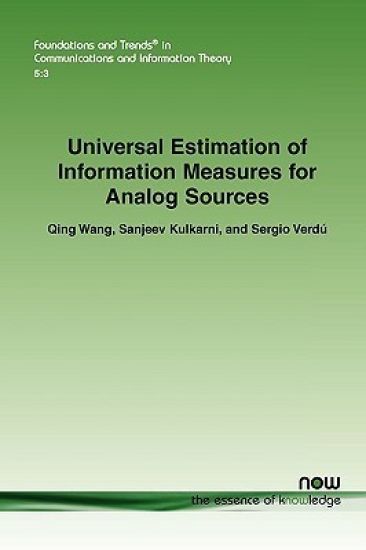
Entropy, mutual information and divergence measure the randomness, dependence and dissimilarity, respectively, of random objects. In addition to their prominent role in information theory, they have found numerous applications, among others, in probability theory statistics, physics, chemistry, molecular biology, ecology, bioinformatics, neuroscience, machine learning, linguistics, and finance. Many of these applications require a universal estimate of information measures which does not assume knowledge of the statistical properties of the observed data. Over the past few decades, several nonparametric algorithms have been proposed to estimate information measures.Universal Estimation of Information Measures for Analog Sources presents a comprehensive survey of universal estimation of information measures for memoryless analog (real-valued or real vector-valued) sources with an emphasis on the estimation of mutual information and divergence and their applications. The book reviews the consistency of the universal algorithms and the corresponding sufficient conditions as well as their speed of convergence.Universal Estimation of Information Measures for Analog Sources provides a comprehensive review of an increasingly important topic in Information Theory. It will be of interest to students, practitioners and researchers working in Information Theory.