Kirjojen hintavertailu. Mukana 12 390 323 kirjaa ja 12 kauppaa.

Kirjailija

Qinglai Wei

Kirjat ja teokset yhdessä paikassa: 7 kirjaa, julkaisuja vuosilta 2017-2025, suosituimpien joukossa Intelligent Computing. Vertaile teosten hintoja ja tarkista saatavuus suomalaisista kirjakaupoista.

7 kirjaa

Kirjojen julkaisuhaarukka 2017-2025.

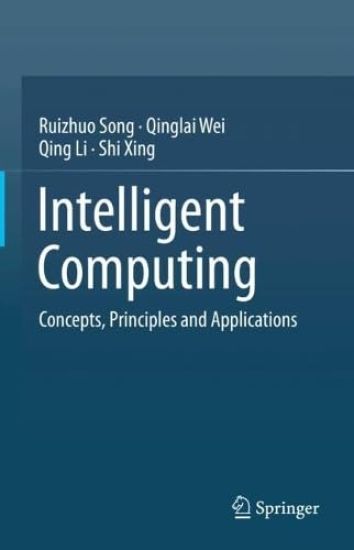
Intelligent Computing

Intelligent Computing

Ruizhuo Song; Qinglai Wei; Qing Li; Shi Xing

Springer Nature Switzerland AG
2025
sidottu
Intelligent computing is a computational approach primarily inspired by the objective laws governing biological groups in nature, as well as the behaviors of biological thinking and movement. It encompasses various algorithmic fields such as evolutionary computation, swarm intelligence computation, neural computation, and more. These algorithms typically achieve the goals of intelligent computing by simulating the distinctive functions of certain species in nature or specific characteristics of natural phenomena. By programming and executing the collective wisdom of biological groups and leveraging natural laws, optimization algorithms with intelligent essence are designed. This book serves as an introduction to widely used and common intelligent computing methods. It covers fundamental concepts, principles, model characteristics, and typical application examples of various intelligent computing methods. Additionally, it provides the latest examples along with corresponding Matlab or Python codes, facilitating readers in deepening their understanding and reproducing the content. The target audience for this book includes senior undergraduate and graduate students majoring in automation, artificial intelligence, intelligent science and technology, computer science, and related fields. It can also serve as a valuable self-study reference for professionals in computer science, artificial intelligence, and related disciplines.
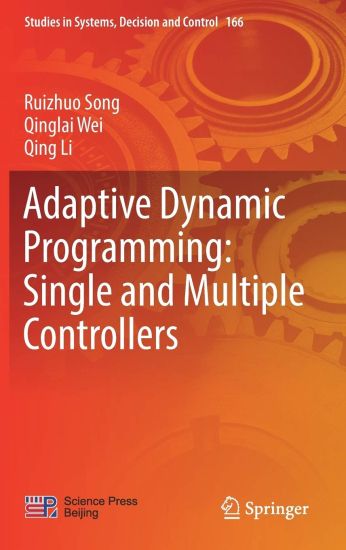
Adaptive Dynamic Programming: Single and Multiple Controllers

Adaptive Dynamic Programming: Single and Multiple Controllers

Ruizhuo Song; Qinglai Wei; Qing Li

Springer Verlag, Singapore
2019
sidottu
This book presents a class of novel optimal control methods and games schemes based on adaptive dynamic programming techniques. For systems with one control input, the ADP-based optimal control is designed for different objectives, while for systems with multi-players, the optimal control inputs are proposed based on games. In order to verify the effectiveness of the proposed methods, the book analyzes the properties of the adaptive dynamic programming methods, including convergence of the iterative value functions and the stability of the system under the iterative control laws. Further, to substantiate the mathematical analysis, it presents various application examples, which provide reference to real-world practices.
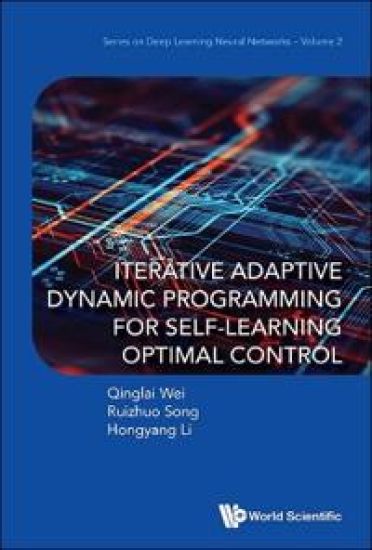
Iterative Adaptive Dynamic Programming For Self-learning Optimal Control

Iterative Adaptive Dynamic Programming For Self-learning Optimal Control

Qinglai Wei; Ruizhuo Song; Hongyang Li

WORLD SCIENTIFIC PUBLISHING CO PTE LTD
2025
sidottu
This unique book introduces the iterative adaptive dynamic programming theory from the control systems perspectives, with the most recent results of iterative adaptive dynamic programming methods. Advanced theoretical analysis and some practical applications of iterative adaptive dynamic programming are provided. Furthermore, the practical applications in residential energy systems are also highlighted, showing the good performance of the iterative adaptive dynamic programming methods.The useful reference text benefits professionals, researchers, academics, graduate and undergraduates students in control engineering.
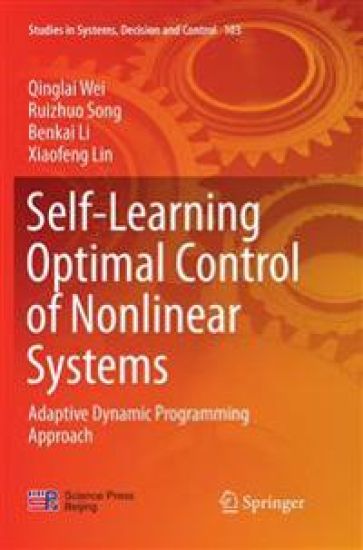
Self-Learning Optimal Control of Nonlinear Systems

Self-Learning Optimal Control of Nonlinear Systems

Qinglai Wei; Ruizhuo Song; Benkai Li; Xiaofeng Lin

Springer Verlag, Singapore
2019
nidottu
This book presents a class of novel, self-learning, optimal control schemes based on adaptive dynamic programming techniques, which quantitatively obtain the optimal control schemes of the systems. It analyzes the properties identified by the programming methods, including the convergence of the iterative value functions and the stability of the system under iterative control laws, helping to guarantee the effectiveness of the methods developed. When the system model is known, self-learning optimal control is designed on the basis of the system model; when the system model is not known, adaptive dynamic programming is implemented according to the system data, effectively making the performance of the system converge to the optimum.With various real-world examples to complement and substantiate the mathematical analysis, the book is a valuable guide for engineers, researchers, and students in control science and engineering.
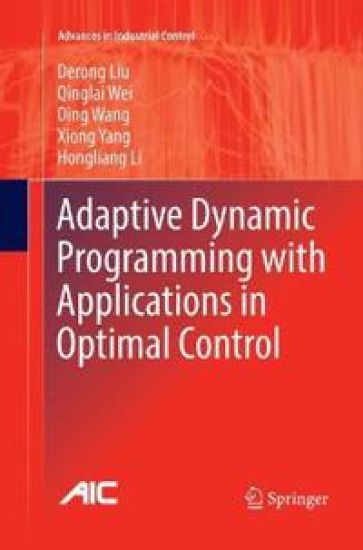
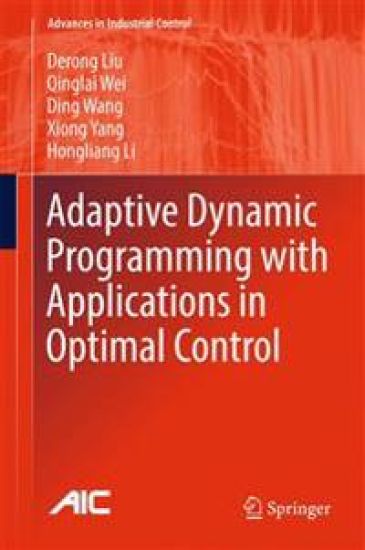
Adaptive Dynamic Programming with Applications in Optimal Control

Adaptive Dynamic Programming with Applications in Optimal Control

Derong Liu; Qinglai Wei; Ding Wang; Xiong Yang; Hongliang Li

Springer International Publishing AG
2018
nidottu
This book covers the most recent developments in adaptive dynamic programming (ADP). The text begins with a thorough background review of ADP making sure that readers are sufficiently familiar with the fundamentals. In the core of the book, the authors address first discrete- and then continuous-time systems. Coverage of discrete-time systems starts with a more general form of value iteration to demonstrate its convergence, optimality, and stability with complete and thorough theoretical analysis. A more realistic form of value iteration is studied where value function approximations are assumed to have finite errors. Adaptive Dynamic Programming also details another avenue of the ADP approach: policy iteration. Both basic and generalized forms of policy-iteration-based ADP are studied with complete and thorough theoretical analysis in terms of convergence, optimality, stability, and error bounds. Among continuous-time systems, the control of affine and nonaffine nonlinear systems is studied using the ADP approach which is then extended to other branches of control theory including decentralized control, robust and guaranteed cost control, and game theory. In the last part of the book the real-world significance of ADP theory is presented, focusing on three application examples developed from the authors’ work:• renewable energy scheduling for smart power grids;• coal gasification processes; and• water–gas shift reactions.Researchers studying intelligent control methods and practitioners looking to apply them in the chemical-process and power-supply industries will find much to interest them in this thorough treatment of an advanced approach to control.
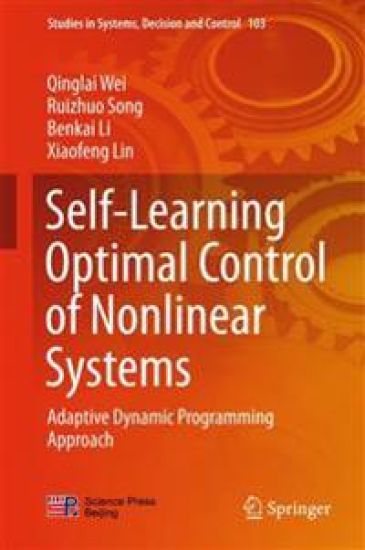
Self-Learning Optimal Control of Nonlinear Systems

Self-Learning Optimal Control of Nonlinear Systems

Qinglai Wei; Ruizhuo Song; Benkai Li; Xiaofeng Lin

Springer Verlag, Singapore
2017
sidottu
This book presents a class of novel, self-learning, optimal control schemes based on adaptive dynamic programming techniques, which quantitatively obtain the optimal control schemes of the systems. It analyzes the properties identified by the programming methods, including the convergence of the iterative value functions and the stability of the system under iterative control laws, helping to guarantee the effectiveness of the methods developed. When the system model is known, self-learning optimal control is designed on the basis of the system model; when the system model is not known, adaptive dynamic programming is implemented according to the system data, effectively making the performance of the system converge to the optimum.With various real-world examples to complement and substantiate the mathematical analysis, the book is a valuable guide for engineers, researchers, and students in control science and engineering.
Adaptive Dynamic Programming with Applications in Optimal Control

Adaptive Dynamic Programming with Applications in Optimal Control

Derong Liu; Qinglai Wei; Ding Wang; Xiong Yang; Hongliang Li

Springer International Publishing AG
2017
sidottu
This book covers the most recent developments in adaptive dynamic programming (ADP). The text begins with a thorough background review of ADP making sure that readers are sufficiently familiar with the fundamentals. In the core of the book, the authors address first discrete- and then continuous-time systems. Coverage of discrete-time systems starts with a more general form of value iteration to demonstrate its convergence, optimality, and stability with complete and thorough theoretical analysis. A more realistic form of value iteration is studied where value function approximations are assumed to have finite errors. Adaptive Dynamic Programming also details another avenue of the ADP approach: policy iteration. Both basic and generalized forms of policy-iteration-based ADP are studied with complete and thorough theoretical analysis in terms of convergence, optimality, stability, and error bounds. Among continuous-time systems, the control of affine and nonaffine nonlinear systems is studied using the ADP approach which is then extended to other branches of control theory including decentralized control, robust and guaranteed cost control, and game theory. In the last part of the book the real-world significance of ADP theory is presented, focusing on three application examples developed from the authors’ work:• renewable energy scheduling for smart power grids;• coal gasification processes; and• water–gas shift reactions.Researchers studying intelligent control methods and practitioners looking to apply them in the chemical-process and power-supply industries will find much to interest them in this thorough treatment of an advanced approach to control.