

Kirjailija
Quan Nguyen
Kirjat ja teokset yhdessä paikassa: 9 kirjaa, julkaisuja vuosilta 2018-2026, suosituimpien joukossa Grokking Bayes. Vertaile teosten hintoja ja tarkista saatavuus suomalaisista kirjakaupoista.
9 kirjaa
Kirjojen julkaisuhaarukka 2018-2026.
Apply advanced techniques for optimising machine learning processes For machine learning practitioners confident in maths and statistics. Bayesian Optimization in Action shows you how to optimise hyperparameter tuning, A/B testing, and other aspects of the machine learning process, by applying cutting-edge Bayesian techniques. Using clear language, Bayesian Optimization helps pinpoint the best configuration for your machine-learning models with speed and accuracy. With a range of illustrations, and concrete examples, this book proves that Bayesian Optimisation doesn't have to be difficult! Key features include: Train Gaussian processes on both sparse and large data setsCombine Gaussian processes with deep neural networks to make them flexible and expressiveFind the most successful strategies for hyperparameter tuningNavigate a search space and identify high-performing regionsApply Bayesian Optimisation to practical use cases such as cost-constrained, multi-objective, and preference optimisationUse PyTorch, GPyTorch, and BoTorch to implement Bayesian optimisation You will get in-depth insights into how Bayesian optimisation works and learn how to implement it with cutting-edge Python libraries. The book's easy-to-reuse code samples will let you hit the ground running by plugging them straight into your own projects! About the technology Experimenting in science and engineering can be costly and time-consuming, especially without a reliable way to narrow down your choices. Bayesian Optimisation helps you identify optimal configurations to pursue in a search space. It uses a Gaussian process and machine learning techniques to model an objective function and quantify the uncertainty of predictions. Whether you're tuning machine learning models, recommending products to customers, or engaging in research, Bayesian Optimisation can help you make better decisions faster.
Hands-On Application Development with PyCharm
Bruce M. Van Horn II; Quan Nguyen
PACKT PUBLISHING LIMITED
2023
nidottu
Unleash the power of PyCharm to craft business, scientific, and web applications in Python with this definitive guide Key Features Learn basic to advanced PyCharm concepts to improve developer efficiency on your Python projects Learn with practical examples that focus on efficient application development Explore features such as code automation, graphical debugging, and remote development Purchase of the print or Kindle book includes a free PDF eBook Book DescriptionIn the quest to develop robust, professional-grade software with Python and meet tight deadlines, it’s crucial to have the best tools at your disposal. In this second edition of Hands-on Application Development with PyCharm, you’ll learn tips and tricks to work at a speed and proficiency previously reserved only for elite developers. To achieve that, you’ll be introduced to PyCharm, the premiere professional integrated development environment for Python programmers among the myriad of IDEs available. Regardless of how Python is utilized, whether for general automation scripting, utility creation, web applications, data analytics, machine learning, or business applications, PyCharm offers tooling that simplifies complex tasks and streamlines common ones. In this book, you'll find everything you need to harness PyCharm's full potential and make the most of Pycharm's productivity shortcuts. The book comprehensively covers topics ranging from installation and customization to web development, database management, and data analysis pipeline development helping you become proficient in Python application development in diverse domains. By the end of this book, you’ll have discovered the remarkable capabilities of PyCharm and how you can achieve a new level of capability and productivity.What you will learn Explore basic and advanced PyCharm features Set up, configure, and customize your Python projects in PyCharm Develop web applications with Flask, Django, FastAPI, and Pyramid Discover PyCharm's capabilities for database management and data visualization Explore code automation, debugging, and remote development in PyCharm Perform data science tasks using Jupyter notebooks, NumPy, and pandas Who this book is forThis book is for Python practitioners and learners looking to boost their productivity and proficiency by harnessing the features and capabilities of PyCharm, all while gaining insights into best practices for modern application development. Basic knowledge of Python is required, making the book accessible to both newcomers and experienced Python developers.
Write fast, robust, and highly reusable applications using Python's internal optimization, state-of-the-art performance-benchmarking tools, and cutting-edge librariesKey FeaturesBenchmark, profile, and accelerate Python programs using optimization toolsScale applications to multiple processors with concurrent programmingMake applications robust and reusable using effective design patternsBook DescriptionPython's powerful capabilities for implementing robust and efficient programs make it one of the most sought-after programming languages.In this book, you'll explore the tools that allow you to improve performance and take your Python programs to the next level.This book starts by examining the built-in as well as external libraries that streamline tasks in the development cycle, such as benchmarking, profiling, and optimizing. You'll then get to grips with using specialized tools such as dedicated libraries and compilers to increase your performance at number-crunching tasks, including training machine learning models.The book covers concurrency, a major solution to making programs more efficient and scalable, and various concurrent programming techniques such as multithreading, multiprocessing, and asynchronous programming.You'll also understand the common problems that cause undesirable behavior in concurrent programs.Finally, you'll work with a wide range of design patterns, including creational, structural, and behavioral patterns that enable you to tackle complex design and architecture challenges, making your programs more robust and maintainable.By the end of the book, you'll be exposed to a wide range of advanced functionalities in Python and be equipped with the practical knowledge needed to apply them to your use cases.What you will learnWrite efficient numerical code with NumPy, pandas, and XarrayUse Cython and Numba to achieve native performanceFind bottlenecks in your Python code using profilersOptimize your machine learning models with JAXImplement multithreaded, multiprocessing, and asynchronous programsSolve common problems in concurrent programming, such as deadlocksTackle architecture challenges with design patternsWho this book is forThis book is for intermediate to experienced Python programmers who are looking to scale up their applications in a systematic and robust manner. Programmers from a range of backgrounds will find this book useful, including software engineers, scientific programmers, and software architects.
The Statistics and Calculus with Python Workshop
Peter Farrell; Alvaro Fuentes; Ajinkya Sudhir Kolhe; Quan Nguyen; Alexander Joseph Sarver; Marios Tsatsos
Packt Publishing Limited
2020
nidottu
Are you looking to start developing artificial intelligence applications? Do you need a refresher on key mathematical concepts? Full of engaging practical exercises, The Statistics and Calculus with Python Workshop will show you how to apply your understanding of advanced mathematics in the context of Python. The book begins by giving you a high-level overview of the libraries you'll use while performing statistics with Python. As you progress, you'll perform various mathematical tasks using the Python programming language, such as solving algebraic functions with Python starting with basic functions, and then working through transformations and solving equations. Later chapters in the book will cover statistics and calculus concepts and how to use them to solve problems and gain useful insights. Finally, you'll study differential equations with an emphasis on numerical methods and learn about algorithms that directly calculate values of functions. By the end of this book, you’ll have learned how to apply essential statistics and calculus concepts to develop robust Python applications that solve business challenges.Key Features Discover how most programmers use the main Python libraries when performing statistics with Python Use descriptive statistics and visualizations to answer business and scientific questions Solve complicated calculus problems, such as arc length and solids of revolution using derivatives and integrals What you will learnGet to grips with the fundamental mathematical functions in Python Perform calculations on tabular datasets using pandas Understand the differences between polynomials, rational functions, exponential functions, and trigonometric functions Use algebra techniques for solving systems of equations Solve real-world problems with probability Solve optimization problems with derivatives and integrals Who this book is forIf you are a Python programmer who wants to develop intelligent solutions that solve challenging business problems, then this book is for you. To better grasp the concepts explained in this book, you must have a thorough understanding of advanced mathematical concepts, such as Markov chains, Euler's formula, and Runge-Kutta methods as the book only explains how these techniques and concepts can be implemented in Python.
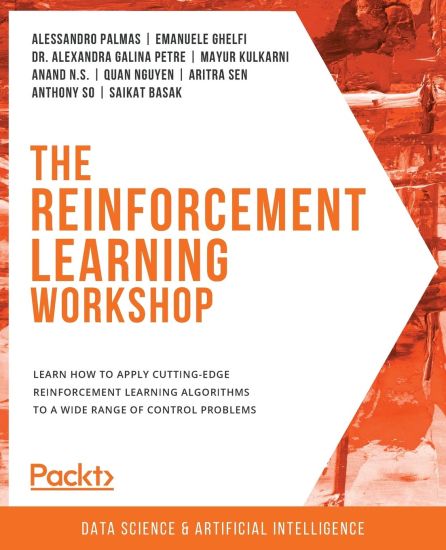
The The Reinforcement Learning Workshop
Alessandro Palmas; Emanuele Ghelfi; Dr. Alexandra Galina Petre; Mayur Kulkarni; Anand N.S.; Quan Nguyen; Aritra Sen; Anthony So; Saikat Basak
Packt Publishing Limited
2020
nidottu
Start with the basics of reinforcement learning and explore deep learning concepts such as deep Q-learning, deep recurrent Q-networks, and policy-based methods with this practical guideKey FeaturesUse TensorFlow to write reinforcement learning agents for performing challenging tasksLearn how to solve finite Markov decision problemsTrain models to understand popular video games like BreakoutBook DescriptionVarious intelligent applications such as video games, inventory management software, warehouse robots, and translation tools use reinforcement learning (RL) to make decisions and perform actions that maximize the probability of the desired outcome. This book will help you to get to grips with the techniques and the algorithms for implementing RL in your machine learning models.Starting with an introduction to RL, you’ll be guided through different RL environments and frameworks. You’ll learn how to implement your own custom environments and use OpenAI baselines to run RL algorithms. Once you’ve explored classic RL techniques such as Dynamic Programming, Monte Carlo, and TD Learning, you’ll understand when to apply the different deep learning methods in RL and advance to deep Q-learning. The book will even help you understand the different stages of machine-based problem-solving by using DARQN on a popular video game Breakout. Finally, you’ll find out when to use a policy-based method to tackle an RL problem.By the end of The Reinforcement Learning Workshop, you’ll be equipped with the knowledge and skills needed to solve challenging problems using reinforcement learning.What you will learnUse OpenAI Gym as a framework to implement RL environmentsFind out how to define and implement reward functionExplore Markov chain, Markov decision process, and the Bellman equationDistinguish between Dynamic Programming, Monte Carlo, and Temporal Difference LearningUnderstand the multi-armed bandit problem and explore various strategies to solve itBuild a deep Q model network for playing the video game BreakoutWho this book is forIf you are a data scientist, machine learning enthusiast, or a Python developer who wants to learn basic to advanced deep reinforcement learning algorithms, this workshop is for you. A basic understanding of the Python language is necessary.
A definitive guide to PyCharm to help you build business-oriented Python applications ranging from modern web development to data scienceKey FeaturesLearn basic to advanced PyCharm concepts to improve efficiency of your Python projectsWork through practical examples that focus on efficient application development with PyCharmExplore advanced features in PyCharm such as code automation, version control, and GUI debuggingBook DescriptionJetBrain’s PyCharm is the most popular Integrated Development Environment (IDE) used by the Python community thanks to its numerous features that facilitate faster, more accurate, and more productive programming practices. However, the abundance of options and customizations can make PyCharm seem quite intimidating.Hands-on Application Development with PyCharm starts with PyCharm’s installation and configuration process, and systematically takes you through a number of its powerful features that can greatly improve your productivity. You’ll explore code automation, version control, graphical debugging/testing, management of virtual environments, and much more. Finally, you’ll delve into specific PyCharm features that support web development and data science, two of the fastest growing applications in Python programming. These include the integration of the Django framework as well as the extensive support for IPython and Jupyter Notebook.By the end of this PyCharm book, you will have gained extensive knowledge of the tool and be able to implement its features and make the most of its support for your projects.What you will learnExplore PyCharm functionalities and what makes it stand out from other Python IDEsSet up, configure, and customize your Python projects in PyCharmUnderstand how PyCharm integrates with Django for web developmentDiscover PyCharm's capabilities in database management and data visualizationPerform code automation, GUI testing, and version control in PyCharmIntegrate interactive Python tools such as Jupyter Notebooks for building virtual environmentsWho this book is forIf you’re a beginner or an expert Python user looking to improve your productivity using one of the best Python IDEs, this book is for you. Basic knowledge of Python programming language is expected.
Advanced Python Programming
Dr. Gabriele Lanaro; Quan Nguyen; Sakis Kasampalis
Packt Publishing Limited
2019
nidottu
Create distributed applications with clever design patterns to solve complex problemsKey FeaturesSet up and run distributed algorithms on a cluster using Dask and PySparkMaster skills to accurately implement concurrency in your codeGain practical experience of Python design patterns with real-world examplesBook DescriptionThis Learning Path shows you how to leverage the power of both native and third-party Python libraries for building robust and responsive applications. You will learn about profilers and reactive programming, concurrency and parallelism, as well as tools for making your apps quick and efficient. You will discover how to write code for parallel architectures using TensorFlow and Theano, and use a cluster of computers for large-scale computations using technologies such as Dask and PySpark. With the knowledge of how Python design patterns work, you will be able to clone objects, secure interfaces, dynamically choose algorithms, and accomplish much more in high performance computing.By the end of this Learning Path, you will have the skills and confidence to build engaging models that quickly offer efficient solutions to your problems.This Learning Path includes content from the following Packt products:Python High Performance - Second Edition by Gabriele LanaroMastering Concurrency in Python by Quan NguyenMastering Python Design Patterns by Sakis KasampalisWhat you will learnUse NumPy and pandas to import and manipulate datasetsAchieve native performance with Cython and NumbaWrite asynchronous code using asyncio and RxPyDesign highly scalable programs with application scaffoldingExplore abstract methods to maintain data consistencyClone objects using the prototype patternUse the adapter pattern to make incompatible interfaces compatibleEmploy the strategy pattern to dynamically choose an algorithmWho this book is forThis Learning Path is specially designed for Python developers who want to build high-performance applications and learn about single core and multi-core programming, distributed concurrency, and Python design patterns. Some experience with Python programming language will help you get the most out of this Learning Path.
Immerse yourself in the world of Python concurrency and tackle the most complex concurrent programming problemsKey FeaturesExplore the core syntaxes, language features and modern patterns of concurrency in PythonUnderstand how to use concurrency to keep data consistent and applications responsiveUtilize application scaffolding to design highly-scalable programs Book DescriptionPython is one of the most popular programming languages, with numerous libraries and frameworks that facilitate high-performance computing. Concurrency and parallelism in Python are essential when it comes to multiprocessing and multithreading; they behave differently, but their common aim is to reduce the execution time. This book serves as a comprehensive introduction to various advanced concepts in concurrent engineering and programming.Mastering Concurrency in Python starts by introducing the concepts and principles in concurrency, right from Amdahl's Law to multithreading programming, followed by elucidating multiprocessing programming, web scraping, and asynchronous I/O, together with common problems that engineers and programmers face in concurrent programming. Next, the book covers a number of advanced concepts in Python concurrency and how they interact with the Python ecosystem, including the Global Interpreter Lock (GIL). Finally, you'll learn how to solve real-world concurrency problems through examples.By the end of the book, you will have gained extensive theoretical knowledge of concurrency and the ways in which concurrency is supported by the Python languageWhat you will learnExplore the concepts of concurrency in programmingExplore the core syntax and features that enable concurrency in PythonUnderstand the correct way to implement concurrencyAbstract methods to keep the data consistent in your programAnalyze problems commonly faced in concurrent programmingUse application scaffolding to design highly-scalable programsWho this book is forThis book is for developers who wish to build high-performance applications and learn about signle-core, multicore programming or distributed concurrency. Some experience with Python programming language is assumed.