Kirjojen hintavertailu. Mukana 12 473 954 kirjaa ja 12 kauppaa.

Kirjailija

Quan Yu

Kirjat ja teokset yhdessä paikassa: 6 kirjaa, julkaisuja vuosilta 2014-2021, suosituimpien joukossa Dynamic Sharing of Wireless Spectrum. Vertaile teosten hintoja ja tarkista saatavuus suomalaisista kirjakaupoista.

6 kirjaa

Kirjojen julkaisuhaarukka 2014-2021.

Spatial Multidimensional Cooperative Transmission Theories And Key Technologies

Spatial Multidimensional Cooperative Transmission Theories And Key Technologies

Lin Bai; Xianling Liang; Zhenyu Xiao; Ronghong Jin; Quan Yu

World Scientific Publishing Co Pte Ltd
2020
sidottu
This book introduces the basic theory and key technologies of MIMO multi-antenna system, the characteristics and applications of spatial multi-dimensional cooperative transmission in the Ground-based, Air-based and Space-based communication systems as well as several advanced technologies for spatial multidimensional cooperative transmission from theoretical and practical perspectives. The Chinese edition of this book won the 4th Chinese Government Award for Publishing, and the authors are well known in the field of Spatial Information Network.
Dynamic Sharing of Wireless Spectrum

Dynamic Sharing of Wireless Spectrum

Haibo Zhou; Quan Yu; Xuemin (Sherman) Shen; Shaohua Wu; Qinyu Zhang

Springer International Publishing AG
2018
nidottu
This book focuses on the current research on the dynamic spectrum sharing for efficient spectrum resource utilization, which covers the overlay spectrum sharing, underlay spectrum sharing and database-assisted spectrum sharing related research issues.
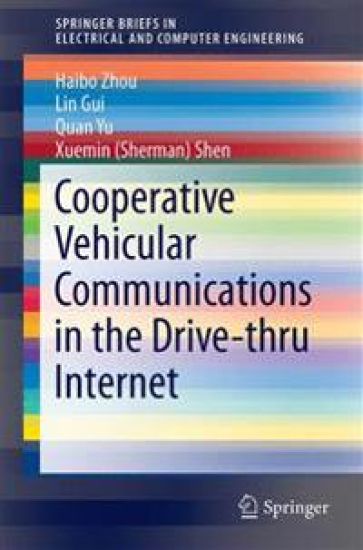
Cooperative Vehicular Communications in the Drive-thru Internet

Cooperative Vehicular Communications in the Drive-thru Internet

Haibo Zhou; Lin Gui; Quan Yu; Xuemin (Sherman) Shen

Springer International Publishing AG
2015
nidottu
This brief presents a unified analytical framework for the evaluation of drive-thru Internet performance and accordingly proposes an optimal spatial access control management approach. A comprehensive overview and in-depth discussion of the research literature is included. It summarizes the main concepts and methods, and highlights future research directions. The brief also introduces a novel cooperative vehicular communication framework together with a delicate linear cluster formation scheme and low-delay content forwarding approach to provide a flexible and efficient vehicular content distribution in the drive-thru Internet. The presented medium access control and vehicular content distribution related research results in this brief provide useful insights for the design approach of Wi-Fi enabled vehicular communications and it motivates a new line of thinking for the performance enhancements of future vehicular networking. Advanced-level students, researchers and professionals interested in vehicular networks or coordinated network sharing will find Cooperative Vehicular Communications in the Drive-thru Internet a valuable reference.
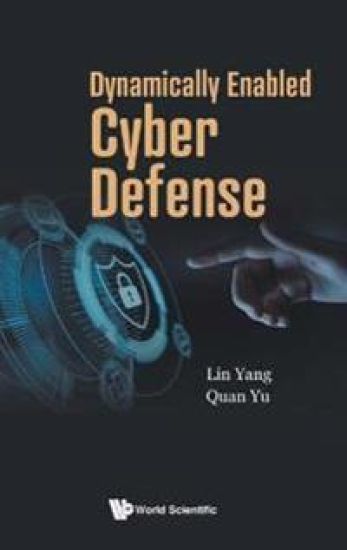
Dynamically Enabled Cyber Defense

Dynamically Enabled Cyber Defense

Lin Yang; Quan Yu

World Scientific Publishing Co Pte Ltd
2021
sidottu
The book puts forward dynamically enabled cyber defense technology as a solution to the system homogenization problem. Based on the hierarchy of the protected information system entity, the book elaborates on current mainstream dynamic defense technologies from four aspects: the internal hardware platform, software service, information data and external network communication. It also ascertains their possible evolution routes, clarifies their relationship with existing security products, and makes macro analyses and discussions on security gain and overall system efficiency of these technologies.This book can be used as both a textbook for graduate courses related to electronic information as well as a reference for scientific researchers engaged in relevant research. It helps graduate students majoring in electronics and information sciences to gain an understanding in dynamically-enabled cyber defense. Scientists and engineers specialising in network security research should also find this book to be a useful guide on recent developments in network security.
Low Complexity MIMO Receivers

Low Complexity MIMO Receivers

Lin Bai; Jinho Choi; Quan Yu

Springer International Publishing AG
2016
nidottu
Multiple-input multiple-output (MIMO) systems can increase the spectral efficiency in wireless communications. However, the interference becomes the major drawback that leads to high computational complexity at both transmitter and receiver. In particular, the complexity of MIMO receivers can be prohibitively high. As an efficient mathematical tool to devise low complexity approaches that mitigate the interference in MIMO systems, lattice reduction (LR) has been widely studied and employed over the last decade. The co-authors of this book are world's leading experts on MIMO receivers, and here they share the key findings of their research over years. They detail a range of key techniques for receiver design as multiple transmitted and received signals are available. The authors first introduce the principle of signal detection and the LR in mathematical aspects. They then move on to discuss the use of LR in low complexity MIMO receiver design with respect to different aspects, including uncoded MIMO detection, MIMO iterative receivers, receivers in multiuser scenarios, and multicell MIMO systems.
Low Complexity MIMO Receivers

Low Complexity MIMO Receivers

Lin Bai; Jinho Choi; Quan Yu

Springer International Publishing AG
2014
sidottu
Multiple-input multiple-output (MIMO) systems can increase the spectral efficiency in wireless communications. However, the interference becomes the major drawback that leads to high computational complexity at both transmitter and receiver. In particular, the complexity of MIMO receivers can be prohibitively high. As an efficient mathematical tool to devise low complexity approaches that mitigate the interference in MIMO systems, lattice reduction (LR) has been widely studied and employed over the last decade. The co-authors of this book are world's leading experts on MIMO receivers, and here they share the key findings of their research over years. They detail a range of key techniques for receiver design as multiple transmitted and received signals are available. The authors first introduce the principle of signal detection and the LR in mathematical aspects. They then move on to discuss the use of LR in low complexity MIMO receiver design with respect to different aspects, including uncoded MIMO detection, MIMO iterative receivers, receivers in multiuser scenarios, and multicell MIMO systems.