Kirjojen hintavertailu. Mukana 12 595 353 kirjaa ja 12 kauppaa.
Kirjailija
Quentin Wodon
Kirjat ja teokset yhdessä paikassa: 9 kirjaa, julkaisuja vuosilta 2001-2015, suosituimpien joukossa School Infrastructure in Paraguay. Vertaile teosten hintoja ja tarkista saatavuus suomalaisista kirjakaupoista.
This study provides a diagnostic of the state of school infrastructure in Paraguay, its investments needs, its current budget allocations, and the targeting performance of investments to the schools most in need.
The Economics of Faith-Based Service Delivery provides the first ever comprehensive empirical assessment of the role that faith-inspired institutions (FIIs) play in the supply of health care and education services in sub-Saharan Africa. Wodon focuses on estimating the market share, reach to the poor, and cost for households that rely on FIIs as opposed to public and private secular providers of education and health care services. He also analyzes the causes of user reliance on FIIs, the comparative performance of FIIs, and the level of satisfaction among those that use their services. The Economics of Faith-Based Service Delivery is an innovate combination of previously untapped nationally representative household surveys, qualitative fieldwork, and insights from the fields of religious studies and social economics.
Membership in Service Clubs provides the first rigorous assessment of the activities of Rotary, a global service organization founded in 1905 that implements projects and helps build goodwill and peace throughout the world.
The purpose of this study is to build a stronger evidence base on the role of faith-inspired, private secular, and public schools in sub-Saharan Africa using nationally representative household surveys as well as qualitative data. Six main findings emerge from the study: (1) Across a sample of 16 countries, the average market share for faith-inspired schools is at 10-15 percent, and the market share for private secular schools is of a similar order of magnitude; (2) On average faith-inspired schools do not reach the poor more than other groups; they also do not reach the poor more than public schools, but they do reach the poor significantly more than private secular schools; (3) The cost of faith-inspired schools for households is higher than that of public schools, possibly because of a lack of access to public funding, but lower than that of private secular schools; (4) Faith-inspired and private secular schools have higher satisfaction rates among parents than public schools; (5) Parents using faith-inspired schools place a stronger emphasis on religious education and moral values; (6) Students in faith-inspired and private schools perform better than those in public schools, but this may be due in part to self-selection.
In the past decade the global financial assistance for AIDS responses increased tremendously and the donor community provided greater resources to community responses. Yet little is known about the global magnitude of these resources and their allocation among HIV and AIDS activities and services. To address this knowledge gap, this report pulls together evidence from several different sources (donor data bases, surveys of civil society organisations, country funding profiles) to determine, among other things, how funds are reaching civil society and community-based organisations, how these funds are being used, and the degree to which these organisations rely on other sources of funding. The analysis suggests that funding flows have increased dramatically for civil society organisations (CSOs), reaching at least $690 million per year on average during the period 2003 - 2009. However, much smaller funding is reaching organisations at local level. The report documents the impact achieved by this funding. Traditionally, civil society organisations have been perceived at times to be providers of humanitarian aid, innovators in implementing responses adapted to local needs, or inefficient actors diverting public funds from more effective uses. The report argues that current evidence shows that community responses play a useful complementary role to national AIDS programs that has been achieved with relatively little funding. Contrary to a widespread view, the report highlights that community responses add resources to national programs. In Kenya, Nigeria and Zimbabwe, substantial mobilisation of resources in the form of volunteers are mobilised by communities. There is a strong risk that in the current environment of increased resource scarcity, prevention programs implemented by civil society organisations would be cut unless there is strong evidence of value for money being generated. Community-based organisations are ill equipped to answer that question, but there is scope for improving the results that they generate. The report argues that improving coordination with national programs, strengthening consistency between local activities and HIV epidemics, building stronger network of civil society organisations, and mobilising sustainable funding are the most important ways for community responses to move forward and address the challenges faced by community responses.
Despite substantial progress towards peace, economic growth, and better governance since 2003, Liberia remains one of the poorest countries in the world. The objective of this study is twofold. First it is to provide a basic diagnostic of both consumption-based poverty and human development (especially education and health) in the country using the 2007 CWIQ (Core Welfare Indicators Questionnaire) survey. Second, it is to assess the likely impact on the poor of the recent economic crisis, and especially the increase in rice prices, and to document the targeting performance of various measures taken by the government in 2008/09 to help the poor cope with the crisis. These measures included a reduction in import taxes for rice, a reform of the personal income tax, and the implementation of a cash for work temporary employment program.
While consumer utility subsidies are widespread in both the water and electricity sectors, their effectiveness in reaching and distributing resources to the poor is the subject of much debate. Water, Electricity, and the Poor brings together empirical evidence on subsidy performance across a wide range of countries. It documents the prevalence of consumer subsidies, provides a typology of the many variants found in the developing world, and presents a number of indicators useful in assessing the degree to which such subsidies benefit the poor, focusing on three key concepts: beneficiary incidence, benefit incidence, and materiality. The findings on subsidy performance will be useful to policy makers, utility regulators, and sector practitioners who are contemplating introducing, eliminating, or modifying utility subsidies, and to those who view consumer utility subsidies as a social protection instrument.
The study explores the link between infrastructure reform and poverty observed in Latin America. It details why infrastructure investment is likely to continue to be a core component of many poverty alleviation programs. The study also stresses why and how, in most countries, infrastructure reform aimed at promoting private financing of investment needs, must be designed in ways in which poverty concerns are taken into account. It provides practical guidelines and options to ensure that the critical needs for additional infrastructure investments are met and that the strategies to address the needs of the poor are as cost effective as possible.
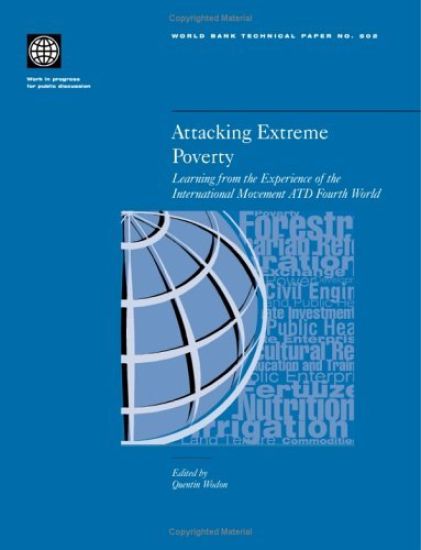
This book is comprised of a collection of essays on extreme poverty. It focuses on what it means to live in extreme poverty, how to reach the very poor through programs and interventions, and how to make private and public institutions more responsive to their needs. This book also analyzes the relationship between extreme poverty and human rights. It places emphasis on the contribution made by the International Movement ATD Fourth World, and its founder, Joseph Wresinski, to the understanding of the very poor and what is required to fight extreme poverty.