Kirjojen hintavertailu. Mukana 12 209 252 kirjaa ja 12 kauppaa.

Kirjailija

R A Duff

Kirjat ja teokset yhdessä paikassa: 8 kirjaa, julkaisuja vuosilta 1986-2018, suosituimpien joukossa The Trial on Trial: Volume 3. Vertaile teosten hintoja ja tarkista saatavuus suomalaisista kirjakaupoista.

Mukana myös kirjoitusasut: R. A. Duff

8 kirjaa

Kirjojen julkaisuhaarukka 1986-2018.

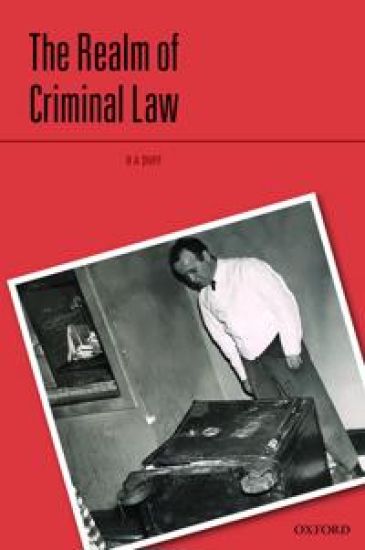
The Realm of Criminal Law

The Realm of Criminal Law

R A Duff

Oxford University Press
2018
sidottu
We are said to face a crisis of over-criminalization: our criminal law has become chaotic, unprincipled, and over-expansive. This book proposes a normative theory of criminal law, and of criminalization, that shows how criminal law could be ordered, principled, and restrained. The theory is based on an account of criminal law as a distinctive legal practice that functions to declare and define a set of public wrongs, and to call to formal public account those who commit such wrongs; an account of the role that such practice can play in a democratic republic of free and equal citizens; and an account of the central features of such a political community, and of the way in which it constitutes its public realm-its civil order. Criminal law plays an important, but limited, role in such a political community in protecting, but also partly constituting, its civil order. On the basis of this account, we can see how such a political community will decide what kinds of conduct should be criminalized - not by applying one or more of the substantive master principles that theorists have offered, but by considering which kinds of conduct fall within its public realm (as distinct from the private realms that are not the polity's business), and which kinds of wrong within that realm require this distinctive kind of response (rather than one of the other kinds of available response). The outcome of such a deliberative process will probably be a more limited, and a more rational and principled, criminal law.
Answering for Crime

Answering for Crime

R A Duff

Hart Publishing
2009
nidottu
This is the paperback edition of Antony Duff's acclaimed new work on the structures of criminal law and criminal liability. His starting point is a distinction between responsibility (understood as answerability) and liability, and a conception of responsibility as relational and practice-based. This focus on responsibility, as a matter of being answerable to those who have the standing to call one to account, throws new light on a range of questions in criminal law theory: on the question of criminalisation, which can now be cast as the question of what we should have to answer for, and to whom, under the threat of criminal conviction and punishment; on questions about the criminal trial, as a process through which defendants are called to answer, and about the conditions (bars to trial) given which a trial would be illegitimate; on questions about the structure of offences, the distinction between offences and defences, and the phenomena of strict liability and strict responsibility; and on questions about the structures of criminal defences. The net result is not a theory of criminal law; but it is an account of the structure of criminal law as an institution through which a liberal polity defines a realm of public wrongdoing, and calls those who perpetrate (or are accused of perpetrating) such wrongs to account. "For a criminal law theorist, this book is simply a must read. Duff's sweeping coverage of criminal law-ranging from the act requirement to justifications and excuses-offers a structural edifice that is indispensible. Though one may not always agree with Duff, his original analysis and complex rethinking provides significant insights into the most central questions within criminal law theory. One cannot help but learn from Duff. And anyone who wishes to be taken seriously in criminal law theory will have to grapple with his arguments." Kimberley Kessler Ferzan, Criminal Justice Ethics, 2009 "Philosophers who specialize in normative inquiries but find the time to read only one book in criminal theory every few years should immediately place Answering for Crime at the very top of their pile. It is the best book to have appeared in the philosophy of criminal law in the last decade, and the finest book ever to have focused on the structure of criminal responsibility. Answering for Crime cements Antony Duff's reputation as one of the two most important philosophers of criminal law living in the Anglo-American world today...Answering for Crime is an exceedingly original work of legal philosophy written in a refreshingly accessible style...I believe that any future work on the structure of criminal responsibility and liability must begin with Duff's work. No existing book in the philosophy of criminal law can rival the breadth, scope, and sophistication contained in Duff's analysis. I admire Answering for Crime deeply and recommend it strongly not only to criminal theorists, but also to all philosophers interested in how criminal theory sheds light on normative inquiry generally." Douglas Husak, Law and Philosophy, 2009 "...the book is an ambitious one, and has implications for almost every aspect of criminal law theory...As was to be expected from one of the most philosophically sophisticated yet institutionally sensitive writers in the field of criminal law theory, Answering for Crime is a rich book that makes a very substantial contribution to the discipline. ..The argument is complex and, particularly in the early chapters, does not always make for easy reading; but the conception is clear, elegant, and fully worked through..." Nicola Lacey, New Criminal Law Review, 2009 "It covers so many important issues with such clarity and rigour that one review cannot possibly do it justice...What Duff says about crimes, but also his views about a whole range of other issues, are deeply thought out and important...Duff's book does more to articulate a clear and structured view of criminal responsibility than has been achieved to date and his account of criminal responsibility and liability, as well as of the central doctrines and practices of criminal responsibility, will have lasting significance for criminal lawyers and philosophers alike." Victor Tadros, Mind, 2009
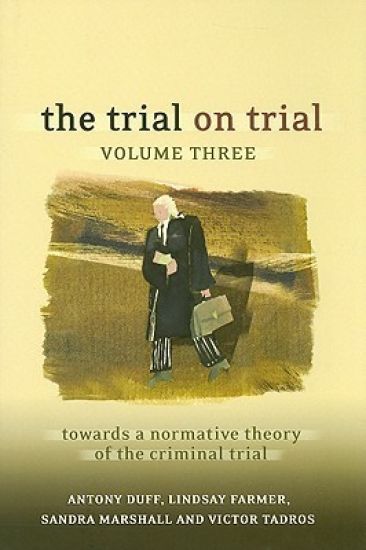
The Trial on Trial: Volume 3

The Trial on Trial: Volume 3

Lindsay Farmer; R A Duff; Sandra Marshall; Victor Tadros

Hart Publishing
2007
sidottu
The criminal trial is under attack. Traditional principles have been challenged or eroded; in England and Wales the right to trial by jury has been restricted and rules concerning bad character evidence, double jeopardy and the right to silence have been substantially altered to "rebalance" the system in favour of victims. In the pursuit of security, particularly from terrorism, the right to a fair trial has been denied to some altogether. In fact trials have for a long time been an infrequent occurrence, most criminal convictions being the consequence of a guilty plea. Moreover, while this very public struggle over the future of the criminal trial is conducted, there is also a less publicly observed controversy about the significance of trials in modern society. Trials are under normative attack, their value being doubted by those who seek different kinds of process - conciliatory or restorative - to address the needs of victims and move away from the imposition of state power through trials and punishments. This book seeks to develop a normative theory of the criminal trial as a way of defending the importance of trials in our criminal justice system. The trial, it is suggested, calls defendants to answer a charge and, if they are criminally responsible, to account for their conduct. The trial is seen as a communicative process through which the defendant can challenge claims of wrongdoing made against him, including the norms in the light of which those claims are made. The book develops this communicative theory by first making a careful study of the history of trials, before moving on to outline the theory, which is then developed through chapters looking at the practices and principles of trials, alternative regulatory models, the roles of participants, the relationship between investigation and trial and trials as public fora.
Answering for Crime

Answering for Crime

R A Duff

Hart Publishing
2007
sidottu
In this long-awaited book, Antony Duff offers a new perspective on the structures of criminal law and criminal liability. His starting point is a distinction between responsibility (understood as answerability) and liability, and a conception of responsibility as relational and practice-based. This focus on responsibility, as a matter of being answerable to those who have the standing to call one to account, throws new light on a range of questions in criminal law theory: on the question of criminalization, which can now be cast as the question of what we should have to answer for, and to whom, under the threat of criminal conviction and punishment; on questions about the criminal trial, as a process through which defendants are called to answer, and about the conditions (bars to trial) given which a trial would be illegitimate; on questions about the structure of offences, the distinction between offences and defences, and the phenomena of strict liability and strict responsibility; and on questions about the structures of criminal defences. The net result is not a theory of criminal law; but it is an account of the structure of criminal law as an institution through which a liberal polity defines a realm of public wrongdoing, and calls those who perpetrate (or are accused of perpetrating) such wrongs to account.
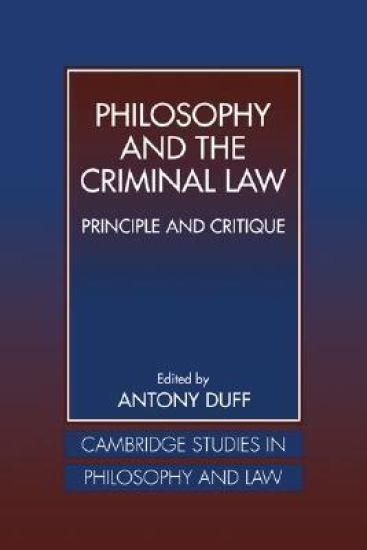
Philosophy and the Criminal Law

Philosophy and the Criminal Law

R. A. Duff

Cambridge University Press
1998
sidottu
Five pre-eminent legal theorists tackle a range of fundamental questions on the nature of the philosophy of criminal law. Their essays explore the extent to which and the ways in which our systems of criminal law can be seen as rational and principled. The essays discuss some of the principles by which, it is often thought, a system of law should be structured, and they ask whether our own systems are genuinely principled or riven by basic contradictions, reflecting deeper political and social conflicts. The volume as a whole shows how lively and exciting contemporary legal theory can be.
Criminal Attempts

Criminal Attempts

R. A. Duff

Clarendon Press
1997
sidottu
This book reflects the belief that a careful study of the Law of Attempts should be both interesting in itself, as well as being a productive route into a number of larger and deeper issues in criminal law theory and in the philosophy of action. By identifying the legal doctrines which courts and legislatures have developed or adopted, the author goes on to ask whether and how they can be rationalized or rendered persuasive. Such an approach involves paying detailed attention to cases. The book is also unusual in that it grapples with English, Scots and US law, showing great breadth of research as well as philosophical sophistication. This is a work which is likely to become a seminal study and a major contribution to the study of law and legal philosophy.
Trials and Punishments

Trials and Punishments

R. A. Duff

Cambridge University Press
1991
pokkari
How can a system of criminal punishment be justified? In particular can it be justified if the moral demand that we respect each other as autonomous moral agents is taken seriously? Traditional attempts to justify punishment as a deterrent or as retribution fail, but Duff suggests that punishment can be understood as a communicative attempt to bring a wrong-doer to repent her crime. This account is supported by discussions of moral blame, of penance, of the nature of the law's demands, and of the proper meaning and purpose of the criminal process of trial and verdict: it deals both with the ideals that should inform a system of criminal law and the extent to which those ideals are actualised in existing institutions and practices. The conclusion is pessimistic: punishment cannot be justified within our legal system; and this gap between the ideal and the actual presents us with serious moral dilemmas.
Trials and Punishments

Trials and Punishments

R. A. Duff

Cambridge University Press
1986
sidottu
How can a system of criminal punishment be justified? In particular can it be justified if the moral demand that we respect each other as autonomous moral agents is taken seriously? Traditional attempts to justify punishment as a deterrent or as retribution fail, but Duff suggests that punishment can be understood as a communicative attempt to bring a wrong-doer to repent her crime. This account is supported by discussions of moral blame, of penance, of the nature of the law's demands, and of the proper meaning and purpose of the criminal process of trial and verdict: it deals both with the ideals that should inform a system of criminal law and the extent to which those ideals are actualised in existing institutions and practices. The conclusion is pessimistic: punishment cannot be justified within our legal system; and this gap between the ideal and the actual presents us with serious moral dilemmas.