Kirjojen hintavertailu. Mukana 12 595 353 kirjaa ja 12 kauppaa.

Kirjailija

R. Alton Lee

Kirjat ja teokset yhdessä paikassa: 10 kirjaa, julkaisuja vuosilta 1990-2022, suosituimpien joukossa The Bizarre Careers of John R. Brinkley. Vertaile teosten hintoja ja tarkista saatavuus suomalaisista kirjakaupoista.

Mukana myös kirjoitusasut: R Alton Lee

10 kirjaa

Kirjojen julkaisuhaarukka 1990-2022.

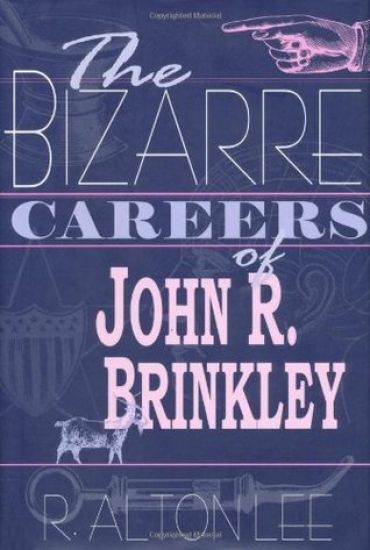
The Bizarre Careers of John R. Brinkley

The Bizarre Careers of John R. Brinkley

R Alton Lee

THE UNIVERSITY PRESS OF KENTUCKY
2022
nidottu
By 1926, it seemed that John R. Brinkley's experimental rejuvenation cure – transplanting goat glands into aging men – had taken the nation by storm. Never mind that 'Doc' Brinkley's medical credentials were shaky at best and that he prescribed medication over the airwaves via his high-power radio stations. To most in the medical field, he was a quack; to his many patients and listeners he was a brilliant surgeon, a saviour of their lost manhood and youth. His rogue radio stations, XER and its successor XERA, eventually broadcast at an antenna-shattering 1,000,000 watts and were not only a haven for Brinkley's lucrative quackery, but also hosted an unprecedented number of then-unknown country musicians and other guests. Indisputably, he transformed the fields of medicine, politics, and radio broadcasting in the 20th century. The Bizarre Careers of John R. Brinkley tells the story of the infamous 'Goat Gland Doctor' – a controversial medical charlatan, groundbreaking radio impresario, and prescient political campaigner – and recounts his amazing rags-to-riches-to-rags career. A master manipulator and skilled con artist, Brinkley's story was but a patchy perpetuation of myths by journalistic and personal accounts – until now. Alton Lee brings Brinkley's infamous legacy to the forefront, exploring how he ruthlessly exploited the sexual frustrations of aging men and the general public's antipathy toward medical doctors for his personal gain. Lee leaves no stone unturned in this account of a man who changed the course of American institutions forever.
When Sunflowers Bloomed Red

When Sunflowers Bloomed Red

R. Alton Lee; Steven Cox

University of Nebraska Press
2020
sidottu
When Sunflowers Bloomed Red is a welcome addition to the history of the American Midwest that should have appeal to students, scholars, and general readers.-Greg Hall, Annals of Iowa When Sunflowers Bloomed Red offers readers entry into the Kansas radical tradition and shows how the Great Plains agrarian movement influenced and transformed politics and culture in the twentieth century and beyond. When Sunflowers Bloomed Red reveals the origins of agrarian radicalism in the late nineteenth-century United States. Great Plains radicals, particularly in Kansas, influenced the ideological principles of the Populist movement, the U.S. labor movement, American socialism, American syndicalism, and American communism into the mid-twentieth century. Known as the American Radical Tradition, members of the Greenback Labor Party and the Knights of Labor joined with Prohibitionists, agrarian Democrats, and progressive Republicans to form the Great Plains Populist Party (later the People’s Party) in the 1890s. The Populists called for the expansion of the money supply through the free coinage of silver, federal ownership of the means of communication and transportation, the elimination of private banks, universal suffrage, and the direct election of U.S. senators. They also were the first political party to advocate for familiar features of modern life, such as the eight-hour workday for agrarian and industrial laborers, a graduated income tax system, and a federal reserve system to manage the nation’s money supply. When the People’s Party lost the hotly contested election of 1896, members of the party dissolved into socialist and other left-wing parties and often joined efforts with the national Progressive movement.
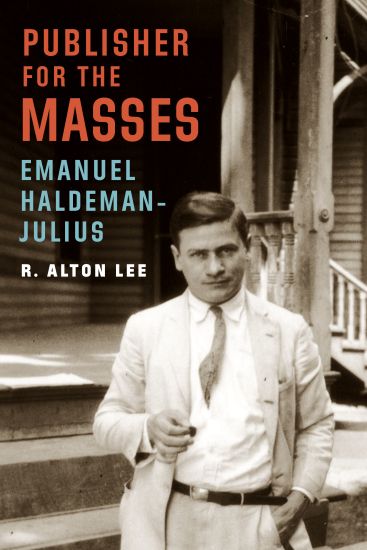
Publisher for the Masses, Emanuel Haldeman-Julius

Publisher for the Masses, Emanuel Haldeman-Julius

R. Alton Lee

University of Nebraska Press
2018
sidottu
His admirers called him the “Barnum of Books” and the “Voltaire of Kansas” because of his ability to bring culture and education to the people. R. Alton Lee brings to life Emanuel Haldeman-Julius (1889–1951), a writer-publisher-entrepreneur who was one of America’s most significant publishers and editorialists of the twentieth century. His company published a record 500,000,000 copies of 2,580 titles and was second only to the U.S. Government Printing Office in the quantity of publications it produced. Lee details Haldeman-Julius’s family origins in Russia and his formative years in Philadelphia, where he learned the book trade. As a writer and editor for the Social Democrat, Sunday Call, and Western Comrade, Haldeman-Julius was already well known by the time he launched his own publishing company. Haldeman-Julius knew, was nurtured by, and published writers such as Jack London, Upton Sinclair, Jane Addams, Emma Goldman, H. L. Mencken, Carl Sandburg, Eugene V. Debs, Clarence Darrow, Job Harriman, Will Durant, and Bertrand Russell, among others. Based in Girard, Kansas, his company, Haldeman-Julius Publications, covered socialist politics, the philosophy of free thought, and both new and classic books marketed to ordinary Americans, including the Little Blue Book series of classics in Western thought and literature. This biography of the enigmatic and energetic Haldeman-Julius opens a window into the fascinating world of early twentieth-century radical politics and publishing.
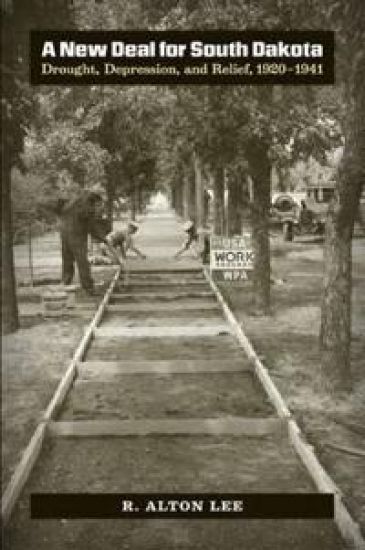
A New Deal for South Dakota

A New Deal for South Dakota

R. Alton Lee

South Dakota State Historical Society
2016
nidottu
In South Dakota, drought, grasshoppers, and low commodity prices were the final blows in a long economic downturn that began after World War I. These conditions finally brought the state to its knees during the Great Depression. Many South Dakotans fled; others hung on with the aid of New Deal programs. Instituted by President Franklin D. Roosevelt and administered by politicians like the colorful Democratic governor Tom Berry, New Deal projects supported nearly half of South Dakota’s entire population in the depths of the depression.The built landscape and economic underpinnings of present-day South Dakota are direct legacies of this era. Civilian Conservation Corps and Works Progress Administration projects expanded the state’s infrastructure by building dams, civic facilities, and highways that are still used today. Other programs offered additional opportunities for young people, women, and minorities.The state’s familiar political culture and style of governance also harkens back to the Great Depression, as South Dakotans voted to reject their short-lived Democratic government and entrust the administration of the New Deal to Republican lawmakers such as Governor Leslie Jensen. The story is one of desperate times, intense rivalries, and rare moments of cooperation as a devastated Plains state fought to keep its head above water.Political historian R. Alton Lee examines the effects of New Deal programs on families, farmers, miners, youth, women, American Indians, and others. Focusing on South Dakota, he evaluates the state’s efforts to stave off both starvation and federal dependence as its people endured the worst natural and economic disaster of modern times.
Sunflower Justice

Sunflower Justice

R. Alton Lee

University of Nebraska Press
2014
sidottu
Until recently, American legal historiography focused almost solely on national government. Although much of Kansas law reflects U.S. law, the state court's arbitrary powers over labor-management conflicts, yellow dog contracts, civil rights, gender issues, and domestic relations set precedents that reverberated around the country. Sunflower Justice is a pioneering work that presents the history of a state through the use of its supreme court decisions as evidence. R. Alton Lee traces Kansas's legal history through 150 years of records, shedding light on the state's political, economic, and social history in this groundbreaking overview of Kansas legal cases and judicial biographies. Beginning with the territorial justices and continuing through the late twentieth century, R. Alton Lee covers the dispossession of Native Americans' land, the growth and impact of labor unions, antimonopoly cases against railroad and mining companies, a nine-year state ban on the movie Birth of a Nation, and implications and effects of desegregation, as well as the shooting of Dr. George Tiller for performing legal abortions. Because judicial decisions are not made in a vacuum, Lee presents each of the justices in the context of the era and their personal experiences before examining how their decisions shaped Kansas political, economic, social, and legal history.
Farmers Vs. Wage Earners

Farmers Vs. Wage Earners

R. Alton Lee

University of Nebraska Press
2008
pokkari
While predominantly agrarian, Kansas has a surprisingly rich heritage of labor history and played an active role in the major labor strife of the late nineteenth and early twentieth centuries. Farmers vs. Wage Earners is a survey of the organized labor movement in the Sunflower State, which reflected in a microcosm the evolution of attitudes toward labor in the United States. R. Alton Lee emphasizes the social and political developments of labor in Kansas and what it was like to work in the mines, the oil fields, and the factories that created the modern industrial world. He vividly describes the stories of working people: how they and their families lived and worked, their dreams and aspirations, their reasons for joining a union and how it served their interests, how they fought to achieve their goals through the political process, and how employment changed over the decades in terms of race, gender, and working conditions. The general public supported labor after the Civil War, but increasing urbanization and the farmer-dominated legislatures helped quell this sympathy, and new ire was eventually directed at the workingman. By examining the progress of industrial labor in an agrarian state, Lee shows how Kansans, like many Americans, could eagerly accept the federal largesse of the New Deal but at the same time bitterly denounce its philosophy and goals in the wake of the Great Depression.
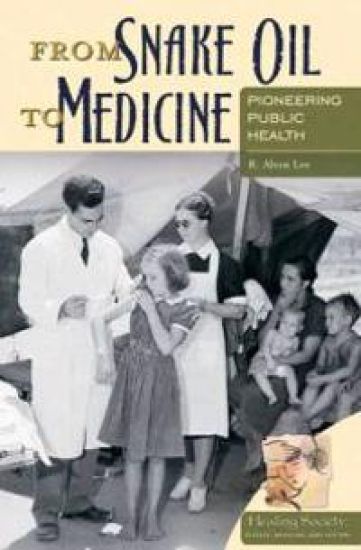
From Snake Oil to Medicine

From Snake Oil to Medicine

R. Alton Lee

Praeger Publishers Inc
2007
sidottu
Without Samuel J. Crumbine and his Kansas Department of Health, diseases festering in water sources, food and the common towel would have caused thousands of deaths in the United States. Crumbine and his associates paved the way to better treatment of tuberculosis. This well-written account leads the reader down a path of crucial medical advancements.Samuel J. Crumbine was a medical educator without peer, who used his department of health to disseminate the latest developments he and others throughout the world were achieving in public health. He found it necessary to propagandize a skeptical and sometimes hostile public to accept the germ theory, the idea that invisible microbes were making them ill and that they should clean up their environment and their food and water sources. He had to convince the public to rely on modern medicine, not snake oil and other miracle cures for a healthy living. R. Alton Lee's historical account might offer insight in today's threat of Bird Flu and other recent medical threats for any reader.
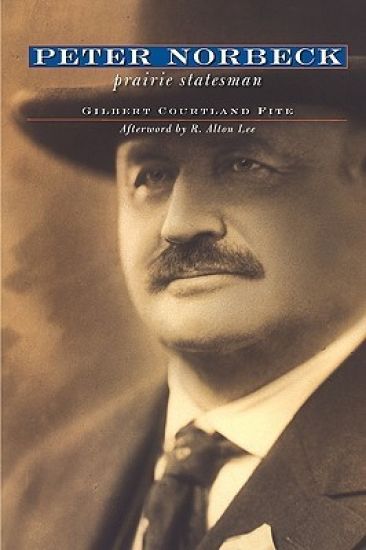
Peter Norbeck

Peter Norbeck

Gilbert Courtland Fite; R. Alton Lee

South Dakota State Historical Society
2005
nidottu
From successful well-driller to governor and United States senator, Peter Norbeck (1870–1936) worked tirelessly for South Dakota. A progressive Republican, strong supporter of the policies of Theodore Roosevelt, and early conservationist, he was a towering figure in state politics. In Peter Norbeck: Prairie Statesman, Gilbert Fite has written his definitive biography, and through the generous support of the Meierhenry family, it is again available, with a new introduction, afterword, and photographs. Norbeck was a man of many interests, but his first concern was the farmer. As a supporter of state-owned industries and a leader in national agricultural legislation, he worked diligently for the benefit of rural residents. He also helped obtain funding for the carving of Mount Rushmore and directed construction of the scenic Iron Mountain Road leading to the monument. Through his efforts, legislation establishing Grand Teton National Park and extending the boundaries of Yellowstone National Park, as well as the Migratory Bird Conservation Act of 1929, became law.
Eisenhower and Landrum-Griffin

Eisenhower and Landrum-Griffin

R. Alton Lee

The University Press of Kentucky
1990
sidottu
During the 1950s two Senate investigations, both highly publicized through the new medium of television, revealed the spread of racketeers and corruption among labor unions. Taking advantage of these sensational revelations, business interests, who for years had chafed against the federal government's pro-labor policies, mounted a campaign to curb labor's power. With the support of the business-oriented administration of Dwight Eisenhower, they pushed through Congress a new "reform" law -- the Landrum-Griffin Act. In this book, R. Alton Lee, author of an earlier study of the Taft-Hartley law, offers the first detailed legislative history of this important act and with it an examination of the Eisenhower presidency.Lee traces the development of the public's distrust of labor leaders and the rising sentiment for reform and then follows the progress of the legislation through both houses of Congress in the midst of moves and countermoves by labor and management. He shows how some of the leading actors in the struggle -- notably John Kennedy, Lyndon Johnson, and Barry Goldwater -- used the occasion to further their political ambitions. In the final vote the swing of public opinion against labor and the potent combination of conservative southern Democrats and northern Republicans secured for the law an overwhelming majority in Congress.The enactment of the Landrum-Griffin law, Lee concludes, is yet another example of Eisenhower's astuteness as a politician, one who marshaled the force of his popular appeal and adroitly deployed his administrative aides to achieve his goal. It also provides a revealing example of the interplay among public, president, and Congress in the American system.Eisenhower and Landrum-Griffin makes a valuable contribution to political and labor history and to a deeper understanding of the Eisenhower presidency.
The Bizarre Careers of John R. Brinkley

The Bizarre Careers of John R. Brinkley

R Alton Lee

The University Press of Kentucky
2002
sidottu
Tells the story of the infamous "Goat Gland Doctor" -- controversial medical charlatan, groundbreaking radio impresario, and prescient political campaigner -- and recounts his amazing rags to riches to rags career. A popular joke of the 1920s posed the question, "What's the fastest thing on four legs?" The punch line? "A goat passing Dr. Brinkley's hospital!" It seems that John R. Brinkley's virility rejuvenation cure -- transplanting goat gonads into aging men -- had taken the nation by storm. Never mind that "Doc" Brinkley's medical credentials were shaky at best and that he prescribed medication over the airwaves via his high-power radio stations. The man built an empire. The Kansas Medical Board combined with the Federal Radio Commission to revoke Brinkley's medical and radio licenses, which various courts upheld. Not to be stopped, Brinkley started a write-in campaign for Governor. He received more votes than any other candidate but lost due to invalidated and "misplaced" ballots. Brinkley's tactics, particularly the use of his radio station and personal airplane, changed political campaigning forever. Brinkley then moved his radio medical practice to Del Rio, Texas, and began operating a "border blaster" on the Mexico side of the Rio Grande. His rogue stations, XER and its successor XERA, eventually broadcast at an antenna-shattering 1,000,000 watts and were not only a haven for Brinkley's lucrative quackery, but also hosted an unprecedented number of then-unknown country musicians and other guests.