Kirjojen hintavertailu. Mukana 12 390 323 kirjaa ja 12 kauppaa.

Kirjailija

R. Carter Hill

Kirjat ja teokset yhdessä paikassa: 10 kirjaa, julkaisuja vuosilta 1984-2024, suosituimpien joukossa Advanced Econometric Methods. Vertaile teosten hintoja ja tarkista saatavuus suomalaisista kirjakaupoista.

10 kirjaa

Kirjojen julkaisuhaarukka 1984-2024.

Principles of Econometrics

Principles of Econometrics

R. Carter Hill; William E. Griffiths; Guay C. Lim

JOHN WILEY SONS INC
2024
nidottu
Principles of Econometrics, Fifth Edition, is an introductory book for undergraduate students in economics and finance, as well as first-year graduate students in a variety of fields that include economics, finance, accounting, marketing, public policy, sociology, law, and political science. Students will gain a working knowledge of basic econometrics so they can apply modeling, estimation, inference, and forecasting techniques when working with real-world economic problems. Readers will also gain an understanding of econometrics that allows them to critically evaluate the results of others’ economic research and modeling, and that will serve as a foundation for further study of the field. This new edition of the highly-regarded econometrics text includes major revisions that both reorganize the content and present students with plentiful opportunities to practice what they have read in the form of chapter-end exercises.
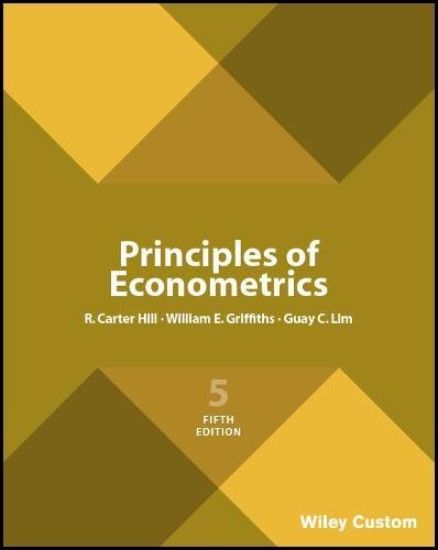
Principles of Econometrics

Principles of Econometrics

R. Carter Hill; William E. Griffiths; Guay C. Lim

John Wiley Sons Inc
2018
nidottu
Principles of Econometrics, Fifth Edition, is an introductory book for undergraduate students in economics and finance, as well as first-year graduate students in a variety of fields that include economics, finance, accounting, marketing, public policy, sociology, law, and political science. Students will gain a working knowledge of basic econometrics so they can apply modeling, estimation, inference, and forecasting techniques when working with real-world economic problems. Readers will also gain an understanding of econometrics that allows them to critically evaluate the results of others’ economic research and modeling, and that will serve as a foundation for further study of the field. This new edition of the highly-regarded econometrics text includes major revisions that both reorganize the content and present students with plentiful opportunities to practice what they have read in the form of chapter-end exercises.
Using SAS for Econometrics

Using SAS for Econometrics

R. Carter Hill; Randall C. Campbell

John Wiley Sons Inc
2012
nidottu
A supplement such as Using SAS for Econometrics is quite essential for use in a classroom environment, for those attempting to learn SAS, and for quick and useful reference. The SAS documentation comes in many volumes, and several are thousands of pages long. This makes for a very difficult challenge when getting started with SAS. This volume spans several levels of econometrics. It is suitable for undergraduate students who will use canned SAS statistical procedures, and for graduate students who will use advanced procedures as well as direct programming in SASs matrix language, discussed in chapter appendices. Material within the chapters is accessible to undergraduate and/or Masters students, with appendices to chapters devoted to more advanced materials and matrix programming.
Using Excel for Principles of Econometrics

Using Excel for Principles of Econometrics

Genevieve Briand; R. Carter Hill

John Wiley Sons Inc
2012
nidottu
Principles of Econometrics is an introductory book for undergraduate students in economics and finance, and can be used for MBA and first-year graduate students in many fields. The 4th Edition provides students with an understanding of why econometrics is necessary and a working knowledge of basic econometric tools. This text emphasizes motivation, understanding and implementation by introducing very simple economic models and asking economic questions that students can answer.
Using Stata for Principles of Econometrics

Using Stata for Principles of Econometrics

Lee C. Adkins; R. Carter Hill

John Wiley Sons Inc
2011
nidottu
This is the Using Stata text for Principles of Econometrics, 4th Edition.Principles of Econometrics is an introductory book for undergraduate students in economics and finance, and can be used for MBA and first-year graduate students in many fields. The 4th Edition provides students with an understanding of why econometrics is necessary and a working knowledge of basic econometric tools. This text emphasizes motivation, understanding and implementation by introducing very simple economic models and asking economic questions that students can answer.
Learning and Practicing Econometrics

Learning and Practicing Econometrics

William E. Griffiths; R. Carter Hill; George G. Judge

John Wiley Sons Inc
1993
sidottu
Designed to promote students' understanding of econometrics and to build a more operational knowledge of economics through a meaningful combination of words, symbols and ideas. Each chapter commences in the way economists begin new empirical projects--with a question and an economic model--then proceeds to develop a statistical model, select an estimator and outline inference procedures. Contains a copious amount of problems, experimental exercises and case studies.
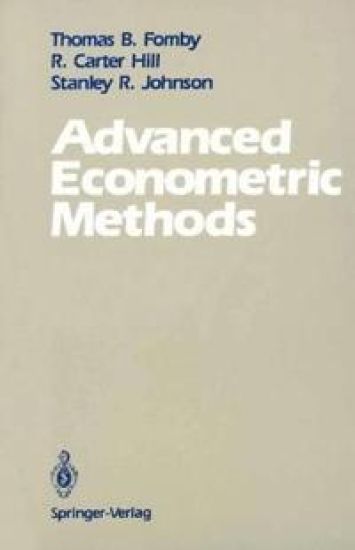
Advanced Econometric Methods

Advanced Econometric Methods

Thomas B. Fomby; R. Carter Hill; Stanley R. Johnson

Springer-Verlag New York Inc.
1988
nidottu
This book had its conception in 1975in a friendly tavern near the School of Businessand PublicAdministration at the UniversityofMissouri-Columbia. Two of the authors (Fomby and Hill) were graduate students of the third (Johnson), and were (and are) concerned about teaching econometrics effectively at the graduate level. We decided then to write a book to serve as a comprehensive text for graduate econometrics. Generally, the material included in the bookand itsorganization have been governed by the question, " Howcould the subject be best presented in a graduate class?" For content, this has meant that we have tried to cover " all the bases " and yet have not attempted to be encyclopedic. The intended purpose has also affected the levelofmathematical rigor. We have tended to prove only those results that are basic and/or relatively straightforward. Proofs that would demand inordinant amounts of class time have simply been referenced. The book is intended for a two-semester course and paced to admit more extensive treatment of areas of specific interest to the instructor and students. We have great confidence in the ability, industry, and persistence of graduate students in ferreting out and understanding the omitted proofs and results. In the end, this is how one gains maturity and a fuller appreciation for the subject in any case. It is assumed that the readers of the book will have had an econometric methods course, using texts like J. Johnston's Econometric Methods, 2nd ed.
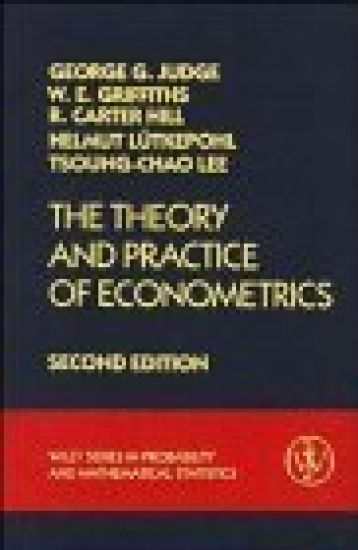
The Theory and Practice of Econometrics

The Theory and Practice of Econometrics

George G. Judge; William E. Griffiths; R. Carter Hill; Helmut Lütkepohl; Tsoung-Chao Lee

John Wiley Sons Inc
1985
sidottu
This broadly based graduate-level textbook covers the major models and statistical tools currently used in the practice of econometrics. It examines the classical, the decision theory, and the Bayesian approaches, and contains material on single equation and simultaneous equation econometric models. Includes an extensive reference list for each topic.
Advanced Econometric Methods

Advanced Econometric Methods

Thomas B. Fomby; R. Carter Hill; Stanley R. Johnson

Springer
1984
sidottu
1 Introduction.- 2 Review of Ordinary Least Squares and Generalized Least Squares.- 3 Point Estimation and Tests of Hypotheses in Small Samples.- 4 Large Sample Point Estimation and Tests of Hypotheses.- 5 Stochastic Regressors.- 6 Use of Prior Information.- 7 Preliminary Test and Stein-Rule Estimators.- 8 Feasible Generalized Least Squares Estimation.- 9 Heteroscedasticity.- 10 Autocorrelation.- 11 Lagged Dependent Variables and Autcorrelation.- 12 Unobservable Variables.- 13 Multicollinearity.- 14 Varying Coefficient Models.- 15 Models That Combine Time-Series and Cross-Section Data.- 16 The Analysis of Models with Qualitative or Censored Dependent Variables.- 17 Distributed Lags.- 18 Uncertainty in Model Specification and Selection.- 19 Introduction to Simultaneous Equations Models.- 20 Identification.- 21 Limited Information Estimation.- 22 Full Information Estimation.- 23 Reduced Form Estimation and Prediction in Simultaneous Equations Models.- 24 Properties of Dynamic Simultaneous Equations Models.- 25 Special Topics in Simultaneous Equations.- Appendix Estimation and Inference in Nonlinear Statistical Models.- A.1 Nonlinear Optimization.- A.1.1 Method of Steepest Ascent.- A.1.2 The Method of Newton.- A.1.3 Method of Quadratic Hill Climbing.- A.1.4 Numerical Differentiation.- A.2 Maximum Likelihood Estimation.- A.2.1 Use of the Method of Newton.- A.2.2 Method of Scoring.- A.2.3 The Method of Berndt, Hall, Hall, and Hausman.- A.2.4 Asymptotic Tests Based on the Maximum Likelihood Method.- A.2.4a The Wald Test.- A.2.4b The Lagrange-Multiplier Test.- A.2.4c The Likelihood Ratio Test Statistic.- A.2.4d Concluding Remarks.- A.3 Nonlinear Regression.- A.4 Summary and Guide to Further Readings.- A.5 References.