
Kirjailija
R D Blackmore
Kirjat ja teokset yhdessä paikassa: 226 kirjaa, julkaisuja vuosilta 1993-2026, suosituimpien joukossa Christowell: A Dartmoor Tale, in Three Volumes,. Vertaile teosten hintoja ja tarkista saatavuus suomalaisista kirjakaupoista.
Mukana myös kirjoitusasut: R. D. Blackmore, R.D. Blackmore
226 kirjaa
Kirjojen julkaisuhaarukka 1993-2026.

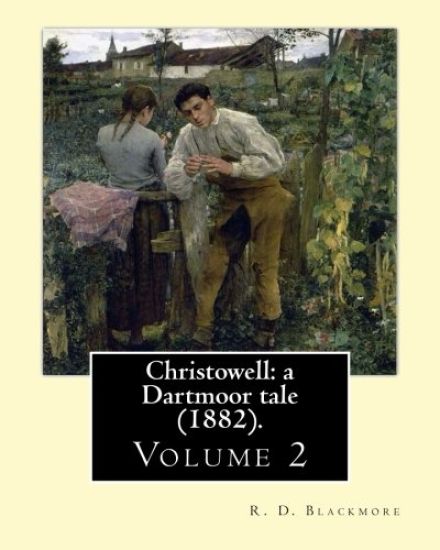
Christowell: a Dartmoor tale (1882). By: R. D. Blackmore (Volume 2).In three volume: Christowell: a Dartmoor tale is a three-volume
R. D. Blackmore
Createspace Independent Publishing Platform
2017
nidottu
Christowell: a Dartmoor tale is a three-volume novel by R. D. Blackmore published in 1882. It is set in the fictional village of Christowell on the eastern edge of Dartmoor. Plot introduction The complex and picturesque life which goes on in the parish of Christowell is the theme of the novel.The story begins with the garden where resides "Captain Larks," alias Mr. Arthur, who is neither Mr. Arthur nor "Captain Larks," but a mysterious soldier who renounced his own good name to save one who was his brother and fellow officer from disgrace. Misfortune has driven him into retirement, and so he lives among his flowers and fruit. Nobody knows anything about him, save the clergyman, Parson Short.Mr. Arthur has a daughter, Rose, who, after visiting him as a child during her holidays for several years, at last comes to live with him at his cottage. It is when she appears, however, that her father's troubles may be said to begin; for she falls in love with Jack Westcombe the son of a retired officer, whom Rose's father declines to see, conscious of the cloud that rests on himself. Among other characters there are Pugsley the carrier, Sir Joseph Touchwood, who has made a fortune out of shoes supplied by contract to Lord Wellington's army, Julia Touchwood, and a Richard ("Dicky") Touchwood who achieves small honors at Cambridge, but greater ones at home as a rat-catcher. The villain of the plot is a Mr. Gaston who attempts every crime from murder to bribery to compass his ends, and succeeds in hoodwinking every one for some time and keeping Mr. Arthur out of his lawful inheritance........ Richard Doddridge Blackmore (7 June 1825 - 20 January 1900), known as R. D. Blackmore, was one of the most famous English novelists of the second half of the nineteenth century. He won acclaim for vivid descriptions and personification of the countryside, sharing with Thomas Hardy a Western England background and a strong sense of regional setting in his works. Blackmore, often referred to as the "Last Victorian", was a pioneer of the movement in fiction that continued with Robert Louis Stevenson and others. He has been described as "proud, shy, reticent, strong-willed, sweet-tempered, and self-centred." Apart from his novel Lorna Doone, which has enjoyed continuing popularity, his work has gone out of print. Biography: Richard Doddridge Blackmore was born on 7 June 1825 at Longworth in Berkshire (now Oxfordshire), one year after his elder brother Henry (1824-1875), where his father, John Blackmore, was Curate-in-charge of the parish. His mother died a few months after his birth - the victim of an outbreak of typhus which had occurred in the village. After this loss John Blackmore moved to Bushey, Herts, then to his native Devon, first to Kings Nympton, then Culmstock, Tor Mohun and later to Ashford, in the same county. 2] Richard, however, was taken by his aunt, Mary Frances Knight, and after her marriage to the Rev. Richard Gordon, moved with her to Elsfield rectory, near Oxford. His father married again in 1831, whereupon Richard returned to live with him. Having spent much of his childhood in the lush and pastoral "Doone Country" of Exmoor, and along the Badgworthy Water (where there is now a memorial stone in Blackmore's honour), Blackmore came to love the very countryside he immortalised in Lorna Doone...........
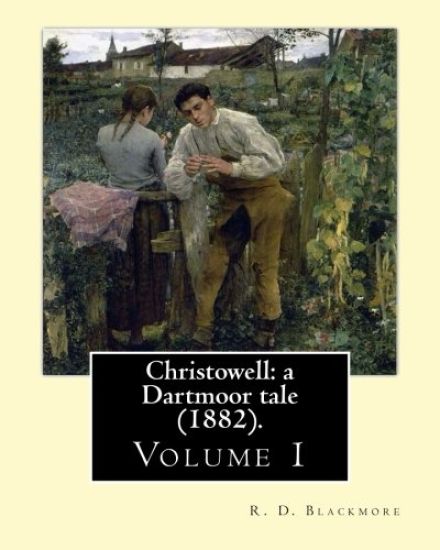
Christowell: a Dartmoor tale (1882). By: R. D. Blackmore (Volume 1). In three volume: Christowell: a Dartmoor tale is a three-volum
R. D. Blackmore
Createspace Independent Publishing Platform
2017
nidottu
Christowell: a Dartmoor tale is a three-volume novel by R. D. Blackmore published in 1882. It is set in the fictional village of Christowell on the eastern edge of Dartmoor. Plot introduction The complex and picturesque life which goes on in the parish of Christowell is the theme of the novel.The story begins with the garden where resides "Captain Larks," alias Mr. Arthur, who is neither Mr. Arthur nor "Captain Larks," but a mysterious soldier who renounced his own good name to save one who was his brother and fellow officer from disgrace. Misfortune has driven him into retirement, and so he lives among his flowers and fruit. Nobody knows anything about him, save the clergyman, Parson Short.Mr. Arthur has a daughter, Rose, who, after visiting him as a child during her holidays for several years, at last comes to live with him at his cottage. It is when she appears, however, that her father's troubles may be said to begin; for she falls in love with Jack Westcombe the son of a retired officer, whom Rose's father declines to see, conscious of the cloud that rests on himself. Among other characters there are Pugsley the carrier, Sir Joseph Touchwood, who has made a fortune out of shoes supplied by contract to Lord Wellington's army, Julia Touchwood, and a Richard ("Dicky") Touchwood who achieves small honors at Cambridge, but greater ones at home as a rat-catcher. The villain of the plot is a Mr. Gaston who attempts every crime from murder to bribery to compass his ends, and succeeds in hoodwinking every one for some time and keeping Mr. Arthur out of his lawful inheritance................ Richard Doddridge Blackmore (7 June 1825 - 20 January 1900), known as R. D. Blackmore, was one of the most famous English novelists of the second half of the nineteenth century. He won acclaim for vivid descriptions and personification of the countryside, sharing with Thomas Hardy a Western England background and a strong sense of regional setting in his works. Blackmore, often referred to as the "Last Victorian", was a pioneer of the movement in fiction that continued with Robert Louis Stevenson and others. He has been described as "proud, shy, reticent, strong-willed, sweet-tempered, and self-centred." Apart from his novel Lorna Doone, which has enjoyed continuing popularity, his work has gone out of print. Biography: Richard Doddridge Blackmore was born on 7 June 1825 at Longworth in Berkshire (now Oxfordshire), one year after his elder brother Henry (1824-1875), where his father, John Blackmore, was Curate-in-charge of the parish. His mother died a few months after his birth - the victim of an outbreak of typhus which had occurred in the village. After this loss John Blackmore moved to Bushey, Herts, then to his native Devon, first to Kings Nympton, then Culmstock, Tor Mohun and later to Ashford, in the same county. 2] Richard, however, was taken by his aunt, Mary Frances Knight, and after her marriage to the Rev. Richard Gordon, moved with her to Elsfield rectory, near Oxford. His father married again in 1831, whereupon Richard returned to live with him. Having spent much of his childhood in the lush and pastoral "Doone Country" of Exmoor, and along the Badgworthy Water (where there is now a memorial stone in Blackmore's honour), Blackmore came to love the very countryside he immortalised in Lorna Doone. .......
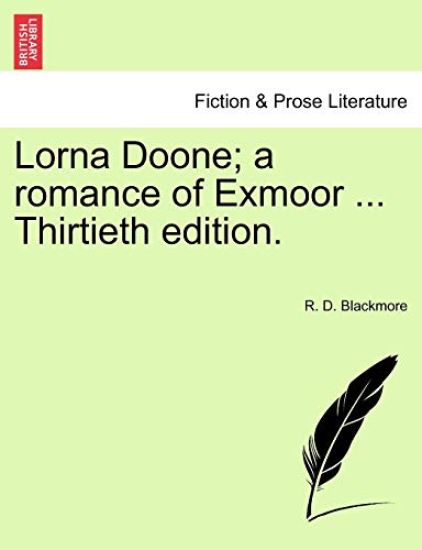
Lorna Doone; A Romance of Exmoor ... Thirtieth Edition. Vol.I
R D Blackmore
British Library, Historical Print Editions
2011
pokkari
'Every woman clutched her child, and every man turned pale at the very name of "Doone"' John Ridd, an unsophisticated farmer, falls in love with the beautiful and aristocratic Lorna Doone, kidnapped as a child by the outlaw Doones on Exmoor. Ridd's rivalry with the villainous Carver Doone reaches a dramatic climax that will determine Lorna's future happiness. First published in 1869, Lorna Doone was praised by R. L. Stevenson and Thomas Hardy and has remained constantly in print. The novel has many aspects: it is a romance; a historical novel set at the time of the Monmouth Rebellion in the seventeenth century; and a new development in the pastoral tradition. Underneath an ostensibly idyllic evocation of rural bliss and tale of love and high adventure lies a solid defence of Victorian social values, and a hero whose self-doubt prompts him constantly to prove himself. ABOUT THE SERIES: For over 100 years Oxford World's Classics has made available the widest range of literature from around the globe. Each affordable volume reflects Oxford's commitment to scholarship, providing the most accurate text plus a wealth of other valuable features, including expert introductions by leading authorities, helpful notes to clarify the text, up-to-date bibliographies for further study, and much more.
First published in 1869, Lorna Doone is the story of John Ridd, a farmer who finds love amid the religious and social turmoil of seventeenth-century England. He is just a boy when his father is slain by the Doones, a lawless clan inhabiting wild Exmoor on the border of Somerset and Devon. Seized by curiosity and a sense of adventure, he makes his way to the valley of the Doones, where he is discovered by the beautiful Lorna. In time their childish fantasies blossom into mature love-a bond that will inspire John to rescue his beloved from the ravages of a stormy winter, rekindling a conflict with his archrival, Carver Doone, that climaxes in heartrending violence. Beloved for its portrait of star-crossed lovers and its surpassing descriptions of the English countryside, Lorna Doone is R. D. Blackmore's enduring masterpiece.

The beauty of Exmoor dominates this blend of romance and adventure that is R.D. Blackmore's novel "Lorna Doone". Spanning 13 years, all the characters are here from the ruthless Doones to the peace-loving Ridds with the love of John Ridd for Lorna Doone at the heart of the play.