Kirjojen hintavertailu. Mukana 12 595 353 kirjaa ja 12 kauppaa.

Kirjailija

R. Kenneth Carty

Kirjat ja teokset yhdessä paikassa: 9 kirjaa, julkaisuja vuosilta 1991-2022, suosituimpien joukossa L'action des partis politiques dans les circonscriptions au Canada. Vertaile teosten hintoja ja tarkista saatavuus suomalaisista kirjakaupoista.

9 kirjaa

Kirjojen julkaisuhaarukka 1991-2022.

Pivot or Pirouette?

Pivot or Pirouette?

Tom Flanagan; Gerald Baier; R. Kenneth Carty

University of British Columbia Press
2022
pokkari
Pivot or Pirouette? covers both the backstory and the aftermath of the strangest election in Canadian history, as told by an insider who was involved in the events before, during, and after the ballots were cast.In the early 1990s, a pan-Canadian coalition of Tory voters had been splintered by constitutional politics. Discontented voters flocked to new regional parties; the Conservatives attempted to turn the tide by choosing the first female prime minister, but their efforts fell flat. In the 1993 election, the party was reduced to two seats, the separatist Bloc Québécois became the official opposition, and the Reform Party swept the West. Although the shocking results seemed pivotal, ultimately the pivot turned into a full pirouette as Canadian politics returned to historical norms: new parties shake up the system but are eventually absorbed into it, bringing innovation but not transformation. You can't understand modern Canadian politics without understanding the 1993 election.
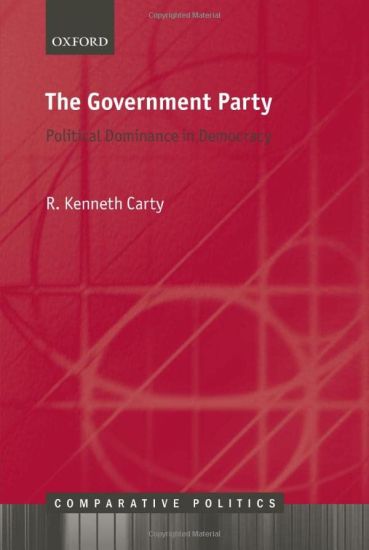
The Government Party

The Government Party

R. Kenneth Carty

Oxford University Press
2022
sidottu
Democracy thrives on vigorous competition between political parties. However, in several established democracies one party manages to dominate national politics for decades at a time, seemingly creating a democratic one-party unnatural democracy. This book examines five such countries - Canada, Ireland, India, Japan, Italy - to understand what kind of party comes to dominate democratic competition, and how and why they do so. In different countries with different political challenges, an analysis of their 'Government Parties' reveals their common relationship with the origins and operations of the states they dominate, and the nation- and/or state-building challenges they face. Democratic dominance cannot last forever; how a government party responds to the seemingly inevitable decline of long-term support defines the prospects for its unnatural democracy. Comparative Politics is a series for researchers, teachers, and students of political science that deals with contemporary government and politics. Global in scope, books in the series are characterized by a stress on comparative analysis and strong methodological rigour. The series is published in association with the European Consortium for Political Research. For more information visit www.ecprnet.eu The series is edited by Susan Scarrow, John and Rebecca Moores Professor of Political Science at the University of Houston, and Jonathan Slapin, Professor of Political Institutions and European Politics, Department of Political Science, University of Zurich.
Big Tent Politics

Big Tent Politics

R. Kenneth Carty

University of British Columbia Press
2015
pokkari
The Liberal Party of Canada is one of the most successful parties in the democratic world. It dominated Canadian politics for a century, practising an inclusive style of "big tent" politics that allowed it to fend off opponents on both the left and right. How did it do this? What kind of party organization did it build over the decades to manage its remarkable string of election victories?This book traces the record of the party over the twentieth century, revealing the cyclical character of its success and charting its capacity to respond to change. It also unwraps Liberal practices and organization to reveal the party's distinctive "brokerage" approach to politics as well as a franchise-style structure that tied local grassroots supporters to the national leadership.R. Kenneth Carty provides a masterful analysis of how one party came to lead the nation's public life. In a country riven by difference, the Liberals' enduring political success was an extraordinary feat. But as Carty reflects, given the party's not-so-distant travails, even with an election win, will it be able to reinvent itself for the twenty-first century?
When Citizens Decide

When Citizens Decide

Patrick Fournier; Henk van der Kolk; R. Kenneth Carty; André Blais; Jonathan Rose

Oxford University Press
2011
sidottu
Three unprecedented large-scale democratic experiments have recently taken place. Citizen assemblies on electoral reform were conducted in British Columbia, the Netherlands, and Ontario. Groups of randomly selected ordinary citizens were asked to independently design the next electoral system. In each case, the participants spent almost an entire year learning about electoral systems, consulting the public, deliberating, debating, and ultimately deciding what specific institution should be adopted. When Citizens Decide uses these unique cases to examine claims about citizens' capacity for democratic deliberation and active engagement in policy-making. It offers empirical insight into numerous debates and provides answers to a series of key questions: 1) Are ordinary citizens able to decide about a complex issue? Are their decisions reasonable? 2) Who takes part in such proceedings? Are they dominated by people dissatisfied by the status quo? 3) Do some citizens play a more prominent role than others? Are decisions driven by the most vocal or most informed members? 4) Did the participants decide by themselves? Were they influenced by staff, political parties, interest groups, or the public hearings? 5) Does participation in a deliberative process foster citizenship? Did participants become more trusting, tolerant, open-minded, civic-minded, interested in politics, and active in politics? 6) How do the other political actors react? Can the electorate accept policy proposals made by a group of ordinary citizens? The analyses rely upon various types of evidence about both the inner workings of the assemblies and the reactions toward them outside: multi-wave panel surveys of assembly members, content analysis of newspaper coverage, and public opinion survey data. The lessons drawn from this research are relevant to those interested in political participation, public opinion, deliberation, public policy, and democracy. Comparative Politics is a series for students, teachers, and researchers of political science that deals with contemporary government and politics. Global in scope, books in the series are characterised by a stress on comparative analysis and strong methodological rigour. The series is published in association with the European Consortium for Political Research. For more information visit: www.essex.ac.uk/ecpr. The Comparative Politics Series is edited by Professor David M. Farrell, School of Politics and International Relations, University College Dublin, Kenneth Carty, Professor of Political Science, University of British Columbia, and Professor Dirk Berg-Schlosser, Institute of Political Science, Philipps University, Marburg.
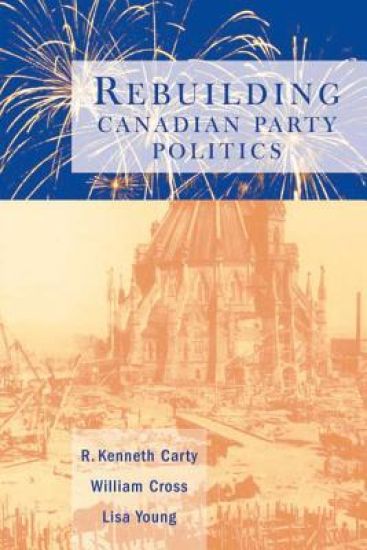
Rebuilding Canadian Party Politics

Rebuilding Canadian Party Politics

R. Kenneth Carty; William P. Cross; Lisa Young

University of British Columbia Press
2000
pokkari
Canadian party politics collapsed in the early 1990s. This book is about that collapse, about the end of a party system, with a unique pattern of party organization and competition, that had governed Canada's national politics for several decades, and about the ongoing struggle to build its successor. Rebuilding Canadian Party Politics discusses the breakdown of the old party system, the emergence of the Reform Party and the Bloc Québécois, and the fate of the Conservative and New Democratic Parties. It focuses on the internal workings of parties in this new era, examining the role of professionals, new technologies, and local activists.To understand the ambiguities of our current party system, the authors attended local and national party meetings, nomination and leadership meetings, and campaign kick-off rallies. They visited local campaign offices to observe the parties' grassroots operations and conducted interviews with senior party officials, pollsters, media and advertising specialists, and leader-tour directors.Written in a lively and accessible style, this book will interest students of party politics and Canadian political history, as well as general readers eager to make sense of the changes reshaping national politics today.
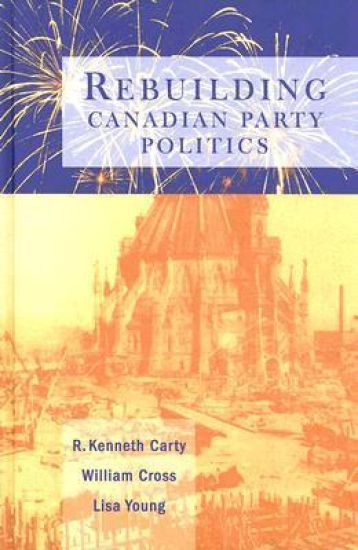
Rebuilding Canadian Party Politics

Rebuilding Canadian Party Politics

R. Kenneth Carty; William P. Cross; Lisa Young

University of British Columbia Press
2000
sidottu
Canadian party politics collapsed in the early 1990s. This book is about that collapse, about the end of a party system, with a unique pattern of party organization and competition, that had governed Canada's national politics for several decades, and about the ongoing struggle to build its successor. Rebuilding Canadian Party Politics discusses the breakdown of the old party system, the emergence of the Reform Party and the Bloc Québécois, and the fate of the Conservative and New Democratic Parties. It focuses on the internal workings of parties in this new era, examining the role of professionals, new technologies, and local activists.To understand the ambiguities of our current party system, the authors attended local and national party meetings, nomination and leadership meetings, and campaign kick-off rallies. They visited local campaign offices to observe the parties' grassroots operations and conducted interviews with senior party officials, pollsters, media and advertising specialists, and leader-tour directors.Written in a lively and accessible style, this book will interest students of party politics and Canadian political history, as well as general readers eager to make sense of the changes reshaping national politics today.
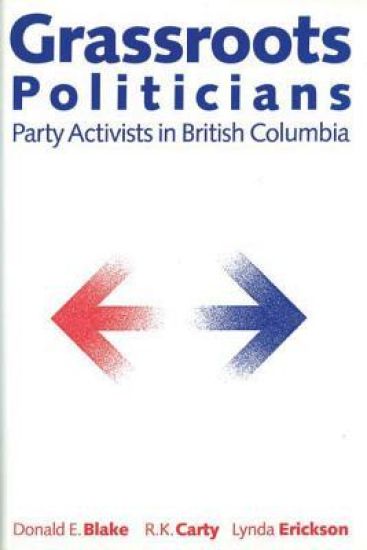
Grassroots Politicians

Grassroots Politicians

Donald E. Blake; R. Kenneth Carty; Lynda Erickson

University of British Columbia Press
1991
sidottu
Grassroots Politicians is the first systematic account ofparty activists at the provincial level in Canada. To understand thepattern of political polarization in British Columbia, the authorsexamine the values and beliefs of those at the party cores -- thepeople behind the party images who elect leaders, nominate candidates,and work in electoral campaigns. In the New Democratic Party they playa crucial role in determining policy, in the Social Credit they help toshape party direction and governing style by their choice of leader,and, among the Liberals, they form the small band that keeps the partyalive in the province. The authors challenge the view that Social Credit is a homogeneouslyright-wing party and that the New Democrats have clearly opted for thepolitical centre. They record how party profiles have changed over theyears -- Social Credit activists becoming better educated, wealthier,and less diverse in terms of ties to national parties, while the NDP isnow more middle-class, white collar, and professional. They exploresuch questions as why individuals stay in a weak party like the B.C.Liberals, how the New Democrats interpret successive Social Creditvictories, and to what extent B.C. activists are similar to those inother provinces or in national parties. They offer an analysis of theleadership selection process in each party and a detailed account ofthe convention that chose Bill Vander Zalm. By examining the attitudesand ideologies of party activists, they are able to pinpoint theirlocations on the left/right spectrum, identify internal divisions, andassess the problems and opportunities they pose for party leaders andelection strategies. As the British Columbia case illustrates, partymilitants carry distinctive subcultures which have a significant impacton the ongoing dynamics and immediate outcomes in competitive partysystems. The study also shows that the partisan involvement ofactivists in national political parties is one of the major forces thatlinks the otherwise separate provincial and federal political worldsinhabited by British Columbians.
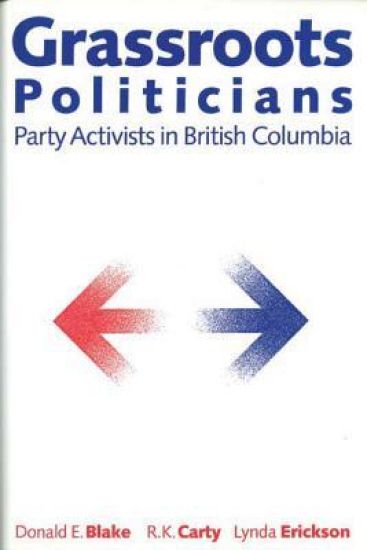
Grassroots Politicians

Grassroots Politicians

Donald E. Blake; R. Kenneth Carty; Lynda Erickson

University of British Columbia Press
1991
pokkari
Grassroots Politicians is the first systematic account ofparty activists at the provincial level in Canada. To understand thepattern of political polarization in British Columbia, the authorsexamine the values and beliefs of those at the party cores -- thepeople behind the party images who elect leaders, nominate candidates,and work in electoral campaigns. In the New Democratic Party they playa crucial role in determining policy, in the Social Credit they help toshape party direction and governing style by their choice of leader,and, among the Liberals, they form the small band that keeps the partyalive in the province. The authors challenge the view that Social Credit is a homogeneouslyright-wing party and that the New Democrats have clearly opted for thepolitical centre. They record how party profiles have changed over theyears -- Social Credit activists becoming better educated, wealthier,and less diverse in terms of ties to national parties, while the NDP isnow more middle-class, white collar, and professional. They exploresuch questions as why individuals stay in a weak party like the B.C.Liberals, how the New Democrats interpret successive Social Creditvictories, and to what extent B.C. activists are similar to those inother provinces or in national parties. They offer an analysis of theleadership selection process in each party and a detailed account ofthe convention that chose Bill Vander Zalm. By examining the attitudesand ideologies of party activists, they are able to pinpoint theirlocations on the left/right spectrum, identify internal divisions, andassess the problems and opportunities they pose for party leaders andelection strategies. As the British Columbia case illustrates, partymilitants carry distinctive subcultures which have a significant impacton the ongoing dynamics and immediate outcomes in competitive partysystems. The study also shows that the partisan involvement ofactivists in national political parties is one of the major forces thatlinks the otherwise separate provincial and federal political worldsinhabited by British Columbians.