Kirjojen hintavertailu. Mukana 12 595 353 kirjaa ja 12 kauppaa.

Kirjailija

R. Mesiar

Kirjat ja teokset yhdessä paikassa: 2 kirjaa, julkaisuja vuosilta 2000-2010, suosituimpien joukossa Triangular Norms. Vertaile teosten hintoja ja tarkista saatavuus suomalaisista kirjakaupoista.

2 kirjaa

Kirjojen julkaisuhaarukka 2000-2010.

Triangular Norms

Triangular Norms

Erich Peter Klement; R. Mesiar; E. Pap

Springer
2010
nidottu
The history of triangular norms started with the paper "Statistical metrics" [Menger 1942]. The main idea of Karl Menger was to construct metric spaces where probability distributions rather than numbers are used in order to de­ scribe the distance between two elements of the space in question. Triangular norms (t-norms for short) naturally came into the picture in the course of the generalization of the classical triangle inequality to this more general set­ ting. The original set of axioms for t-norms was considerably weaker, including among others also the functions which are known today as triangular conorms. Consequently, the first field where t-norms played a major role was the theory of probabilistic metric spaces ( as statistical metric spaces were called after 1964). Berthold Schweizer and Abe Sklar in [Schweizer & Sklar 1958, 1960, 1961] provided the axioms oft-norms, as they are used today, and a redefinition of statistical metric spaces given in [Serstnev 1962]led to a rapid development of the field. Many results concerning t-norms were obtained in the course of this development, most of which are summarized in the monograph [Schweizer & Sklar 1983]. Mathematically speaking, the theory of (continuous) t-norms has two rather independent roots, namely, the field of (specific) functional equations and the theory of (special topological) semigroups.
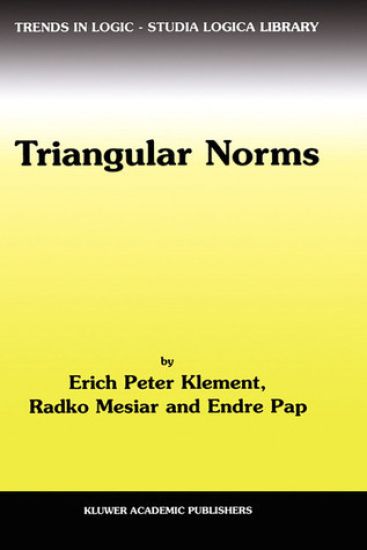
Triangular Norms

Triangular Norms

Erich Peter Klement; R. Mesiar; E. Pap

Springer
2000
sidottu
The history of triangular norms started with the paper "Statistical metrics" [Menger 1942]. The main idea of Karl Menger was to construct metric spaces where probability distributions rather than numbers are used in order to de­ scribe the distance between two elements of the space in question. Triangular norms (t-norms for short) naturally came into the picture in the course of the generalization of the classical triangle inequality to this more general set­ ting. The original set of axioms for t-norms was considerably weaker, including among others also the functions which are known today as triangular conorms. Consequently, the first field where t-norms played a major role was the theory of probabilistic metric spaces ( as statistical metric spaces were called after 1964). Berthold Schweizer and Abe Sklar in [Schweizer & Sklar 1958, 1960, 1961] provided the axioms oft-norms, as they are used today, and a redefinition of statistical metric spaces given in [Serstnev 1962]led to a rapid development of the field. Many results concerning t-norms were obtained in the course of this development, most of which are summarized in the monograph [Schweizer & Sklar 1983]. Mathematically speaking, the theory of (continuous) t-norms has two rather independent roots, namely, the field of (specific) functional equations and the theory of (special topological) semigroups.