Kirjojen hintavertailu. Mukana 12 265 175 kirjaa ja 12 kauppaa.

Kirjailija

Rafael G González-Acuña

Kirjat ja teokset yhdessä paikassa: 15 kirjaa, julkaisuja vuosilta 2020-2026, suosituimpien joukossa Freeform Vector Diffraction Theory. Vertaile teosten hintoja ja tarkista saatavuus suomalaisista kirjakaupoista.

Mukana myös kirjoitusasut: Rafael G. González-Acuña, Rafael G Gonzalez-Acuna

15 kirjaa

Kirjojen julkaisuhaarukka 2020-2026.

Freeform Vector Diffraction Theory

Freeform Vector Diffraction Theory

Rafael G. González-Acuña

TAYLOR FRANCIS LTD
2026
sidottu
Freeform Vector Diffraction Theory traces the conceptual journey from classical scalar diffraction to a rigorous and generalized framework for computing the vector diffraction patterns of arbitrary freeform wavefronts and complex, spatially varying polarization states. Readers will gain a unified theoretical perspective that enables accurate prediction of electromagnetic field behavior in high-numerical-aperture systems and modern non-conventional optics. The book delivers these fundamental insights through detailed mathematical and geometrical toolkits, including vector calculus and Zernike polynomials, which facilitate rigorous derivations of the generalized Richards-Wolf integrals in both cylindrical and Cartesian coordinates. It also explores key practical applications in fields such as super-resolution microscopy, advanced lithography, and optical trapping. Through in-depth analysis of apodization functions and the response of radially, azimuthally, and linearly polarized light, readers will learn to precisely characterize complex optical systems affected by significant aberrations. This work is an indispensable resource for leading researchers, optical design engineers, and graduate students in optics and photonics who seek to accurately model non-stigmatic and aberrated systems. The text clearly sets itself apart from other treatises on the subject by moving beyond the classical assumptions of spherical and ideal wavefronts typical of traditional theories. Instead, it offers a robust analytical framework for freeform surfaces and complex vectorial beams encountered in today’s technology. By masterfully integrating concepts such as the Malus-Dupin theorem and the angular spectrum representation, the book equips professionals with the essential tools to analyze the vector nature of light and optimize optical instruments in an era where structured light continues to reveal profound new insights into the electromagnetic nature of radiation.
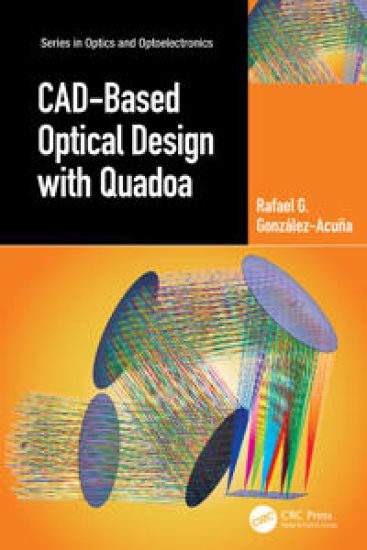
CAD-Based Optical Design with Quadoa

CAD-Based Optical Design with Quadoa

Rafael G. González-Acuña

TAYLOR FRANCIS LTD
2026
nidottu
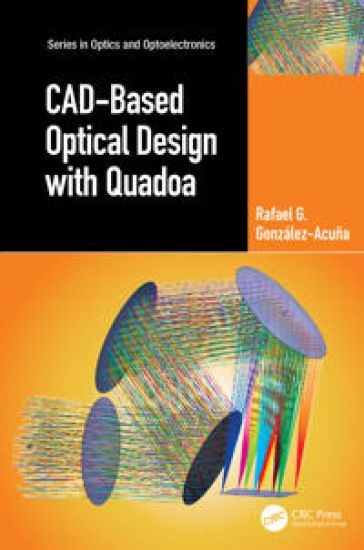
In CAD-Based Optical Design with Quadoa, we explore how optical design entails evaluating application requirements and creating optical systems specifically engineered to meet the exact needs of optical instruments. This extensive system may include optics, light sources, sensors, electronic boards, display devices, and other components. Primarily, optical design focuses on determining the shapes, positions, and materials of lenses and mirrors to ensure the optical system adheres to indicated criteria and specifications. To meet specific requirements, lens designers must use optical design software as an aid for their challenging task. Most of the mentioned optical design programs are based on the idea of a spreadsheet that contains the information on each surface, radius, thickness, materials, and position among other parameters. This paradigm has its positive aspects and negative aspects. But optical design is a field under constant evolution and new ways to design optical systems are emerging. In this book, we are going to construct, optimize, and analyze optical systems under the fresh paradigm of Computer-aided design (CAD) with the help of Quadoa Optical CAD, a novel optical design software. Within the chapters of the book, we are going to see why this paradigm can be very useful in designing optical systems in comparison with the one proposed by spreadsheets. The purpose of this book is to teach optical design with a fresh and reliable tool, Quadoa Optical CA. This book mixes the classical books in optical design and a manual of Quadoa Optical CAD. The purpose of this blend is to give readers enough knowledge to start a practical optical design, with solid theory and robust tools in Quadoa Optical CAD.
CAD-Based Optical Design with Quadoa

CAD-Based Optical Design with Quadoa

Rafael G. González-Acuña

TAYLOR FRANCIS LTD
2025
sidottu
In CAD-Based Optical Design with Quadoa, we explore how optical design entails evaluating application requirements and creating optical systems specifically engineered to meet the exact needs of optical instruments. This extensive system may include optics, light sources, sensors, electronic boards, display devices, and other components. Primarily, optical design focuses on determining the shapes, positions, and materials of lenses and mirrors to ensure the optical system adheres to indicated criteria and specifications. To meet specific requirements, lens designers must use optical design software as an aid for their challenging task.Most of the mentioned optical design programs are based on the idea of a spreadsheet that contains the information on each surface, radius, thickness, materials, and position among other parameters. This paradigm has its positive aspects and negative aspects. But optical design is a field under constant evolution and new ways to design optical systems are emerging. In this book, we are going to construct, optimize, and analyze optical systems under the fresh paradigm of Computer-aided design (CAD) with the help of Quadoa Optical CAD, a novel optical design software. Within the chapters of the book, we are going to see why this paradigm can be very useful in designing optical systems in comparison with the one proposed by spreadsheets.The purpose of this book is to teach optical design with a fresh and reliable tool, Quadoa Optical CA. This book mixes the classical books in optical design and a manual of Quadoa Optical CAD. The purpose of this blend is to give readers enough knowledge to start a practical optical design, with solid theory and robust tools in Quadoa Optical CAD.