Kirjojen hintavertailu. Mukana 12 390 323 kirjaa ja 12 kauppaa.

Kirjailija

Rafael Garcia

Kirjat ja teokset yhdessä paikassa: 9 kirjaa, julkaisuja vuosilta 2012-2024, suosituimpien joukossa Image Blending Techniques and their Application in Underwater Mosaicing. Vertaile teosten hintoja ja tarkista saatavuus suomalaisista kirjakaupoista.

9 kirjaa

Kirjojen julkaisuhaarukka 2012-2024.

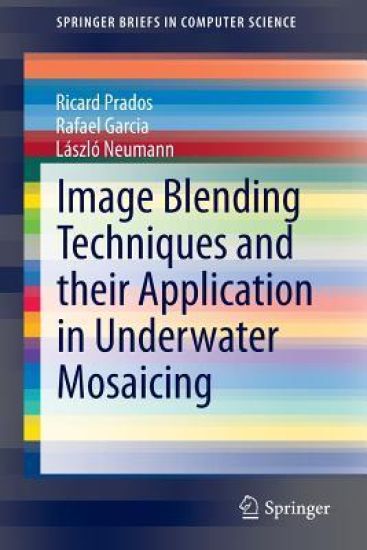
Image Blending Techniques and their Application in Underwater Mosaicing

Image Blending Techniques and their Application in Underwater Mosaicing

Ricard Prados; Rafael Garcia; László Neumann

Springer International Publishing AG
2014
nidottu
This work proposes strategies and solutions to tackle the problem of building photo-mosaics of very large underwater optical surveys, presenting contributions to the image preprocessing, enhancing and blending steps, and resulting in an improved visual quality of the final photo-mosaic. The text opens with a comprehensive review of mosaicing and blending techniques, before proposing an approach for large scale underwater image mosaicing and blending. In the image preprocessing step, a depth dependent illumination compensation function is used to solve the non-uniform illumination appearance due to light attenuation. For image enhancement, the image contrast variability due to different acquisition altitudes is compensated using an adaptive contrast enhancement based on an image quality reference selected through a total variation criterion. In the blending step, a graph-cut strategy operating in the image gradient domain over the overlapping regions is suggested. Next, an out-of-core blending strategy for very large scale photo-mosaics is presented and tested on real data. Finally, the performance of the approach is evaluated and compared with other approaches.
Efficient Topology Estimation for Large Scale Optical Mapping

Efficient Topology Estimation for Large Scale Optical Mapping

Armagan Elibol; Nuno Gracias; Rafael Garcia

Springer-Verlag Berlin and Heidelberg GmbH Co. K
2012
sidottu
Large scale optical mapping methods are in great demand among scientists who study different aspects of the seabed, and have been fostered by impressive advances in the capabilities of underwater robots in gathering optical data from the seafloor. Cost and weight constraints mean that low-cost ROVs usually have a very limited number of sensors. When a low-cost robot carries out a seafloor survey using a down-looking camera, it usually follows a predefined trajectory that provides several non time-consecutive overlapping image pairs. Finding these pairs (a process known as topology estimation) is indispensable to obtaining globally consistent mosaics and accurate trajectory estimates, which are necessary for a global view of the surveyed area, especially when optical sensors are the only data source. This book contributes to the state-of-art in large area image mosaicing methods for underwater surveys using low-cost vehicles equipped with a very limited sensor suite. The main focus has been on global alignment and fast topology estimation, which are the most challenging steps in creating large area image mosaics. This book is intended to emphasise the importance of the topology estimation problem and to present different solutions using interdisciplinary approaches opening a way to further develop new strategies and methodologies.
Efficient Topology Estimation for Large Scale Optical Mapping

Efficient Topology Estimation for Large Scale Optical Mapping

Armagan Elibol; Nuno Gracias; Rafael Garcia

Springer-Verlag Berlin and Heidelberg GmbH Co. K
2014
nidottu
Large scale optical mapping methods are in great demand among scientists who study different aspects of the seabed, and have been fostered by impressive advances in the capabilities of underwater robots in gathering optical data from the seafloor. Cost and weight constraints mean that low-cost ROVs usually have a very limited number of sensors. When a low-cost robot carries out a seafloor survey using a down-looking camera, it usually follows a predefined trajectory that provides several non time-consecutive overlapping image pairs. Finding these pairs (a process known as topology estimation) is indispensable to obtaining globally consistent mosaics and accurate trajectory estimates, which are necessary for a global view of the surveyed area, especially when optical sensors are the only data source. This book contributes to the state-of-art in large area image mosaicing methods for underwater surveys using low-cost vehicles equipped with a very limited sensor suite. The main focus has been on global alignment and fast topology estimation, which are the most challenging steps in creating large area image mosaics. This book is intended to emphasise the importance of the topology estimation problem and to present different solutions using interdisciplinary approaches opening a way to further develop new strategies and methodologies.
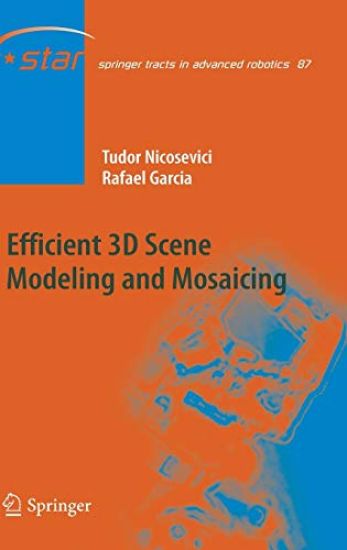
Efficient 3D Scene Modeling and Mosaicing

Efficient 3D Scene Modeling and Mosaicing

Tudor Nicosevici; Rafael Garcia

Springer-Verlag Berlin and Heidelberg GmbH Co. K
2013
sidottu
This book proposes a complete pipeline for monocular (single camera) based 3D mapping of terrestrial and underwater environments. The aim is to provide a solution to large-scale scene modeling that is both accurate and efficient. To this end, we have developed a novel Structure from Motion algorithm that increases mapping accuracy by registering camera views directly with the maps. The camera registration uses a dual approach that adapts to the type of environment being mapped. In order to further increase the accuracy of the resulting maps, a new method is presented, allowing detection of images corresponding to the same scene region (crossovers). Crossovers then used in conjunction with global alignment methods in order to highly reduce estimation errors, especially when mapping large areas. Our method is based on Visual Bag of Words paradigm (BoW), offering a more efficient and simpler solution by eliminating the training stage, generally required by state of the art BoW algorithms. Also, towards developing methods for efficient mapping of large areas (especially with costs related to map storage, transmission and rendering in mind), an online 3D model simplification algorithm is proposed. This new algorithm presents the advantage of selecting only those vertices that are geometrically representative for the scene.
Efficient 3D Scene Modeling and Mosaicing

Efficient 3D Scene Modeling and Mosaicing

Tudor Nicosevici; Rafael Garcia

Springer-Verlag Berlin and Heidelberg GmbH Co. K
2015
nidottu
This book proposes a complete pipeline for monocular (single camera) based 3D mapping of terrestrial and underwater environments. The aim is to provide a solution to large-scale scene modeling that is both accurate and efficient. To this end, we have developed a novel Structure from Motion algorithm that increases mapping accuracy by registering camera views directly with the maps. The camera registration uses a dual approach that adapts to the type of environment being mapped. In order to further increase the accuracy of the resulting maps, a new method is presented, allowing detection of images corresponding to the same scene region (crossovers). Crossovers then used in conjunction with global alignment methods in order to highly reduce estimation errors, especially when mapping large areas. Our method is based on Visual Bag of Words paradigm (BoW), offering a more efficient and simpler solution by eliminating the training stage, generally required by state of the art BoW algorithms. Also, towards developing methods for efficient mapping of large areas (especially with costs related to map storage, transmission and rendering in mind), an online 3D model simplification algorithm is proposed. This new algorithm presents the advantage of selecting only those vertices that are geometrically representative for the scene.
Lessons in Spanish Literature/Lecciones De Literatura
Lecciones de literatura: Edad Media y Siglo de Oro es una exploración detallada de obras literarias muy representativas de dos períodos cruciales en la historia de la literatura española. El texto está diseñado para adentrar a los estudiantes en el contexto histórico, cultural y literario de cada obra. Se les facilita la comprensión profunda de unos textos clásicos que se han adaptado al nivel de estudiantes de español como lengua extranjera. El libro está organizado en doce capítulos que abarcan desde la épica medieval y la poesía didáctica de clerecía hasta la prosa y el teatro del Barroco. Algunas de las joyas literarias, que cabría mencionar por haber sido rescatadas a nuestro público lector, son la prosa mística de San Juan, los aforismos de Gracián o el teatro de Calderón en La vida es sueño. Cada capítulo propone un enfoque interactivo con preguntas de comprensión y comentario. Le sigue una amplificación en la que se tratan las cuestiones fundamentales que plantean las obras. Este libro de texto es ideal para cursos universitarios sobre literatura española, tanto a nivel de pregrado como de posgrado. Su profundidad y adaptación de textos clásicos lo hacen especialmente útil para estudiantes no nativos de español, que buscan comprender las facetas complejas de la literatura medieval y del Siglo de Oro en un marco académico riguroso. Lessons in Literature: Medieval Age and Golden Age is a detailed exploration of the most representative literary works from two crucial periods in the history of Spanish literature. The text is designed to immerse students in the historical, cultural, and literary context of each work, facilitating a deep understanding of classic texts adapted for students of Spanish as a foreign language. The book is organized into twelve chapters covering topics from medieval epic and didactic poetry to Baroque prose and theater. Highlights include analyses of the Cantar de mio Cid, the works of Gonzalo de Berceo, and Calderonian theater, particularly Life is a Dream. Each chapter offers an interactive approach with comprehension questions and content amplification to enrich learning. This text is ideal for university courses on Spanish literature, both at undergraduate and graduate levels. Its depth and adaptation of classic texts make it particularly useful for non-native Spanish students seeking to understand the complex facets of medieval and Golden Age literature in a rigorous academic framework.