Kirjojen hintavertailu. Mukana 12 390 323 kirjaa ja 12 kauppaa.

Kirjailija

Rainer Gruhn

Kirjat ja teokset yhdessä paikassa: 4 kirjaa, julkaisuja vuosilta 2012-2014, suosituimpien joukossa Hierarchical Neural Network Structures for Phoneme Recognition. Vertaile teosten hintoja ja tarkista saatavuus suomalaisista kirjakaupoista.

4 kirjaa

Kirjojen julkaisuhaarukka 2012-2014.

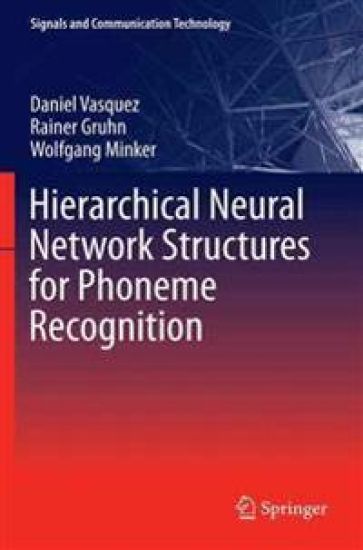
Hierarchical Neural Network Structures for Phoneme Recognition

Hierarchical Neural Network Structures for Phoneme Recognition

Daniel Vasquez; Rainer Gruhn; Wolfgang Minker

Springer-Verlag Berlin and Heidelberg GmbH Co. K
2014
nidottu
In this book, hierarchical structures based on neural networks are investigated for automatic speech recognition. These structures are mainly evaluated within the phoneme recognition task under the Hybrid Hidden Markov Model/Artificial Neural Network (HMM/ANN) paradigm. The baseline hierarchical scheme consists of two levels each which is based on a Multilayered Perceptron (MLP). Additionally, the output of the first level is used as an input for the second level. This system can be substantially speeded up by removing the redundant information contained at the output of the first level.

Novel Techniques for Dialectal Arabic Speech Recognition

Novel Techniques for Dialectal Arabic Speech Recognition

Mohamed Elmahdy; Rainer Gruhn; Wolfgang Minker

Springer-Verlag New York Inc.
2014
nidottu
Novel Techniques for Dialectal Arabic Speech describes approaches to improve automatic speech recognition for dialectal Arabic. Since speech resources for dialectal Arabic speech recognition are very sparse, the authors describe how existing Modern Standard Arabic (MSA) speech data can be applied to dialectal Arabic speech recognition, while assuming that MSA is always a second language for all Arabic speakers. In this book, Egyptian Colloquial Arabic (ECA) has been chosen as a typical Arabic dialect. ECA is the first ranked Arabic dialect in terms of number of speakers, and a high quality ECA speech corpus with accurate phonetic transcription has been collected. MSA acoustic models were trained using news broadcast speech. In order to cross-lingually use MSA in dialectal Arabic speech recognition, the authors have normalized the phoneme sets for MSA and ECA. After this normalization, they have applied state-of-the-art acoustic model adaptation techniques like Maximum Likelihood Linear Regression (MLLR) and Maximum A-Posteriori (MAP) to adapt existing phonemic MSA acoustic models with a small amount of dialectal ECA speech data. Speech recognition results indicate a significant increase in recognition accuracy compared to a baseline model trained with only ECA data.
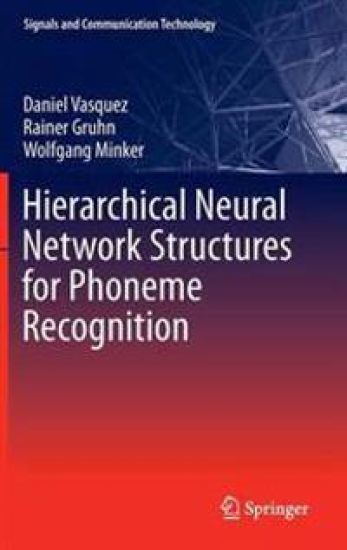
Hierarchical Neural Network Structures for Phoneme Recognition

Hierarchical Neural Network Structures for Phoneme Recognition

Daniel Vasquez; Rainer Gruhn; Wolfgang Minker

Springer-Verlag Berlin and Heidelberg GmbH Co. K
2012
sidottu
In this book, hierarchical structures based on neural networks are investigated for automatic speech recognition. These structures are mainly evaluated within the phoneme recognition task under the Hybrid Hidden Markov Model/Artificial Neural Network (HMM/ANN) paradigm. The baseline hierarchical scheme consists of two levels each which is based on a Multilayered Perceptron (MLP). Additionally, the output of the first level is used as an input for the second level. This system can be substantially speeded up by removing the redundant information contained at the output of the first level.
Novel Techniques for Dialectal Arabic Speech Recognition

Novel Techniques for Dialectal Arabic Speech Recognition

Mohamed Elmahdy; Rainer Gruhn; Wolfgang Minker

Springer-Verlag New York Inc.
2012
sidottu
Novel Techniques for Dialectal Arabic Speech describes approaches to improve automatic speech recognition for dialectal Arabic. Since speech resources for dialectal Arabic speech recognition are very sparse, the authors describe how existing Modern Standard Arabic (MSA) speech data can be applied to dialectal Arabic speech recognition, while assuming that MSA is always a second language for all Arabic speakers. In this book, Egyptian Colloquial Arabic (ECA) has been chosen as a typical Arabic dialect. ECA is the first ranked Arabic dialect in terms of number of speakers, and a high quality ECA speech corpus with accurate phonetic transcription has been collected. MSA acoustic models were trained using news broadcast speech. In order to cross-lingually use MSA in dialectal Arabic speech recognition, the authors have normalized the phoneme sets for MSA and ECA. After this normalization, they have applied state-of-the-art acoustic model adaptation techniques like Maximum Likelihood Linear Regression (MLLR) and Maximum A-Posteriori (MAP) to adapt existing phonemic MSA acoustic models with a small amount of dialectal ECA speech data. Speech recognition results indicate a significant increase in recognition accuracy compared to a baseline model trained with only ECA data.