Kirjojen hintavertailu. Mukana 12 595 353 kirjaa ja 12 kauppaa.

Kirjailija

Rainer Kress

Kirjat ja teokset yhdessä paikassa: 9 kirjaa, julkaisuja vuosilta 1979-2020, suosituimpien joukossa Integral Equation Methods in Scattering Theory. Vertaile teosten hintoja ja tarkista saatavuus suomalaisista kirjakaupoista.

9 kirjaa

Kirjojen julkaisuhaarukka 1979-2020.

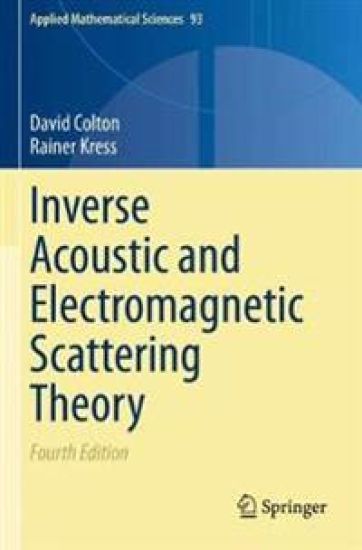
Inverse Acoustic and Electromagnetic Scattering Theory

Inverse Acoustic and Electromagnetic Scattering Theory

David Colton; Rainer Kress

Springer Nature Switzerland AG
2020
nidottu
The inverse scattering problem is central to many areas of science and technology such as radar, sonar, medical imaging, geophysical exploration and nondestructive testing. This book is devoted to the mathematical and numerical analysis of the inverse scattering problem for acoustic and electromagnetic waves. In this fourth edition, a number of significant additions have been made including a new chapter on transmission eigenvalues and a new section on the impedance boundary condition where particular attention has been made to the generalized impedance boundary condition and to nonlocal impedance boundary conditions. Brief discussions on the generalized linear sampling method, the method of recursive linearization, anisotropic media and the use of target signatures in inverse scattering theory have also been added.
Inverse Acoustic and Electromagnetic Scattering Theory

Inverse Acoustic and Electromagnetic Scattering Theory

David Colton; Rainer Kress

Springer Nature Switzerland AG
2019
sidottu
The inverse scattering problem is central to many areas of science and technology such as radar, sonar, medical imaging, geophysical exploration and nondestructive testing. This book is devoted to the mathematical and numerical analysis of the inverse scattering problem for acoustic and electromagnetic waves. In this fourth edition, a number of significant additions have been made including a new chapter on transmission eigenvalues and a new section on the impedance boundary condition where particular attention has been made to the generalized impedance boundary condition and to nonlocal impedance boundary conditions. Brief discussions on the generalized linear sampling method, the method of recursive linearization, anisotropic media and the use of target signatures in inverse scattering theory have also been added.
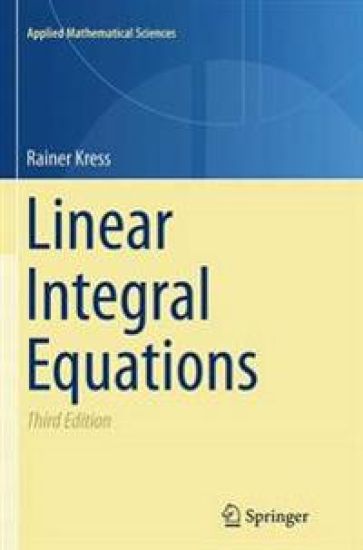
Linear Integral Equations

Linear Integral Equations

Rainer Kress

Springer-Verlag New York Inc.
2016
nidottu
This book combines theory, applications, and numerical methods, and covers each of these fields with the same weight. In order to make the book accessible to mathematicians, physicists, and engineers alike, the author has made it as self-contained as possible, requiring only a solid foundation in differential and integral calculus. The functional analysis which is necessary for an adequate treatment of the theory and the numerical solution of integral equations is developed within the book itself. Problems are included at the end of each chapter. For this third edition in order to make the introduction to the basic functional analytic tools more complete the Hahn–Banach extension theorem and the Banach open mapping theorem are now included in the text. The treatment of boundary value problems in potential theory has been extended by a more complete discussion of integral equations of the first kind in the classical Holder space setting and of both integral equations of the first and second kind in the contemporary Sobolev space setting. In the numerical solution part of the book, the author included a new collocation method for two-dimensional hypersingular boundary integral equations and a collocation method for the three-dimensional Lippmann-Schwinger equation. The final chapter of the book on inverse boundary value problems for the Laplace equation has been largely rewritten with special attention to the trilogy of decomposition, iterative and sampling methodsReviews of earlier editions:"This book is an excellent introductory text for students, scientists, and engineers who want to learn the basic theory of linear integral equations and their numerical solution."(Math. Reviews, 2000)"This is a good introductory text book on linear integral equations. It contains almost all the topics necessary for a student. The presentation of the subject matter is lucid, clear and in the proper modern framework without being too abstract." (ZbMath, 1999)
Linear Integral Equations

Linear Integral Equations

Rainer Kress

Springer-Verlag New York Inc.
2013
sidottu
This book combines theory, applications, and numerical methods, and covers each of these fields with the same weight. In order to make the book accessible to mathematicians, physicists, and engineers alike, the author has made it as self-contained as possible, requiring only a solid foundation in differential and integral calculus. The functional analysis which is necessary for an adequate treatment of the theory and the numerical solution of integral equations is developed within the book itself. Problems are included at the end of each chapter. For this third edition in order to make the introduction to the basic functional analytic tools more complete the Hahn–Banach extension theorem and the Banach open mapping theorem are now included in the text. The treatment of boundary value problems in potential theory has been extended by a more complete discussion of integral equations of the first kind in the classical Holder space setting and of both integral equations of the first and second kind in the contemporary Sobolev space setting. In the numerical solution part of the book, the author included a new collocation method for two-dimensional hypersingular boundary integral equations and a collocation method for the three-dimensional Lippmann-Schwinger equation. The final chapter of the book on inverse boundary value problems for the Laplace equation has been largely rewritten with special attention to the trilogy of decomposition, iterative and sampling methodsReviews of earlier editions:"This book is an excellent introductory text for students, scientists, and engineers who want to learn the basic theory of linear integral equations and their numerical solution."(Math. Reviews, 2000)"This is a good introductory text book on linear integral equations. It contains almost all the topics necessary for a student. The presentation of the subject matter is lucid, clear and in the proper modern framework without being too abstract." (ZbMath, 1999)
Integral Equation Methods in Scattering Theory

Integral Equation Methods in Scattering Theory

David Colton; Rainer Kress

Society for Industrial Applied Mathematics,U.S.
2013
pokkari
This classic book provides a rigorous treatment of the Riesz-Fredholm theory of compact operators in dual systems, followed by a derivation of the jump relations and mapping properties of scalar and vector potentials in spaces of continuous and Holder continuous functions. These results are then used to study scattering problems for the Helmholtz and Maxwell equations. Readers will benefit from:* A full discussion of the mapping properties of scalar and vector potentials in spaces of continuous and Holder continuous functions.* An in-depth treatment of the use of boundary integral equations to solve scattering problems for acoustic and electromagnetic waves.* An introduction to inverse scattering theory with an emphasis on the ill-posedness and nonlinearity of the inverse scattering problem.
Inverse Acoustic and Electromagnetic Scattering Theory

Inverse Acoustic and Electromagnetic Scattering Theory

David Colton; Rainer Kress

Springer-Verlag New York Inc.
2012
sidottu
The inverse scattering problem is central to many areas of science and technology such as radar and sonar, medical imaging, geophysical exploration and nondestructive testing. This book is devoted to the mathematical and numerical analysis of the inverse scattering problem for acoustic and electromagnetic waves. In this third edition, new sections have been added on the linear sampling and factorization methods for solving the inverse scattering problem as well as expanded treatments of iteration methods and uniqueness theorems for the inverse obstacle problem. These additions have in turn required an expanded presentation of both transmission eigenvalues and boundary integral equations in Sobolev spaces. As in the previous editions, emphasis has been given to simplicity over generality thus providing the reader with an accessible introduction to the field of inverse scattering theory.Review of earlier editions: “Colton and Kress have written a scholarly, state of the art account of their view of direct and inverse scattering. The book is a pleasure to read as a graduate text or to dip into at leisure. It suggests a number of open problems and will be a source of inspiration for many years to come.”SIAM Review, September 1994 “This book should be on the desk of any researcher, any student, any teacher interested in scattering theory.”Mathematical Intelligencer, June 1994
Numerical Analysis

Numerical Analysis

Rainer Kress

Springer-Verlag New York Inc.
2012
nidottu
No applied mathematician can be properly trained without some basic un­ derstanding ofnumerical methods, Le., numerical analysis. And no scientist and engineer should be using a package program for numerical computa­ tions without understanding the program's purpose and its limitations. This book is an attempt to provide some of the required knowledge and understanding. It is written in a spirit that considers numerical analysis not merely as a tool for solving applied problems but also as a challenging and rewarding part of mathematics. The main goal is to provide insight into numerical analysis rather than merely to provide numerical recipes. The book evolved from the courses on numerical analysis I have taught since 1971 at the University ofGottingen and may be viewed as a successor of an earlier version jointly written with Bruno Brosowski [10] in 1974. It aims at presenting the basic ideas of numerical analysis in a style as concise as possible. Its volume is scaled to a one-yearcourse, i.e., a two-semester course, addressing second-yearstudents at a German university or advanced undergraduate or first-year graduate students at an American university.
Numerical Analysis

Numerical Analysis

Rainer Kress

Springer-Verlag New York Inc.
1998
sidottu
No applied mathematician can be properly trained without some basic un­ derstanding ofnumerical methods, Le., numerical analysis. And no scientist and engineer should be using a package program for numerical computa­ tions without understanding the program's purpose and its limitations. This book is an attempt to provide some of the required knowledge and understanding. It is written in a spirit that considers numerical analysis not merely as a tool for solving applied problems but also as a challenging and rewarding part of mathematics. The main goal is to provide insight into numerical analysis rather than merely to provide numerical recipes. The book evolved from the courses on numerical analysis I have taught since 1971 at the University ofGottingen and may be viewed as a successor of an earlier version jointly written with Bruno Brosowski [10] in 1974. It aims at presenting the basic ideas of numerical analysis in a style as concise as possible. Its volume is scaled to a one-yearcourse, i.e., a two-semester course, addressing second-yearstudents at a German university or advanced undergraduate or first-year graduate students at an American university.
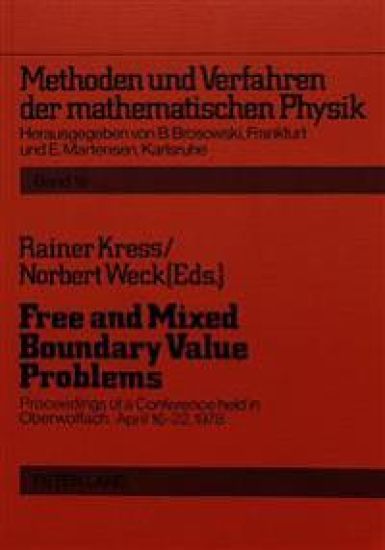
Free and Mixed Boundary Value Problems

Free and Mixed Boundary Value Problems

Rainer Kress; Norbert Weck

Peter Lang GmbH
1979
nidottu
Das Buch enthalt Vortrage, die gehalten wurden auf der von Prof. R. Kress und Prof. N. Weck vom 16.4. bis 22.4.1978 im Mathematischen Forschungsinstitut Oberwolfach veranstalteten Tagung uber Freie und gemischte Randwertaufgaben bei partiellen Differentialgleichungen."