Kirjojen hintavertailu. Mukana 12 537 686 kirjaa ja 12 kauppaa.

Kirjailija

Rajani Sudan

Kirjat ja teokset yhdessä paikassa: 3 kirjaa, julkaisuja vuosilta 2002-2016, suosituimpien joukossa Fair Exotics. Vertaile teosten hintoja ja tarkista saatavuus suomalaisista kirjakaupoista.

3 kirjaa

Kirjojen julkaisuhaarukka 2002-2016.

The Alchemy of Empire

The Alchemy of Empire

Rajani Sudan

Fordham University Press
2016
sidottu
Named 'Top 6' South Asia studies publications of 2016 by the British Association for South Asian Studies The Alchemy of Empire unravels the non-European origins of Enlightenment science. Focusing on the abject materials of empire-building, this study traces the genealogies of substances like mud, mortar, ice, and paper, as well as forms of knowledge like inoculation. Showing how East India Company employees deployed the paradigm of alchemy in order to make sense of the new worlds they confronted, Rajani Sudan argues that the Enlightenment was born largely out of Europe's (and Britain's) sense of insecurity and inferiority in the early modern world. Plumbing the depths of the imperial archive, Sudan uncovers the history of the British Enlightenment in the literary artifacts of the long eighteenth century, from the correspondence of the East India Company and the papers of the Royal Society to the poetry of Alexander Pope and the novels of Jane Austen.
The Alchemy of Empire

The Alchemy of Empire

Rajani Sudan

Fordham University Press
2016
pokkari
Named 'Top 6' South Asia studies publications of 2016 by the British Association for South Asian Studies The Alchemy of Empire unravels the non-European origins of Enlightenment science. Focusing on the abject materials of empire-building, this study traces the genealogies of substances like mud, mortar, ice, and paper, as well as forms of knowledge like inoculation. Showing how East India Company employees deployed the paradigm of alchemy in order to make sense of the new worlds they confronted, Rajani Sudan argues that the Enlightenment was born largely out of Europe's (and Britain's) sense of insecurity and inferiority in the early modern world. Plumbing the depths of the imperial archive, Sudan uncovers the history of the British Enlightenment in the literary artifacts of the long eighteenth century, from the correspondence of the East India Company and the papers of the Royal Society to the poetry of Alexander Pope and the novels of Jane Austen.
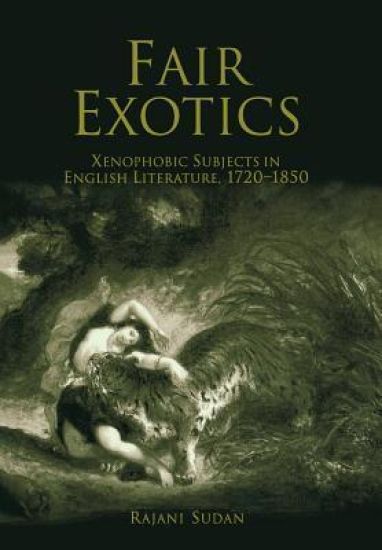
Fair Exotics

Fair Exotics

Rajani Sudan

University of Pennsylvania Press
2002
sidottu
Arguing that the major hallmarks of Romantic literature-inwardness, emphasis on subjectivity, the individual authorship of selves and texts-were forged during the Enlightenment, Rajani Sudan traces the connections between literary sensibility and British encounters with those persons, ideas, and territories that lay uneasily beyond the national border. The urge to colonize and discover embraced both an interest in foreign "fair exotics" and a deeply rooted sense of their otherness. Fair Exotics develops a revisionist reading of the period of the British Enlightenment and Romanticism, an age during which England was most aggressively building its empire. By looking at canonical texts, including Defoe's Robinson Crusoe, Johnson's Dictionary, De Quincey's Confessions of an English Opium Eater, and Bronte's Villette, Sudan shows how the imaginative subject is based on a sense of exoticism created by a pervasive fear of what is foreign. Indeed, as Sudan clarifies, xenophobia is the underpinning not only of nationalism and imperialism but of Romantic subjectivity as well.