Kirjojen hintavertailu. Mukana 12 390 323 kirjaa ja 12 kauppaa.

Kirjailija

Rajib Shaw

Kirjat ja teokset yhdessä paikassa: 3 kirjaa, julkaisuja vuosilta 2010-2024, suosituimpien joukossa Soft Assets in Smart and Resilient City Development. Vertaile teosten hintoja ja tarkista saatavuus suomalaisista kirjakaupoista.

3 kirjaa

Kirjojen julkaisuhaarukka 2010-2024.

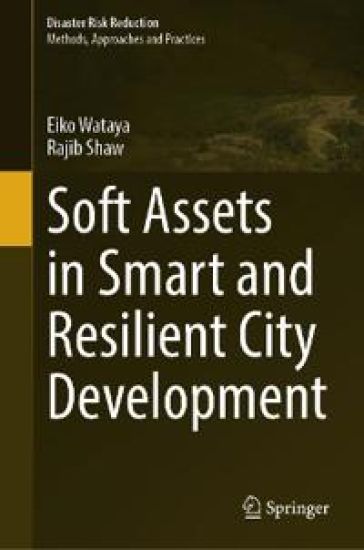
Soft Assets in Smart and Resilient City Development

Soft Assets in Smart and Resilient City Development

Eiko Wataya; Rajib Shaw

SPRINGER VERLAG, SINGAPORE
2024
sidottu
Over the past decade, building smarter, resilient cities is an established global trend in urban development, including developing countries. Unexpected external shocks, disasters and damage from climate change have major impacts on sustainable growth and well-being for citizens in today’s cities and requires comprehensive solutions. To deal with these negative events, cities predominantly invest in hard physical infrastructure, with less attention on non-physical soft assets which are intangible in nature and more difficult to quantify, but essential to achieve effective, balanced sustainable development. The value of soft assets can be substantial, and consistent implementation by cities can generate diverse value and be transformative for their urban development. For that purpose, cities need to establish an appropriate strategy, framework and structure to incorporate soft assets during the plan and implementation of hard infrastructure. This book argues that integrating soft assets in smart, resilient city development is critical to make the hard infrastructure work effectively and create value for cities. The literature review underlines that soft capital can be defined as: 1) human, 2) institutional, 3) external, 4) technology and information, and 5) social. The book also examines how soft assets can be effectively integrated into and create value for smart, resilient city development. Based on previous findings and original research, a unique approach is adopted through the verification of different city-level approaches using the concept of influential nodes, showcasing layered and composite value creation. The analysis addresses innovative implementation factors which enhance disaster resilience and the environment, which is particularly relevant for cities in developing countries. Drawing on previous research, in-depth reviews, new data, and case studies, the book provides new insights and specific policy and action measures to enhance the utilization of soft asset components in parallel with hard infrastructure in smart and resilient city in developing countries.
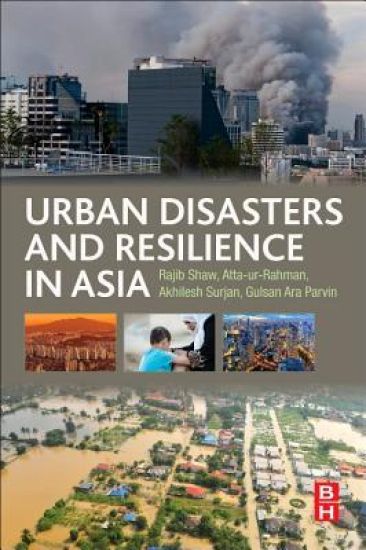
Urban Disasters and Resilience in Asia

Urban Disasters and Resilience in Asia

Rajib Shaw; Akhilesh Surjan; Gulsan Ara Parvin

Butterworth-Heinemann Inc
2016
nidottu
Urban Disasters and Resilience in Asia presents the latest information on the intensity and frequency of disasters. Specifically, the fact that, in urban areas, more than 50% of the world's population is living on just 2% of the land surface, with most of these cities located in Asia and developing countries that have high vulnerability and intensification. The book offers an in-depth and multidisciplinary approach to reducing the impact of disasters by examining specific evidence from events in these areas that can be used to develop best practices and increase urban resilience worldwide. As urban resilience is largely a function of resilient and resourceful citizens, building cities which are more resilient internally and externally can lead to more productive economic returns. In an era of rapid urbanization and increasing disaster risks and vulnerabilities in Asian cities, Urban Disasters and Resilience in Asia is an invaluable tool for policy makers, researchers, and practitioners working in both public and private sectors.
Integrated Lagoon Fisheries Management

Integrated Lagoon Fisheries Management

Shimpei Iwasaki; Rajib Shaw

Emerald Publishing Limited
2010
sidottu
Lagoons are characterized by an essential quality of uncertainty for use in resource management: these are physically vulnerable to various influences from not only the environment but also the adjacent marine and terrestrial areas. In the areas which are shallower and where less water is exchanges, therefore, fishers are required to develop their capacity of knowledge and skills for how to live with change and uncertainty. The wider realization of complex and dynamic lagoon ecosystem and its fisheries management requires multifaceted aspects to be addressed. Fisheries serve as a basis for people's livelihood and food protein especially in Asian countries. Total amounts of fish landing have maintained an upward trend, but existing fisheries management poses various challenges for ensuring wise use of fishery resources which are becoming fully exploited or over-exploited in the world. Out of variant geographical types of fishery domain, lagoon fisheries need to pay more attention to achieve fisheries management. With these recognitions, the book presents a wide variety of lessons learned from case studies from Asian countries (India, Japan and Thailand). Greater emphasis is placed on understanding the status of lagoon fisheries and its management, and assessing people's adaptive capacities to respond to changes in the ecological-social-economic system. Throughout all case study experience, the book will provide policy makers and practitioners with guidance to build enabling conditions for integrated lagoon fisheries management and related sustainable livelihood which involve a concern with issues of power, institutions, worldviews and values among relevant stakeholders.