Kirjojen hintavertailu. Mukana 12 595 353 kirjaa ja 12 kauppaa.

Kirjailija

Ralph Abraham

Kirjat ja teokset yhdessä paikassa: 11 kirjaa, julkaisuja vuosilta 1988-2020, suosituimpien joukossa Dynamics. Vertaile teosten hintoja ja tarkista saatavuus suomalaisista kirjakaupoista.

11 kirjaa

Kirjojen julkaisuhaarukka 1988-2020.

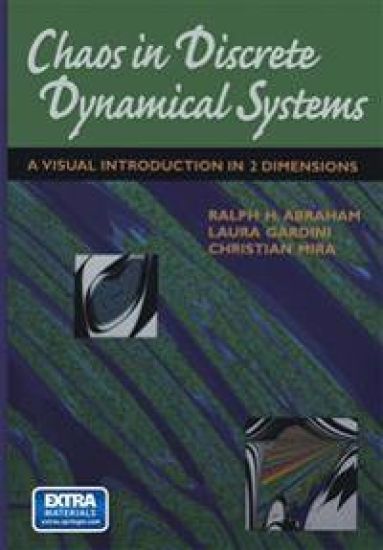
Chaos in Discrete Dynamical Systems

Chaos in Discrete Dynamical Systems

Ralph Abraham; Laura Gardini; Christian Mira

Springer-Verlag New York Inc.
2013
nidottu
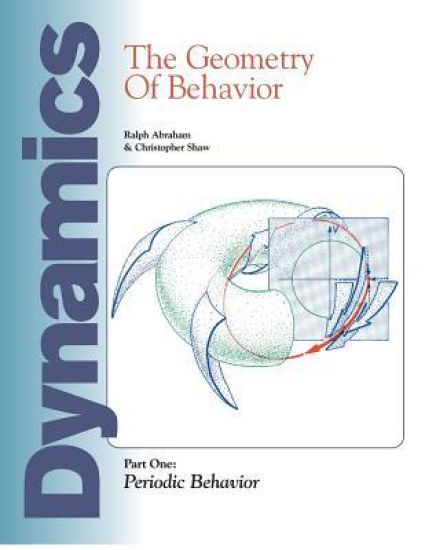
Chaos Theory is a synonym for dynamical systems theory, a branch of mathematics. Dynamical systems come in three flavors: flows (continuous dynamical systems), cascades (discrete, reversible, dynamical systems), and semi-cascades (discrete, irreversible, dynamical systems). Flows and semi-cascades are the classical systems iuntroduced by Poincare a centry ago, and are the subject of the extensively illustrated book: "Dynamics: The Geometry of Behavior," Addison-Wesley 1992 authored by Ralph Abraham and Shaw. Semi- cascades, also know as iterated function systems, are a recent innovation, and have been well-studied only in one dimension (the simplest case) since about 1950. The two-dimensional case is the current frontier of research. And from the computer graphcis of the leading researcher come astonishing views of the new landscape, such as the Julia and Mandelbrot sets in the beautiful books by Heinz-Otto Peigen and his co-workers. Now, the new theory of critical curves developed byMira and his students and Toulouse provide a unique opportunity to explain the basic concepts of the theory of chaos and bifurcations for discete dynamical systems in two-dimensions. The materials in the book and on the accompanying disc are not solely developed only with the researcher and professional in mind, but also with consideration for the student. The book is replete with some 100 computer graphics to illustrate the material, and the CD-ROM contains full-color animations that are tied directly into the subject matter of the book, itself. In addition, much of this material has also been class-tested by the authors. The cross-platform CD also contains a software program called ENDO, which enables users to create their own 2-D imagery with X-Windows. Maple scripts are provided which give the reader the option of working directly with the code from which the graphcs in the book were
Manifolds, Tensor Analysis, and Applications

Manifolds, Tensor Analysis, and Applications

Ralph Abraham; Jerrold E. Marsden; Tudor Ratiu

Springer-Verlag New York Inc.
2012
nidottu
The purpose of this book is to provide core material in nonlinear analysis for mathematicians, physicists, engineers, and mathematical biologists. The main goal is to provide a working knowledge of manifolds, dynamical systems, tensors, and differential forms. Some applications to Hamiltonian mechanics, fluid me­ chanics, electromagnetism, plasma dynamics and control thcory arc given in Chapter 8, using both invariant and index notation. The current edition of the book does not deal with Riemannian geometry in much detail, and it does not treat Lie groups, principal bundles, or Morse theory. Some of this is planned for a subsequent edition. Meanwhile, the authors will make available to interested readers supplementary chapters on Lie Groups and Differential Topology and invite comments on the book's contents and development. Throughout the text supplementary topics are given, marked with the symbols ~ and {l:;J. This device enables the reader to skip various topics without disturbing the main flow of the text. Some of these provide additional background material intended for completeness, to minimize the necessity of consulting too many outside references. We treat finite and infinite-dimensional manifolds simultaneously. This is partly for efficiency of exposition. Without advanced applications, using manifolds of mappings, the study of infinite-dimensional manifolds can be hard to motivate.
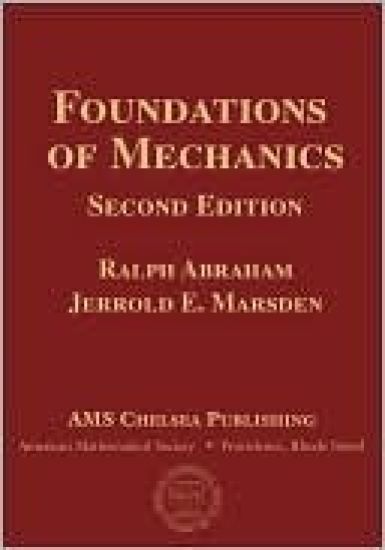
Foundations of Mechanics

Foundations of Mechanics

Ralph Abraham; Jerrold E. Marsden

American Mathematical Society
2008
sidottu
For many years, this book has been viewed as a classic treatment of geometric mechanics. It is known for its broad exposition of the subject, with many features that cannot be found elsewhere. The book is recommended as a textbook and as a basic reference work for the foundations of differentiable and Hamiltonian dynamics.
The Evolutionary Mind

The Evolutionary Mind

Rupert Sheldrake; Terence McKenna; Ralph Abraham

Monkfish Book Publishing Company
2005
pokkari
Stimulating and often startling discussions between three friends, all highly original thinkers: Rupert Sheldrake, controversial biologist, Terence McKenna, psychedelic visionary, and Ralph Abraham, chaos mathematician. Their passion is to break out of paradigms that retard our evolution and to explore new possibilities. Through challenge and synergy they venture where few have gone before, leading their readers on an exciting journey of discovery. Their discussions focus on the evolution of the mind, the role of psychedelics, skepticism, the psychic powers of animals, the structure of time, the life of the heavens, the nature of God, and transformations of consciousness."Three fine thinkers take us plunging into the universe of chaos, mind, and spirit. Instead of leaving us lost, they bring us back with startling insights and more wonder than we knew we had." --Matthew Fox, "Original Blessing and Sheer Joy""A jam-session of the mind, an intellectual movable feast, an on-going conversation that began over twenty years ago and remains as lively and relevant today as it ever was. Sadly, Terence had to leave the conversation a little earlier than planned. But the appearance of this book of trialogues at this critical, historical juncture is a reaffirmation of the potency of the optimistic vision that the trialogues express." --Dennis McKenna, brother of the late Terence McKennaRupert Sheldrake is a biologist and author of many books including "The Sense of Being Stared At, And Other Aspects of the Extended Mind." Ralph Abraham is a mathematician, one of the pioneers of chaos theory and the author of several books including "Chaos, Gaia, Eros: A Chaos Pioneer Uncovers the Three Great Streams of History." The late Terence McKenna was a scholar of shamanism, ethno-botanist, psychedelic researcher and author of many books including "Food of the Gods and True Hallucinations."
Chaos, Creativity, and Cosmic Consciousness

Chaos, Creativity, and Cosmic Consciousness

Rupert Sheldrake; Terence McKenna; Ralph Abraham; Jean Houston

Park Street Press,U.S.
2001
pokkari
A wide-ranging investigation of the ecology of inner and outer space the role of chaos theory in the dynamics of human creation and the rediscovery of traditional wisdom. In this book of trialogues the late psychedelic visionary and shamanologist Terence McKenna, acclaimed biologist and originator of the morphogenetic fields theory Rupert Sheldrake and mathematician and chaos theory scientist Ralph Abraham explore the relationships between chaos and creativity and their connection to cosmic consciousness. Their observations call into question our current views of reality morality and the nature of life in the universe. The authors challenge the reader to the deepest levels of thought with wide-ranging investigations of the ecology of inner and outer space the role of chaos in the dynamics of human creation and the resacralization of the world. Among the provocative questions the authors raise are: Is Armageddon a self-fulfilling prophecy? Are we humans the imaginers or the imagined? Are the eternal laws of nature still evolving? What is the connection between physical light and the light of consciousness? Part ceremony part old-fashioned intellectual discussion these trialogues are an invitation to a new understanding of what Jean Houston calls the dreamscapes of our everyday waking life.
The Web Empowerment Book

The Web Empowerment Book

Ralph Abraham; Frank Jas; Willard Russell

Springer-Verlag New York Inc.
1995
nidottu
After many years of daily UNIX and Internet activity, we came to be enthusiasts of the World-Wide Web while trying to choose an authoring system for a CD-ROM project. We decided to use Web software for the CD-ROM, thus seamlessly integrating the two dis­ joint worlds of CD-ROM publishing and the Internet. We are grate­ ful to our publisher, Allan M. Wylde, for the initiative leading to that idea and then to this book. As we enter the third millennium and complete the computer revo­ lution, our future will depend on our creative actions taken today. The politics of cyberspace, our future world, are being determined now by those who are already empowered with full cyberfunction­ ality on the Internet - which today means the multimedia browsing capabilities of the WWW.theWorld-WideWeb.Itis urgent that concerned people extend themselves as soon as possible into this new world, to participate in the creation of the future. Our purpose in presenting this introduction and empowerment package is to enable as many people as possible to attain this level of citizenship in the future. Turn on, boot up, and jack in! The future is ours to create. xi Software Bundles Here is a minimal suite of software for WWW connection, as described in the Bootstrap chapters in part 2 of this book. Macintosh Level 2: • MacTCpl, from Apple Dealers • t InterSlip, from InterCon and free over the Internet.
Manifolds, Tensor Analysis, and Applications

Manifolds, Tensor Analysis, and Applications

Ralph Abraham; Jerrold E. Marsden; Tudor Ratiu
Springer-Verlag New York Inc.
1988
sidottu
The purpose of this book is to provide core material in nonlinear analysis for mathematicians, physicists, engineers, and mathematical biologists. The main goal is to provide a working knowledge of manifolds, dynamical systems, tensors, and differential forms. Some applications to Hamiltonian mechanics, fluid me­ chanics, electromagnetism, plasma dynamics and control thcory arc given in Chapter 8, using both invariant and index notation. The current edition of the book does not deal with Riemannian geometry in much detail, and it does not treat Lie groups, principal bundles, or Morse theory. Some of this is planned for a subsequent edition. Meanwhile, the authors will make available to interested readers supplementary chapters on Lie Groups and Differential Topology and invite comments on the book's contents and development. Throughout the text supplementary topics are given, marked with the symbols ~ and {l:;J. This device enables the reader to skip various topics without disturbing the main flow of the text. Some of these provide additional background material intended for completeness, to minimize the necessity of consulting too many outside references. We treat finite and infinite-dimensional manifolds simultaneously. This is partly for efficiency of exposition. Without advanced applications, using manifolds of mappings, the study of infinite-dimensional manifolds can be hard to motivate.