Kirjojen hintavertailu. Mukana 12 595 353 kirjaa ja 12 kauppaa.

Kirjailija

Rama Chellappa

Kirjat ja teokset yhdessä paikassa: 9 kirjaa, julkaisuja vuosilta 1991-2023, suosituimpien joukossa Human Identification Based on Gait. Vertaile teosten hintoja ja tarkista saatavuus suomalaisista kirjakaupoista.

9 kirjaa

Kirjojen julkaisuhaarukka 1991-2023.

Can We Trust AI?

Can We Trust AI?

Rama Chellappa

Johns Hopkins University Press
2023
pokkari
Artificial intelligence is part of our daily lives. How can we address its limitations and guide its use for the benefit of communities worldwide?Artificial intelligence (AI) has evolved from an experimental computer algorithm used by academic researchers to a commercially reliable method of sifting through large sets of data that detect patterns not readily apparent through more rudimentary search tools. As a result, AI-based programs are helping doctors make more informed decisions about patient care, city planners align roads and highways to reduce traffic congestion with better efficiency, and merchants scan financial transactions to quickly flag suspicious purchases. But as AI applications grow, concerns have increased, too, including worries about applications that amplify existing biases in business practices and about the safety of self-driving vehicles. In Can We Trust AI?, Dr. Rama Chellappa, a researcher and innovator with 40 years in the field, recounts the evolution of AI, its current uses, and how it will drive industries and shape lives in the future. Leading AI researchers, thought leaders, and entrepreneurs contribute their expertise as well on how AI works, what we can expect from it, and how it can be harnessed to make our lives not only safer and more convenient but also more equitable. Can We Trust AI? is essential reading for anyone who wants to understand the potential—and pitfalls—of artificial intelligence. The book features:• an exploration of AI's origins during the post–World War II era through the computer revolution of the 1960s and 1970s, and its explosion among technology firms since 2012;• highlights of innovative ways that AI can diagnose medical conditions more quickly and accurately;• explanations of how the combination of AI and robotics is changing how we drive; and• interviews with leading AI researchers who are pushing the boundaries of AI for the world's benefit and working to make its applications safer and more just. Johns Hopkins WavelengthsIn classrooms, field stations, and laboratories in Baltimore and around the world, the Bloomberg Distinguished Professors of Johns Hopkins University are opening the boundaries of our understanding of many of the world's most complex challenges. The Johns Hopkins Wavelengths book series brings readers inside their stories, illustrating how their pioneering discoveries and innovations benefit people in their neighborhoods and across the globe in artificial intelligence, cancer research, food systems' environmental impacts, health equity, planetary science, science diplomacy, and other critical arenas of study. Through these compelling narratives, their insights will spark conversations from dorm rooms to dining rooms to boardrooms.
Domain Adaptation for Visual Recognition

Domain Adaptation for Visual Recognition

Raghuraman Gopalan; Ruonan Li; Vishal M. Patel; Rama Chellappa

now publishers Inc
2015
nidottu
Domain adaptation is an active, emerging research area that attempts to address the changes in data distribution across training and testing datasets. With the availability of a multitude of image acquisition sensors, variations due to illumination and viewpoint among others, computer vision applications present a very natural test bed for evaluating domain adaptation methods.This monograph provides a comprehensive overview of domain adaptation solutions for visual recognition problems. By starting with the problem description and illustrations, it discusses three adaptation scenarios, namely, (i) unsupervised adaptation where the ""source domain"" training data is partially labeled and the ""target domain"" test data is unlabeled; (ii) semi-supervised adaptation where the target domain also has partial labels; and (iii) multi-domain heterogeneous adaptation which studies the previous two settings with the source and/or target having more than one domain, and accounts for cases where the features used to represent the data in each domain are different.For all of these scenarios, Domain Adaptation for Visual Recognition discusses the existing adaptation techniques in the literature. These techniques are motivated by the principles of max-margin discriminative learning, manifold learning, sparse coding, as well as low-rank representations, and have shown improved performance on a variety of applications such as object recognition, face recognition, activity analysis, concept classification, and person detection.This book concludes by analyzing the challenges posed by the realm of ""big visual data"" - in terms of the generalization ability of adaptation algorithms to unconstrained data acquisition as well as issues related to their computational tractability - and draws parallels with efforts from the vision community on image transformation models and invariant descriptors so as to facilitate improved understanding of vision problems under uncertainty.
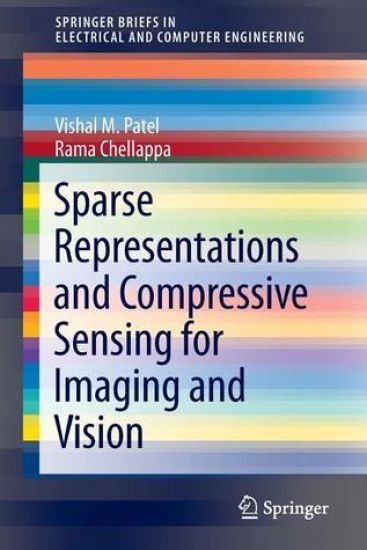
Sparse Representations and Compressive Sensing for Imaging and Vision

Sparse Representations and Compressive Sensing for Imaging and Vision

Vishal M. Patel; Rama Chellappa

Springer-Verlag New York Inc.
2013
nidottu
Compressed sensing or compressive sensing is a new concept in signal processing where one measures a small number of non-adaptive linear combinations of the signal. These measurements are usually much smaller than the number of samples that define the signal. From these small numbers of measurements, the signal is then reconstructed by non-linear procedure. Compressed sensing has recently emerged as a powerful tool for efficiently processing data in non-traditional ways. In this book, we highlight some of the key mathematical insights underlying sparse representation and compressed sensing and illustrate the role of these theories in classical vision, imaging and biometrics problems.
Human Identification Based on Gait

Human Identification Based on Gait

Mark S. Nixon; Tieniu Tan; Rama Chellappa

Springer-Verlag New York Inc.
2011
nidottu
Human Identification Based on Gait is the first book to address gait as a biometric. Biometrics is now in a unique position where it affects most people's lives. This is especially true of "gait", which is one of the most recent biometrics. Recognizing people by the way they walk and run implies analyzing movement which, in turn, implies analyzing sequences of images, thus requiring memory and computational performance that became available only recently. Human Identification Based on Gait introduces developments from distinguished researchers within this relatively new area of biometrics. This book clearly establishes how human gait is biometric. Human Identification Based on Gait is structured to meet the needs of professionals in industry, as well as advanced-level students in computer science.
Unconstrained Face Recognition

Unconstrained Face Recognition

Shaohua Kevin Zhou; Rama Chellappa; Wenyi Zhao

Springer-Verlag New York Inc.
2010
nidottu
Face recognition has been actively studied over the past decade and continues to be a big research challenge. Just recently, researchers have begun to investigate face recognition under unconstrained conditions. Unconstrained Face Recognition provides a comprehensive review of this biometric, especially face recognition from video, assembling a collection of novel approaches that are able to recognize human faces under various unconstrained situations. The underlying basis of these approaches is that, unlike conventional face recognition algorithms, they exploit the inherent characteristics of the unconstrained situation and thus improve the recognition performance when compared with conventional algorithms. Unconstrained Face Recognition is structured to meet the needs of a professional audience of researchers and practitioners in industry. This volume is also suitable for advanced-level students in computer science.
Recognition of Humans and Their Activities Using Video

Recognition of Humans and Their Activities Using Video

Rama Chellappa; Amit K. Roy-Chowdhury; S. Kevin Zhou

Springer International Publishing AG
2007
nidottu
The recognition of humans and their activities from video sequences is currently a very active area of research because of its applications in video surveillance, design of realistic entertainment systems, multimedia communications, and medical diagnosis. In this lecture, we discuss the use of face and gait signatures for human identification and recognition of human activities from video sequences. We survey existing work and describe some of the more well-known methods in these areas. We also describe our own research and outline future possibilities. In the area of face recognition, we start with the traditional methods for image-based analysis and then describe some of the more recent developments related to the use of video sequences, 3D models, and techniques for representing variations of illumination. We note that the main challenge facing researchers in this area is the development of recognition strategies that are robust to changes due to pose, illumination, disguise, and aging. Gait recognition is a more recent area of research in video understanding, although it has been studied for a long time in psychophysics and kinesiology. The goal for video scientists working in this area is to automatically extract the parameters for representation of human gait. We describe some of the techniques that have been developed for this purpose, most of which are appearance based. We also highlight the challenges involved in dealing with changes in viewpoint and propose methods based on image synthesis, visual hull, and 3D models. In the domain of human activity recognition, we present an extensive survey of various methods that have been developed in different disciplines like artificial intelligence, image processing, pattern recognition, and computer vision. We then outline our method for modeling complex activities using 2D and 3D deformable shape theory. The wide application of automatic human identification and activity recognition methods will require the fusionof different modalities like face and gait, dealing with the problems of pose and illumination variations, and accurate computation of 3D models. The last chapter of this lecture deals with these areas of future research.
Unconstrained Face Recognition

Unconstrained Face Recognition

Shaohua Kevin Zhou; Rama Chellappa; Wenyi Zhao

Springer-Verlag New York Inc.
2005
sidottu
Face recognition has been actively studied over the past decade and continues to be a big research challenge. Just recently, researchers have begun to investigate face recognition under unconstrained conditions. Unconstrained Face Recognition provides a comprehensive review of this biometric, especially face recognition from video, assembling a collection of novel approaches that are able to recognize human faces under various unconstrained situations. The underlying basis of these approaches is that, unlike conventional face recognition algorithms, they exploit the inherent characteristics of the unconstrained situation and thus improve the recognition performance when compared with conventional algorithms. Unconstrained Face Recognition is structured to meet the needs of a professional audience of researchers and practitioners in industry. This volume is also suitable for advanced-level students in computer science.
Human Identification Based on Gait

Human Identification Based on Gait

Mark S. Nixon; Tieniu Tan; Rama Chellappa

Springer-Verlag New York Inc.
2005
sidottu
Human Identification Based on Gait is the first book to address gait as a biometric. Biometrics is now in a unique position where it affects most people's lives. This is especially true of "gait", which is one of the most recent biometrics. Recognizing people by the way they walk and run implies analyzing movement which, in turn, implies analyzing sequences of images, thus requiring memory and computational performance that became available only recently. Human Identification Based on Gait introduces developments from distinguished researchers within this relatively new area of biometrics. This book clearly establishes how human gait is biometric. Human Identification Based on Gait is structured to meet the needs of professionals in industry, as well as advanced-level students in computer science.
Artificial Neural Networks for Computer Vision

Artificial Neural Networks for Computer Vision

Yi-Tong Zhou; Rama Chellappa

Springer-Verlag New York Inc.
1991
nidottu
This monograph is an outgrowth of the authors' recent research on the de­ velopment of algorithms for several low-level vision problems using artificial neural networks. Specific problems considered are static and motion stereo, computation of optical flow, and deblurring an image. From a mathematical point of view, these inverse problems are ill-posed according to Hadamard. Researchers in computer vision have taken the "regularization" approach to these problems, where one comes up with an appropriate energy or cost function and finds a minimum. Additional constraints such as smoothness, integrability of surfaces, and preservation of discontinuities are added to the cost function explicitly or implicitly. Depending on the nature of the inver­ sion to be performed and the constraints, the cost function could exhibit several minima. Optimization of such nonconvex functions can be quite involved. Although progress has been made in making techniques such as simulated annealing computationally more reasonable, it is our view that one can often find satisfactory solutions using deterministic optimization algorithms.