Kirjojen hintavertailu. Mukana 12 509 102 kirjaa ja 12 kauppaa.

Kirjailija

Ramesh S.V. Teegavarapu

Kirjat ja teokset yhdessä paikassa: 7 kirjaa, julkaisuja vuosilta 2012-2026, suosituimpien joukossa Imputation Methods for Missing Hydrometeorological Data Estimation. Vertaile teosten hintoja ja tarkista saatavuus suomalaisista kirjakaupoista.

Mukana myös kirjoitusasut: Ramesh S. V. Teegavarapu, Ramesh S V Teegavarapu

7 kirjaa

Kirjojen julkaisuhaarukka 2012-2026.

Stationarity: A Gentle Introduction

Stationarity: A Gentle Introduction

Ramesh S V Teegavarapu; Priyank J Sharma

WORLD SCIENTIFIC PUBLISHING CO PTE LTD
2026
sidottu
This unique compendium focuses on the use and applications of the state-of-the-art exploratory data analysis and statistical methods to understand the concept of stationarity and assessment based on hydroclimatic data. Stationarity assessment is the key for hydrologic design, particularly in the context of changing climate.The comprehensive text presents a thorough discussion of the parametric, unit root and non-parametric methods adopted for stationarity assessment with their vivid practical examples, issues and implications.This useful reference manual benefits researchers, professionals, academics and graduate students in the fields of hydrology, climate change and climatology.
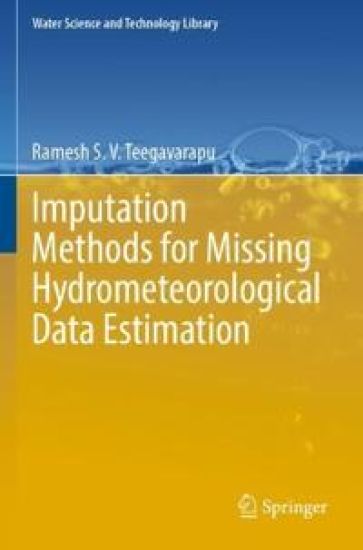
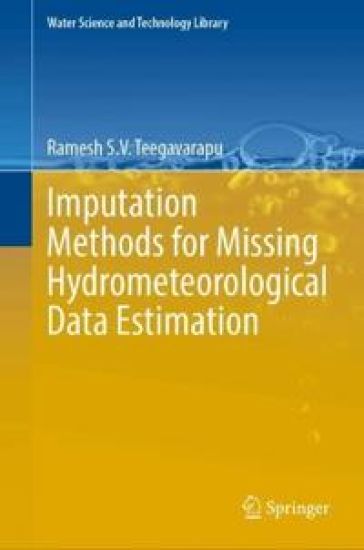
Imputation Methods for Missing Hydrometeorological Data Estimation

Imputation Methods for Missing Hydrometeorological Data Estimation

Ramesh S.V. Teegavarapu

Springer International Publishing AG
2025
nidottu
Missing data is a ubiquitous problem that plagues many hydrometeorological datasets. Objective and robust spatial and temporal imputation methods are needed to estimate missing data and create error-free, gap-free, and chronologically continuous data. This book is a comprehensive guide and reference for basic and advanced interpolation and data-driven methods for imputing missing hydrometeorological data. The book provides detailed insights into different imputation methods, such as spatial and temporal interpolation, universal function approximation, and data mining-assisted imputation methods. It also introduces innovative spatial deterministic and stochastic methods focusing on the objective selection of control points and optimal spatial interpolation. The book also extensively covers emerging machine learning techniques that can be used in spatial and temporal interpolation schemes and error and performance measures for assessing interpolation methods and validating imputed data. The book demonstrates practical applications of these methods to real-world hydrometeorological data. It will cater to the needs of a broad spectrum of audiences, from graduate students and researchers in climatology and hydrological and earth sciences to water engineering professionals from governmental agencies and private entities involved in the processing and use of hydrometeorological and climatological data.
Imputation Methods for Missing Hydrometeorological Data Estimation

Imputation Methods for Missing Hydrometeorological Data Estimation

Ramesh S.V. Teegavarapu

Springer International Publishing AG
2024
sidottu
Missing data is a ubiquitous problem that plagues many hydrometeorological datasets. Objective and robust spatial and temporal imputation methods are needed to estimate missing data and create error-free, gap-free, and chronologically continuous data. This book is a comprehensive guide and reference for basic and advanced interpolation and data-driven methods for imputing missing hydrometeorological data. The book provides detailed insights into different imputation methods, such as spatial and temporal interpolation, universal function approximation, and data mining-assisted imputation methods. It also introduces innovative spatial deterministic and stochastic methods focusing on the objective selection of control points and optimal spatial interpolation. The book also extensively covers emerging machine learning techniques that can be used in spatial and temporal interpolation schemes and error and performance measures for assessing interpolation methods and validating imputed data. The book demonstrates practical applications of these methods to real-world hydrometeorological data. It will cater to the needs of a broad spectrum of audiences, from graduate students and researchers in climatology and hydrological and earth sciences to water engineering professionals from governmental agencies and private entities involved in the processing and use of hydrometeorological and climatological data.
Dynamic Simulation and Virtual Reality in Hydrology and Water Resources Management

Dynamic Simulation and Virtual Reality in Hydrology and Water Resources Management

Ramesh S.V. Teegavarapu; Chandramouli V. Chandramouli

TAYLOR FRANCIS LTD
2023
nidottu
Dynamic Simulation and Virtual Reality in Hydrology and Water Resources Management focuses on the understanding, use, and application of system dynamics simulation and virtual reality approaches for modeling the spatial and temporal behavior of natural and managed hydro-environmental systems. The book discusses concepts of systems thinking and system dynamics approach, and it furthers understanding of the dynamic behavior of natural and engineering systems using feedbacks and dynamic simulation. Numerous examples of models built using different system dynamics simulation modeling environments are provided. It also introduces concepts related to computer animation and virtual reality–based immersive modeling. Applications of systems dynamics, simulation with animation, and virtual reality approaches for modeling and management of hydro-environmental systems are illustrated through case studies. This text is ideal for water resources professionals, graduate students, hydrologic modelers, and engineers who are interested in systems thinking, dynamic simulation, and virtual reality modeling approaches. It will serve as a valuable reference for engineering professionals who model, manage, and operate hydrosystems. Engineering educators will find the book immensely useful to enhance the learning experiences of students. Dr. Ramesh S. V. Teegavarapu is a professor at Florida Atlantic University with expertise in modeling water resources and environmental systems, hydroinformatics, and climate change.Dr. Chandramouli V. Chandramouli is a professor at Purdue University Northwest. His expertise is in water resources and environmental modeling integrating artificial intelligence techniques.
Dynamic Simulation and Virtual Reality in Hydrology and Water Resources Management

Dynamic Simulation and Virtual Reality in Hydrology and Water Resources Management

Ramesh S.V. Teegavarapu; Chandramouli V. Chandramouli

CRC Press
2021
sidottu
Dynamic Simulation and Virtual Reality in Hydrology and Water Resources Management focuses on the understanding, use, and application of system dynamics simulation and virtual reality approaches for modeling the spatial and temporal behavior of natural and managed hydro-environmental systems. The book discusses concepts of systems thinking and system dynamics approach, and it furthers understanding of the dynamic behavior of natural and engineering systems using feedbacks and dynamic simulation. Numerous examples of models built using different system dynamics simulation modeling environments are provided. It also introduces concepts related to computer animation and virtual reality–based immersive modeling. Applications of systems dynamics, simulation with animation, and virtual reality approaches for modeling and management of hydro-environmental systems are illustrated through case studies. This text is ideal for water resources professionals, graduate students, hydrologic modelers, and engineers who are interested in systems thinking, dynamic simulation, and virtual reality modeling approaches. It will serve as a valuable reference for engineering professionals who model, manage, and operate hydrosystems. Engineering educators will find the book immensely useful to enhance the learning experiences of students. Dr. Ramesh S. V. Teegavarapu is a professor at Florida Atlantic University with expertise in modeling water resources and environmental systems, hydroinformatics, and climate change.Dr. Chandramouli V. Chandramouli is a professor at Purdue University Northwest. His expertise is in water resources and environmental modeling integrating artificial intelligence techniques.
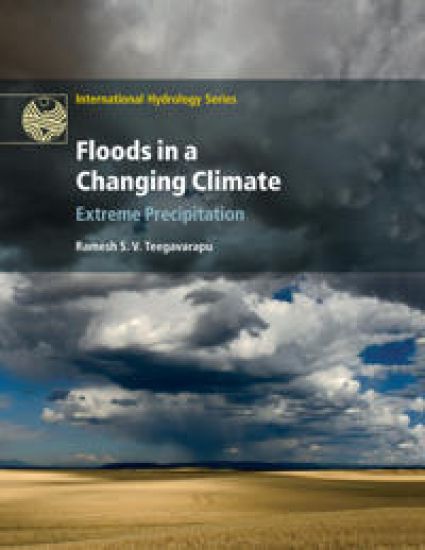
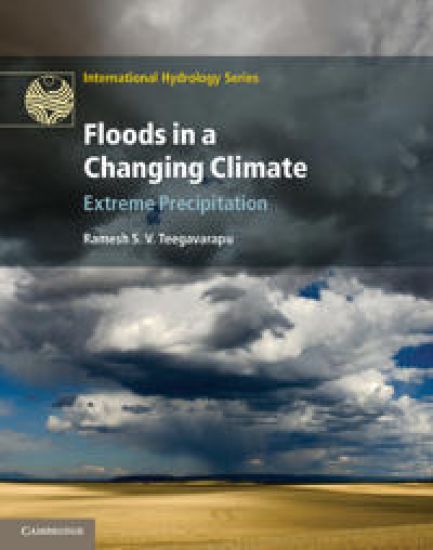
Floods in a Changing Climate

Floods in a Changing Climate

Ramesh S. V. Teegavarapu

Cambridge University Press
2018
pokkari
Measurement, analysis and modeling of extreme precipitation events linked to floods is vital in understanding changing climate impacts and variability. This book provides methods for assessment of the trends in these events and their impacts. It also provides a basis to develop procedures and guidelines for climate-adaptive hydrologic engineering. Academic researchers in the fields of hydrology, climate change, meteorology, environmental policy and risk assessment, and professionals and policy-makers working in hazard mitigation, water resources engineering and climate adaptation will find this an invaluable resource. This volume is the first in a collection of four books on flood disaster management theory and practice within the context of anthropogenic climate change. The others are: Floods in a Changing Climate: Hydrological Modeling by P. P. Mujumdar and D. Nagesh Kumar, Floods in a Changing Climate: Inundation Modeling by Giuliano Di Baldassarre and Floods in a Changing Climate: Risk Management by Slodoban Simonovic.
Floods in a Changing Climate

Floods in a Changing Climate

Ramesh S. V. Teegavarapu

Cambridge University Press
2012
sidottu
Measurement, analysis and modeling of extreme precipitation events linked to floods is vital in understanding changing climate impacts and variability. This book provides methods for assessment of the trends in these events and their impacts. It also provides a basis to develop procedures and guidelines for climate-adaptive hydrologic engineering. Academic researchers in the fields of hydrology, climate change, meteorology, environmental policy and risk assessment, and professionals and policy-makers working in hazard mitigation, water resources engineering and climate adaptation will find this an invaluable resource. This volume is the first in a collection of four books on flood disaster management theory and practice within the context of anthropogenic climate change. The others are: Floods in a Changing Climate: Hydrological Modeling by P. P. Mujumdar and D. Nagesh Kumar, Floods in a Changing Climate: Inundation Modeling by Giuliano Di Baldassarre and Floods in a Changing Climate: Risk Management by Slodoban Simonovic.